
- Release Year: 2003
- Platforms: Windows
- Publisher: 1C Company, Encore, Inc., JoWooD Productions Software AG
- Developer: Nival Interactive LLC
- Genre: Strategy, Tactics
- Perspective: Diagonal-down
- Game Mode: Single-player
- Gameplay: characters control, Destructible Environment, Multiple units, RPG elements, Tactical Combat, Turn-based combat
- Setting: World War II
- Average Score: 87/100
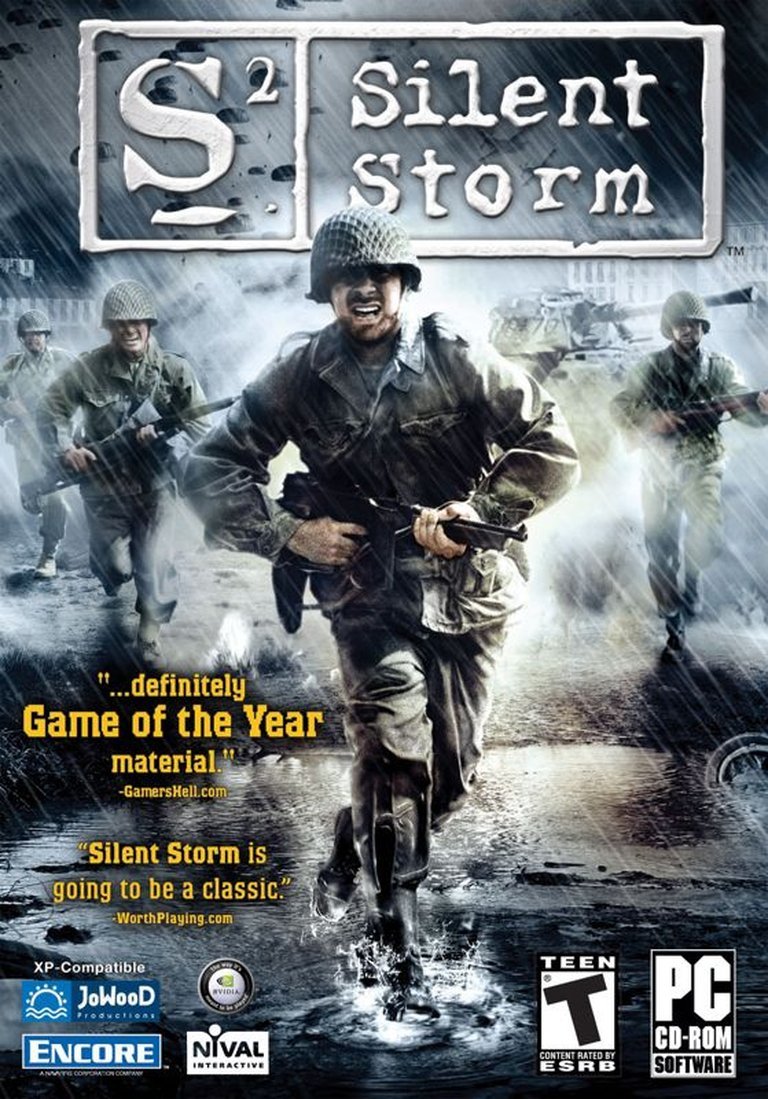
Description
S2: Silent Storm is a 3D turn-based tactical combat game set in 1943 during World War II, offering a true 3D world with destructible environments and ragdoll physics. Players lead squads of either the Axis or Allies through 24 nonlinear missions, featuring 75 weapons and six distinct professions, each with unique advancement trees. The game blends strategy and RPG elements, delivering a rich narrative that takes a sci-fi twist as the war unfolds.
Gameplay Videos
Where to Buy S2: Silent Storm
PC
S2: Silent Storm Free Download
S2: Silent Storm Patches & Updates
S2: Silent Storm Mods
S2: Silent Storm Guides & Walkthroughs
S2: Silent Storm Reviews & Reception
ign.com (95/100): This is the best game that has graced my hard drive in many years.
mobygames.com (83/100): Silent Storm has joined the ranks of X-Com and Jagged Alliance 2 as a brilliant tactical squad-based strategy game.
mobygames.com (83/100): I believe this game is one of the best games released this year, if not one of the best games to come out in the last five years.
S2: Silent Storm Cheats & Codes
PC
Edit the file “autoexec.cfg” in the “cfg” folder of the game and add “wirbelwind”(without quotes) to the end. This will allow the key “`” or ‘~’ to open the console. Then enter the codes below, 1 to turn on the code and 0 to turn it off.
| Code | Effect |
|---|---|
| game_noai 1 | Disable artificial intelligence |
| i_am_an_alien 1 | Everybody including enemies becomes transparent, happens only after loading a saved game |
| getitem x | Get item number x |
| setxplevel x | Set all squad members to x level |
| cheat_showall 1 | Show all enemies including NPCs |
| godmode 1 | Squad invulnerable |
| summonunit [unit number] | Spawn indicated unit |
| addmedalpoints # | Adds the whole team 40mp each, followed by checking for rewards. |
| autoplay | A battle of sorts begins, both teams are computer controlled. |
| autoplay_templates # | Sets a map for autoplay. |
| autoplay_units # | Setting the unit that teams will consist of in autoplay. |
| bind console F11 | Changes the console key to F11 |
Silent Storm: Gold Edition PC
Use the console window to enter this command:
| Code | Effect |
|---|---|
| summonunit X | to summon Thor’s Hammer Panzer Kleins |
Silent Storm: Sentinels PC
Edit the file “autoexec.cfg” in the “cfg” folder of the game and add “wirbelwind” (without quotes) to the end. You can now use the ` key to open the console. Enter the codes below, 1 to turn on the code and 0 to turn it off.
| Code | Effect |
|---|---|
| godmode 1 | God Mode for Squad |
| game_noai 1 | Disable AI |
| i_am_an_alien 1 | Enable Transparency (after save load) |
| getitem # | Get Item Number # |
| setxplevel# | Set All Squad Members to # Level |
| cheat_showall 1 | Show All Enemies |
S2: Silent Storm: Review
Introduction
In the crowded landscape of World War II-themed games, S2: Silent Storm (2003) stands as a defiant anomaly—a turn-based tactical RPG that eschewed real-time trends in favor of meticulous, physics-driven strategy. Developed by Russian studio Nival Interactive, this title arrived at a pivotal moment, offering a heady blend of squad tactics, RPG progression, and unprecedented environmental destruction. While its narrative takes a jarring detour into sci-fi, its core gameplay—pioneering fully destructible 3D environments and ragdoll physics—elevated it to cult status. As we dissect this ambitious relic, it becomes clear: Silent Storm is less a perfect game than a landmark technical achievement that redefined what tactics games could achieve, warts and all.
Development History & Context
Emerging from Moscow-based Nival Interactive (fresh off the Allods series), Silent Storm was a product of both audacity and constraint. The studio’s vision, led by project manager Dmitriy Zakharov Jr. and designers Pavel Epishin and Alexander Mishulin, was audacious: to create a turn-based tactics game with true 3D graphics, fully destructible environments, and realistic physics—all in 2003. Technologically, this was revolutionary. Nival built a custom engine (later reused in Heroes of M&M V) that handled bullet trajectories, ragdoll deaths, and structural collapse in real-time, pushing the limits of contemporary hardware.
The gaming landscape in 2003 favored real-time strategy (Rome: Total War) and WWII shooters (Call of Duty), with turn-based tactics relegated to niche titles. Silent Storm defied this, positioning itself as a spiritual successor to X-Com and Jagged Alliance 2. Published by JoWooD in Europe and Encore in North America, it garnered attention at E3 2003, winning Wargamer’s “Best of Show” in the tactical genre. Yet its release was marred by performance issues on mid-range PCs and a lack of polish—flaws typical of ambitious Eastern European titles of the era.
Narrative & Thematic Deep Dive
Set in 1943, Silent Storm unfolds in an alternate history where the war is merely a backdrop for a shadowy conspiracy: Thor’s Hammer Organization (THO). This cabal, led by enigmatic figures like Hel and Koch, seeks to exhaust both Axis and Allies with advanced weaponry, leaving the world ripe for conquest. Players command elite squads—either Allied or Axis—tasked with uncovering traitors and thwarting THO’s superweapon plots.
The narrative hinges on a clever duality: campaigns for both factions mirror each other, with inverted perspectives (e.g., rescuing a mole in Britain as Allies vs. hunting them as Axis). Yet this symmetry dissolves into a disjointed tale. Early missions ooze Cold War intrigue—spies, double agents, and tense recon—but abruptly shift into Diesel-punk territory with the introduction of Panzerkleins (gasoline-powered, laser-wielding exoskeletons). This genre transition, while technically innovative, feels tonally jarring. As one critic quipped, it’s akin to Band of Brothers teleporting to Mars.
Characters are archetypal rather than deep—a pool of 20 mercenaries (e.g., the stoic sniper Duke, the volatile grenadier Jina) with backstories sketched in codex entries. Voice acting oscillates between passable and caricatured, with thick accents that grate more than they ground the world. Still, THO’s Norse mythology-inspired naming (Lebedev, Berger) and the ethical ambiguity of fighting for “evil” factions add layers to the otherwise straightforward war narrative.
Gameplay Mechanics & Systems
S2: Silent Storm’s brilliance lies in its tactical depth and physics engine. Combat is turn-based, with players managing squads of six via a free-roaming 3D camera. The core loop revolves around Action Points (APs), allocated to movement, stances, and firing modes (e.g., “aimed shot” vs. “long burst”). Six classes—Sniper, Scout, Soldier, Grenadier, Medic, Engineer—offer distinct roles, each with customizable perk trees that reward specialization.
The game’s standout feature is its destructible environments. Bullets splinter walls, grenades crater floors, and explosives collapse roofs. This isn’t mere spectacle; it enables dynamic tactics—blowing through doors to bypass locks, collapsing structures to crush enemies, or creating new sightlines. Ragdoll physics amplify this, sending enemies tumbling down stairs or ragdolling from explosions, creating unscripted moments of chaos.
Yet systems reveal cracks:
– Weapon Familiarity: Accuracy bonuses reset if a weapon is unequipped, forcing repetitive use.
– AI: Enemies lack coordination, often blundering into firelines.
– Balance: Panzerkleins (introduced mid-game) render infantry tactics obsolete, forcing players to engage in clunky mech-vs-mech battles.
– Inventory: Grid-based management becomes tedious with 75+ weapons and items.
Despite these flaws, the reward for mastery is profound. Leveling feels organic—scouts gain stealth perks from sneaking, engineers improve trap disarming—and non-linear missions encourage creative problem-solving.
World-Building, Art & Sound
Silent Storm’s Europe is a patchwork of snow-dusted villages, bombed-out factories, and Alpine bases. Art direction leans toward functional realism: detailed character models, weathered environments, and weapon textures that gleam authentically. However, repetition sets in—many missions reuse “country village” assets, and interiors lack distinctiveness.
Sound design excels in variety: 75+ weapons each have unique reports, from the crack of a Mauser to the thud of a shotgun. Explosives echo satisfyingly, and ambient cues (footsteps, distant gunfire) aid detection. Yet the musical score is forgettable, looping the same leitmotifs ad nauseam. Voice acting is the weakest link, with stilted accents (e.g., a “Scot” with a laughable brogue) undermining immersion.
The sci-fi pivot further strains verisimilitude. Panzerkleins clash with the gritty WWII aesthetic, and energy weapons feel like intrusions from a Fallout mod. Still, when the physics engine aligns—sniping a foe through a window, then watching them collapse a balcony—the atmosphere crackles with tension.
Reception & Legacy
Critically, Silent Storm was a triumph, averaging 83% on Metacritic. Praise heaped on its engine (“Best Use of a Game Engine,” Computer Gaming World, 2005) and tactical depth. IGN hailed it as “the spiritual heir to X-Com,” while GameSpot dubbed it the “Best Game No One Played” of 2004. Yet sales were dismal—fewer than 20,000 copies in the U.S.—due to poor marketing and hardware demands.
Players adored its freedom but lamented its flaws. As one lamented, “Just mentioning Panzerkleins makes baby Elvis cry,” decrying the genre shift. The community, however, rallied: mods like the “No Panzerklein Modification” salvaged the narrative, while Sentinels (2004) refined systems (e.g., weapon durability).
Legacy-wise, Silent Storm influenced a generation of tactics games. Its physics engine inspired titles like Jagged Alliance: Back in Action, while its blend of RPG and tactics paved the way for XCOM: Enemy Unknown. The Silent Storm universe expanded with Hammer & Sickle (2005), a Cold War spin-off that excised sci-fi for gritty espionage. Though overshadowed by modern giants, Silent Storm remains a touchstone for modders and nostalgics—a testament to ambition over polish.
Conclusion
S2: Silent Storm is a paradox: a flawed masterpiece that excels in mechanics yet falters in narrative cohesion. Its destructible physics, class-based progression, and tactical freedom were revolutionary in 2003, setting a benchmark for the genre. Yet the jarring sci-fi swerve, inconsistent voice acting, and Panzerkleins’ imbalance prevent it from reaching greatness.
In the annals of tactical RPGs, however, Silent Storm stands tall. It is a relic of an era where studios dared to innovate, even when it meant stumbling into tonal dissonance. For players seeking the thrill of a perfectly aimed shot through a crumbling wall, or the catharsis of obliterating a mansion with dynamite, it remains unmatched. Flawed? Yes. Essential? Absolutely. Silent Storm is not just a game—it’s a time capsule of tactical ambition, and a reminder that sometimes, the most memorable experiences come from glorious imperfection.