
- Release Year: 2006
- Platforms: Windows
- Publisher: 1C Company, Atari Interactive, Inc., DreamCatcher Interactive Inc.
- Developer: Heuristic Park, Inc.
- Genre: Action, Role-playing (RPG)
- Perspective: Behind view
- Game Mode: LAN, Single-player
- Gameplay: Character customization, Class-based abilities, Heraldry system, Multiplayer cooperation, Nether spells, Quest-driven story, Rune magic, Spell system, Stat-based progression
- Setting: Fantasy
- Average Score: 59/100
Description
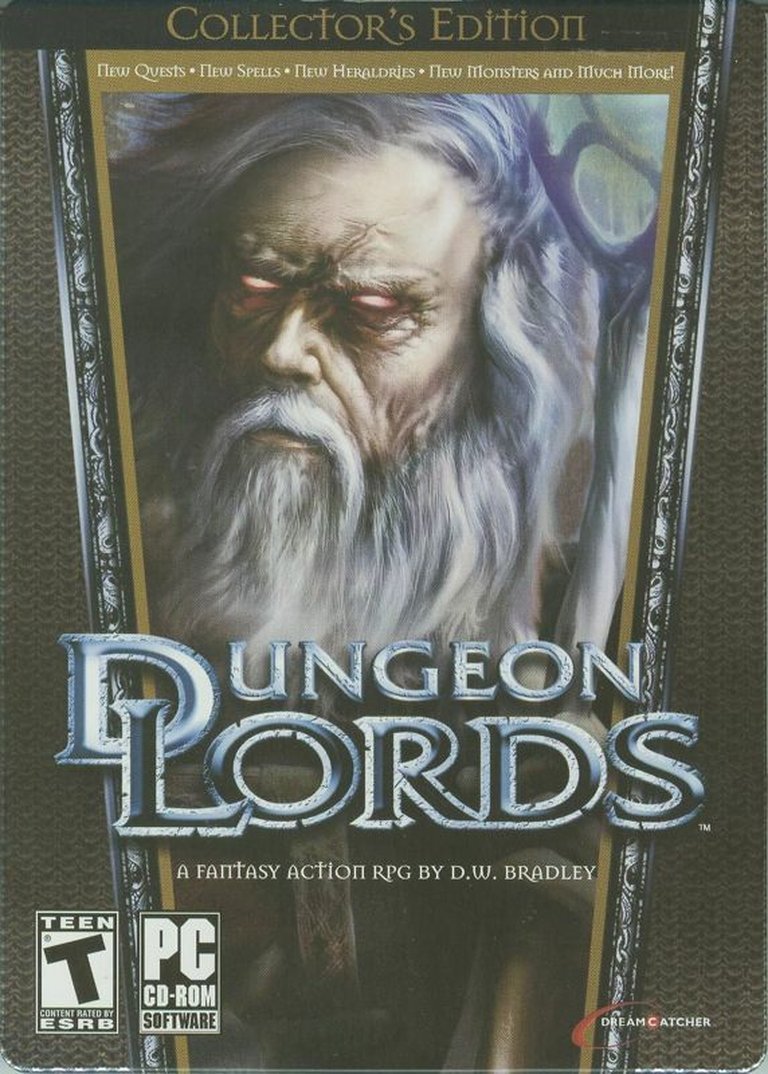
Dungeon Lords: Collector’s Edition is a fantasy action RPG where players embark on an adventure through dark dungeons, combating monsters and completing quests while customizing their character’s class, skills, and abilities. The Collector’s Edition enhances the experience with a limited metal case, rare weapons, new spells, expanded areas, and additional quests, while incorporating all updates and patches from the original version to provide a polished gameplay experience.
Gameplay Videos
Where to Buy Dungeon Lords: Collector’s Edition
PC
Dungeon Lords: Collector’s Edition Free Download
Dungeon Lords: Collector’s Edition Patches & Updates
Dungeon Lords: Collector’s Edition Guides & Walkthroughs
Dungeon Lords: Collector’s Edition Reviews & Reception
mobygames.com (66/100): Collector’s Edition Is The Game To Get…
rpgdot.rpgwatch.com (82/100): If you played (or read about) the original Dungeon Lords, then I probably haven’t said too much that you didn’t know already.
worthplaying.com : Dungeon Lords is an disappointing title, failing in every area where its competition succeeds.
archive.rpgamer.com (30/100): It is truly a depressing state of affairs when a company can legitimately push a defective product into a market where the consumer has no recourse to return the mostly useless merchandise.
Dungeon Lords: Collector’s Edition Cheats & Codes
Dungeon Lords Collector’s Edition (PC)
Enter the key sequences shown while in the game (typically during combat).
| Code | Effect |
|---|---|
| Backflip | Press ‘Away’ + ‘Jump’ to perform a backflip |
| Forward Roll | Tap ‘Forward’ twice to execute a forward roll |
| Side Roll | Tap ‘Left’ or ‘Right’ twice to perform a side roll |
| Leap Sideways | Press ‘Left’ or ‘Right’ + ‘Space’ to leap sideways |
Dungeon Lords: Collector’s Edition: Review
Introduction
To speak of Dungeon Lords: Collector’s Edition is to recount a saga of ambition and redemption. Arriving in 2006 amid a whirlwind of controversy, this iteration stands as the definitive version of a game whose 2005 original release was infamously premature, buggy, and incomplete. For years, Dungeon Lords was synonymous with cautionary tales of broken promises and corporate malpractice, yet through the lens of the Collector’s Edition, it emerges not as a failure, but as a flawed, deeply compelling action RPG that rewards persistence. This review deconstructs how this “finished” product transformed a pariah into a cult classic, analyzing its narrative, mechanics, world, and enduring legacy within the annals of RPG history.
Development History & Context
DreamCatcher Interactive’s decision to publish Dungeon Lords was fraught with tension from its inception. Designed by industry veteran David W. Bradley of Heuristic Park—a creator renowned for his work on the Wizardry series—the game was pitched as a hybrid of deep RPG mechanics and visceral, console-inspired combat. Its development cycle (spanning 2003–2005) was marked by delays and shifting deadlines, culminating in a May 2005 release that was, by all accounts, unfinished. The original version shipped with critical omissions: a non-functional auto-map, missing spells and skills, barren towns devoid of NPCs, and game-breaking bugs that rendered quests impossible to complete. Critic Steve Carter of Game Over famously declared it “a new low for how incomplete a game can be and still get released” (Wikipedia).
Bradley’s vision was ambitious: a real-time combat system inspired by fighting games, a classless progression model, and a vast fantasy world. Yet technical constraints and publisher pressure forced a premature launch. The 2006 Collector’s Edition represented a partial redemption, incorporating three major patches, new quests, and expanded content. However, as Bradley noted in interviews, the original’s damage was irreversible; many early players had already abandoned the franchise. The Collector’s Edition’s existence—essentially a “fixed” version sold as a new product—became a symbol of the industry’s problematic relationship with unfinished releases.
Narrative & Thematic Deep Dive
The plot of Dungeon Lords is a quintessential fantasy framework: the wizard Galdryn of the Meadows is slain by a conspiracy within the Circle of Mages, and his ally Lord Davenmor struggles to save his kingdom from the marauding forces of Lord Barrowgrim. Complicating matters, Davenmor’s daughter vanishes after being pledged to Barrowgrim, sparking a quest driven by love, betrayal, and revenge. While the narrative avoids profundity, it weaves in surprisingly nuanced themes of political intrigue and moral ambiguity. The missing daughter subplot, for instance, humanizes the conflict beyond a simple “good vs. evil” dichotomy (Fandom Wiki).
Dialogue, however, remains a weak point. Conversations are functional at best, often stilted and bereft of personality. Yet the game excels in its thematic consistency: every dungeon, quest, and character choice reinforces a world where power corrupts and trust is fragile. The guild system, in particular, explores loyalty and ambition—joining a thieves’ or mages’ guild often pits personal gain against moral integrity. Though thin on narrative depth, Dungeon Lords compensates with a tone that embraces the grit and unpredictability of classic, unfiltered fantasy RPGs.
Gameplay Mechanics & Systems
The Collector’s Edition’s gameplay is a masterclass in ambiguity and potential. Its core loop revolves around real-time combat, exploration, and character building, each implemented with unique idiosyncrasies.
- Combat: Inspired by console fighting games, battles rely on mouse-controlled combos (e.g., sweeping motions for area-of-effect attacks). While satisfying, the system suffers from inconsistent hit detection and a notorious “stat cap bug” where attributes exceeding 190 cause glitches (e.g., missed attacks, increased damage). Players are advised to cap stats at 190 (MobyGames Reviews).
- Character Progression: The class system is revolutionary. Players begin with a basic class (Fighter, Wizard, etc.) and unlock advanced paths through guilds (e.g., Paladin, Deathlord) by completing quests. Over 30 classes exist, allowing hybrid builds like a spell-slinging Paladin. Skill points are earned per level, enabling near-total freedom to specialize (Legacy Vault).
- Magic System: Spells are purchased as “charges,” not mana points. A Fireball spell bought 20 times grants 20 uses that recharge over time. Rune magic requires specific runes, while Nether magic consumes alchemical ingredients. This complexity adds strategic depth but can feel cumbersome (MobyGames Reviews).
- UI & Multiplayer: The interface is clunky, with inventory management being a particular pain. Multiplayer is limited to LAN sessions, offering co-op dungeon crawling for up to four players—a silver lining for those seeking shared adventure.
World-Building, Art & Sound
Dungeon Lords’ world, the Vale of Ruin, is a tapestry of diverse biomes—from the decaying city of Fargrove to the Forbidden Lands. While not as vast as The Elder Scrolls lore, it excels in environmental storytelling. Ruins are littered with cryptic notes, and the absence of music (beyond a main menu theme) heightens the sense of isolation, making encounters with monsters feel genuinely threatening (Legacy Vault).
Artistically, the game is a product of its era. Textures are low-resolution, but creature design is imaginative—think ogres, vampire bats, and ethereal wraiths. The Collector’s Edition’s steelbook case (a metal tin with embossed artwork) and fold-out map underscore its physical premium, a rarity in 2006 (MobyGames). Sound design is minimalist: environmental effects (dripping water, distant roars) create atmosphere, but the lack of an in-game score leaves dungeons feeling unnervingly quiet—a deliberate choice that some reviewers found unsettling, others immersive (RPGamer).
Reception & Legacy
At launch, the original Dungeon Lords was lambasted. Metacritic scored it 45/100, with IGN calling it “a disaster” and Computer Gaming World awarding it 0 stars. The Collector’s Edition fared better, with critical scores averaging 66% (GameBanshee: 82%, Video Game Talk: 50%). Players were divided: some hailed its “terrific” combat and customization (MobyGames Reviews), while others criticized its “endless waves of thieves” and “lifeless world” (RPGamer).
The game’s legacy is dual-edged. It’s remembered as a cautionary tale of rushed releases but also a cult classic for its bold mechanics. Its influence is indirect: the class-free progression system predated trends seen in Skyrim, while its combat foreshadowed action RPG hybrids like Dragon’s Dogma. In 2012, Dungeon Lords MMXII (a remaster) and the 2015 Steam Edition modernized the game, but the Collector’s Edition remains the purest expression of Bradley’s vision. Today, it’s a nostalgic gem, its reputation salvaged by a community that values ambition over polish (DungeonLords.com).
Conclusion
Dungeon Lords: Collector’s Edition is a paradox: a deeply flawed yet profoundly compelling RPG. It succeeds not as a polished product, but as a testament to iterative design and the resilience of its creator. The Collector’s Edition fixes the original’s most glaring issues, offering a rich world, satisfying combat, and unparalleled character customization. Yet it remains tethered by bugs, a thin narrative, and the specter of its disastrous launch.
For modern players, it’s a niche experience—best approached with patience and tempered expectations. Historically, it stands as a vital artifact of mid-2000s RPGs, a game that dared to be different even as it fell short. In the end, Dungeon Lords is less about perfection and more about potential. And in that potential lies its enduring magic.