
- Release Year: 1999
- Platforms: Macintosh, Windows
- Developer: Cyberlore Studios, Inc.
- Genre: Strategy, Tactics
- Perspective: Diagonal-down
- Game Mode: Single-player
- Gameplay: Business simulation, Managerial, Point-and-select, Real-time strategy, RPG
- Setting: Fantasy
- Average Score: 71/100
Description
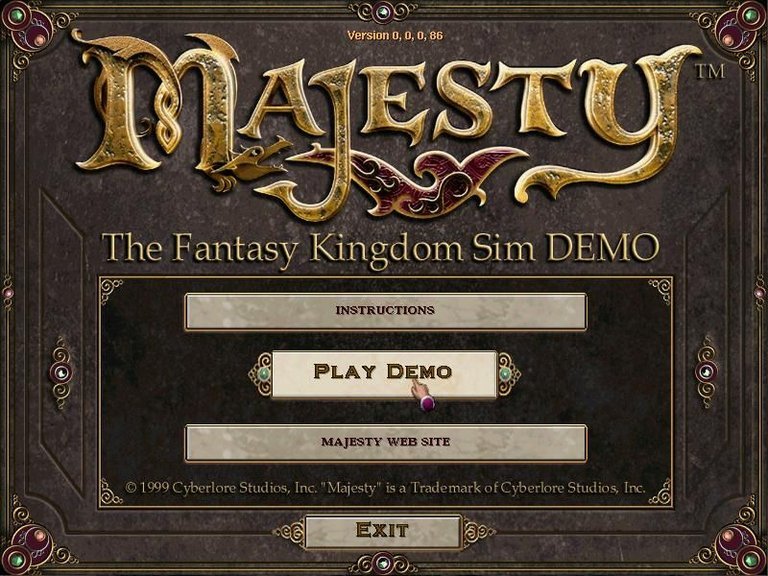
Majesty: The Fantasy Kingdom Sim is a real-time strategy game set in the fantasy realm of Ardania, where players assume the role of a sovereign ruler tasked with managing a kingdom without direct control over units. Instead of commanding armies, the player must attract and incentivize heroic adventurers through reward flags, sending them to explore dangerous landscapes, battle monsters, and complete quests. The demo version features a unique ‘Vampiric Revenge’ quest absent in other releases, along with distinct voiceovers, music, and UI elements. Gameplay blends RPG elements with managerial simulation in an isometric setting, offering indirect control where heroes act autonomously based on assigned rewards.
Gameplay Videos
Majesty: The Fantasy Kingdom Sim (Demo Version) Cracks & Fixes
Majesty: The Fantasy Kingdom Sim (Demo Version) Patches & Updates
Majesty: The Fantasy Kingdom Sim (Demo Version) Guides & Walkthroughs
Majesty: The Fantasy Kingdom Sim (Demo Version) Reviews & Reception
allaboutwindowsphone.com (71/100): Majesty is a game that has many elements right, but there are a few quirky issues
Majesty: The Fantasy Kingdom Sim (Demo Version) Cheats & Codes
PC
Press Enter during game play, then type one of the following codes.
| Code | Effect |
|---|---|
| fill this bag | Additional 10,000 gold |
| build anything | All buildings available |
| give me power | All spells available |
| revelation | Full map |
| victory is mine | Win game |
| i win | Win level |
| i’m a loser baby | Lose game |
| I’M A LOSER BABY | Automatically Lose |
| Victory is mine | Automatically Win |
| BUILD ANYTHING | Construct Any Building |
| now you die | Kill opponent |
| now you die | Lose Game |
| NOW YOU DIE | Destroy any selectable target |
| now you die | Kill Selected Monster |
| now you die | Instantly kills the selected target. This works for demolishing buildings too |
| NOW YOU DIE | Destroy selected building |
| restoration | Restore hit points |
| RESTORATION | Heal All Building/Units |
| cheezy towers | Unlimited spell range |
| CHEEZY TOWERS | Spells Without a Tower |
| cheezy towers | Infinite spell range |
| cheezy towers | Spells Have No Range Limit |
| grow up | Highlighted hero gains five levels |
| grow up | Gain Levels Quickly |
| GROW UP | Selected character gains 5 levels |
| highlighted | More powerful hero |
| Highlighted | Makes the hero more powerful |
| goblin rush | Spawn goblins |
| goblin rush | Spawn a wave of Goblins, Goblin Archers, Goblin Champions, and Goblin Priests |
| prepare to die | Dragon and Rock Golem attack |
| prepare to die | Spawn a wave of Dragons and Rock Golems |
| prepare to die | Spawn dragons and rock golems |
| night of the living dead | Spawn undead |
| Night of the living dead | Spawn all sorts of Undeads |
| night of the living dead | Spawn a wave of Skeletons, Vampires, and Zombies |
| planet fargo | Royal Advisor sings |
| Planet Fargo | Royal advisor will sing for a period of time |
| planet fargo | The Royal Advisor performs a rap |
| frame it | View frame rate |
| FRAME IT | Frame Rate? |
| frame it | Shows Frame Count |
| frame it | Replace the day counter at the top right of the screen with a frame rate counter |
| give me action | Spawn minotaurs |
| pump up the volume | Spawn general monsters |
| pump up the volume | Spawn a wave of monsters including Evil Oculi, Medusae, Rust Spitters, Giant Spiders, and Werewolves |
| leave me alone | Exit a multiplayer game but continue playing it alone |
Macintosh
Press “Enter” during play and type the passwords in
| Code | Effect |
|---|---|
| fill this bag | Additional 10,000 gold |
| build anything | All buildings available |
| give me power | All spells available |
| now you die | Destroy selected building |
| revelation | Full Map |
| grow up | Highlighted hero gains five levels |
| i’m a loser baby | Lose game |
| highlighted | Makes the hero more powerful |
| restoration | Restore hit points |
| prepare to die | Spawn dragons and rock golems |
| pump up the volume | Spawn general monsters |
| goblin rush | Spawn goblins |
| give me action | Spawn minotaurs |
| night of the living dead | Spawn undead |
| cheezy towers | Unlimited spell range |
| frame it | View frame rate |
| victory is mine | Win game |
Majesty: The Northern Expansion
Press Enter during gameplay to open a prompt, then enter these codes:
| Code | Effect |
|---|---|
| fill this bag | 10,000 gold |
| build anything | All buildings available |
| give me power | All spells available |
| revelation | Full map |
| cheezy towers | Infinite spell range |
| now you die | Kills opponents |
| i’m a loser baby | Lose game |
| restoration | Restore health |
| grow up | Selected character gains 5 levels |
| frame it | View frame rate |
| victory is mine | Win game |
Majesty: The Fantasy Kingdom Sim (Demo Version): Review
Introduction
In the crowded landscape of 2000s real-time strategy (RTS) games, Majesty: The Fantasy Kingdom Sim emerged as a defiantly unique experiment. Its demo, released in December 1999, was not merely a preview but a masterclass in subverting genre conventions. Developed by Cyberlore Studios and published by MicroProse under the Hasbro Interactive banner, the demo showcased a revolutionary concept: players don’t control their armies, they govern them. As a monarch in the whimsically perilous realm of Ardania, your role is to build, incentivize, and pray. This demo—a self-contained artifact featuring the exclusive “Vampiric Revenge” quest—offers a crystalline window into a game that redefined strategy by embracing chaos, autonomy, and dark humor. Its legacy lies in how it transformed RTS from a exercise in direct command into a symphony of emergent, often frustrating, heroism. This review dissects the demo’s role in shaping Majesty’s identity, its technical quirks, and its enduring impact on game design.
Development History & Context
Cyberlore Studios, a veteran of strategy titles like Warcraft II: Beyond the Dark Portal, crafted Majesty with a singular vision: to parody the hero-worship of RPGs by placing players in the shoes of a beleaguered monarch. The demo, released a full three months before the full game’s March 2000 launch, served as both a marketing tool and a testing ground for its radical mechanics. In an era dominated by rigid RTS tropes—resource micromanagement, direct unit control, and linear objectives—Majesty’s autonomy-first approach was a calculated risk. The tech constraints of 1999 Windows 9x/ME are evident in the demo’s isometric perspective and sprite-based art, but Cyberlore leveraged these limitations to create a charmingly chaotic world. The gaming landscape was saturated with RTS clones, but Majesty stood apart by emulating the unpredictability of pen-and-paper RPGs. Its voice-acted advisor (“Majesty, a message has arrived!”) and wry humor (“More gold for you, Majesty!”) signaled a shift toward personality-driven design. The demo’s unique “Vampiric Revenge” quest underscored Cyberlore’s confidence in its premise—a self-contained vampire hunt that would later be retrofitted into the 2018 Majesty Gold HD Edition.
Narrative & Thematic Deep Dive
The demo’s narrative is a microcosm of Majesty’s core satire. Set in Ardania—a land where sewers spawn rats the size of SUVs and city guards flee from goblins—the quest “Vampiric Revenge” tasks players with eradicating vampiric corruption. Yet, the narrative is secondary to the gameplay’s existential joke: you are the king, but the heroes are the stars. The demo leans into this through RPG tropes turned on their head. Heroes like Sir Calindor Broadedge (a warrior) or Argoth, Master of the Arcane (a wizard), aren’t your loyal soldiers; they are mercenary freelancers with their own agendas. The dialogue drips with irony: peasants sigh about taxes, advisors plead for funds, and heroes bicker in taverns. Thematically, the demo subverts the “chosen one” archetype by making sovereignty feel less like power and more like administrative purgatory. You can’t command a paladin to slay a vampire; you can reward them for it, and hope they don’t get distracted by an inn or a rival reward flag. This creates a darkly comedic tension between grand objectives and petty human (or elven, or dwarven) frailties. The demo’s vampire narrative is a perfect metaphor for the game’s core conflict: monsters are tangible threats, but the real villains are hero apathy and economic ruin.
Gameplay Mechanics & Systems
The demo’s gameplay is a masterclass in indirect control, stripping away RTS conventions while retaining strategic depth.
Core Loops: Building, Heroes, and Economy
- Indirect Command: Heroes operate on AI-driven priorities. Rogues rush for rewards, paladins raid lairs, and elves perform at inns. The demo’s UI includes a “spell duration” toggle—a beta feature absent in the final game—highlighting the need to manage buffs like haste or healing indirectly.
- Building as Leverage: Construction is your only direct tool. Guilds (warrior, ranger, wizard) and temples (life, death) spawn heroes, while inns (The Surly Dwarf) and marketplaces generate gold. The demo’s “uneven terrain” mechanic (requiring manual leveling) adds logistical depth.
- Economy of Chaos: Gold is generated via caravans, taxes, and hero spending (e.g., buying +3 weapons). Tax collectors must survive raids, and rogues may steal from your coffers. The demo’s “Vampiric Revenge” quest teaches reward placement—bounties on vampire lairs—to guide heroes.
Combat and Progression
- Autonomous Combat: Heroes level up RPG-style, gaining stats and abilities. Wizards learn spells like “Abderrazzaq!” (a beta incantation later replaced) at libraries, while warriors gain health. Yet, battles are unpredictable: a paladin might charge a vampire alone, or a wizard flee from a rat swarm.
- Monster AI: Vampires in the demo spawn from scripted points, but their behavior mirrors the full game’s rock-paper-scissors design (e.g., vampires weak to fire magic). Creature dens act as siege targets, not dungeons.
Demo-Specific Systems
- “Vampiric Revenge” Quest: A linear vampire hunt testing basic reward strategies.
- Beta Elements: Warriors have “shinier” armor; paladins are larger; the victory screen plays a tone. These nuances reveal a pre-release focus on visual feedback.
World-Building, Art & Sound
The demo’s Ardania is a character unto itself. The isometric visuals, rendered in 800×600, blend medieval architecture with cartoonish charm—paladins gleam, rats scuttle comically, and taverns glow warmly. Beta assets like the “uneven terrain” and sewer grate animations create a lived-in, imperfect world. Sound design is equally pivotal: the clink of gold, the swish of swords, and the advisor’s dry delivery (“Majesty, a message has arrived!”) inject personality. The demo’s music is brighter than the final game’s, with triumphant themes offset by moments of tension. Voiceovers are sparse but impactful—heroes shout quips when injured, peasants groan over labor. Together, these elements transform logistics into theater. Even the demo’s UI, with its spell toggle and distinct icons, sells the fantasy of ruling a kingdom by committee.
Reception & Legacy
The demo itself garnered niche attention, but its legacy is inseparable from the full game’s acclaim. Majesty (2000) scored 76% on GameRankings and won Computer Gaming World’s “P Critics lauded its “hands-off formula” (Next Generation) and “Pleasant Surprise of the Year” award. The demo’s “Vampiric Revenge” quest became a legendary artifact—reintroduced only in 2018 via Majesty Gold HD Edition. Its influence is profound:
– Genre Innovation: Pioneered “AI sandbox” mechanics, inspiring titles like RimWorld and Dwarf Fortress.
– Parody in Gaming: Cemented RPG satire as a valid design pillar.
– Ports and Expansions: The demo’s unique elements informed Majesty: The Northern Expansion (2001) and ports to Mac, Linux, and mobile.
– Community: Demos preserved on platforms like the Internet Archive (37.8MB) keep the spirit alive.
Conclusion
Majesty: The Fantasy Kingdom Sim (Demo Version) is more than a preview—it is a time capsule of a revolution. The “Vampiric Revenge” quest encapsulates the game’s genius: transforming strategy from a battle of clicks into a dance of incentives. Its beta quirks—uneven terrain, spell toggles, and voice lines—reveal a studio iterating toward chaos. While the full game would refine these systems, the demo’s core vision—sovereignty as management, heroism as a mercenary force—remains unparalleled. In an age of hyper-controlled RTS experiences, the demo’s legacy is a reminder that true strategy often emerges from surrendering control. It is not merely a game; it is a monument to the beauty of imperfection.
Final Verdict: An essential artifact for strategy historians and a testament to Cyberlore’s audacity. The demo’s “Vampiric Revenge” quest, with its flawed heroes and dark humor, remains a masterclass in emergent storytelling. 9/10.