
- Release Year: 2001
- Platforms: Windows
- Publisher: Gathering of Developers, Inc.
- Genre: Compilation
- Game Mode: LAN, Online PVP, Single-player
- Setting: Germanic, Norse
- Average Score: 80/100
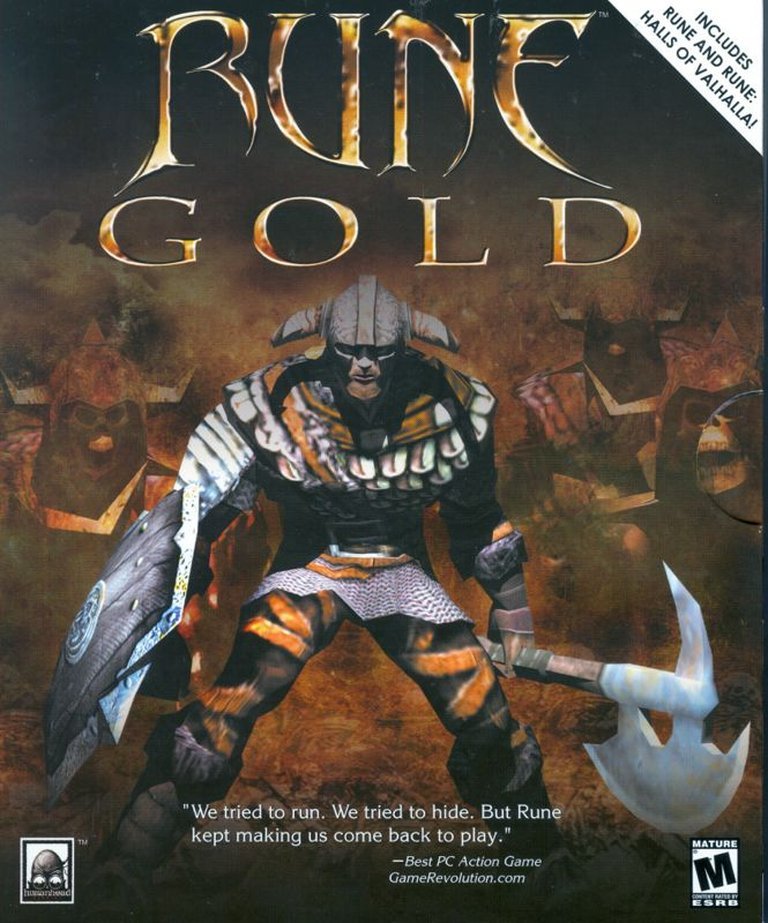
Description
Rune: Gold is a compilation that bundles the original action-adventure game ‘Rune’ and its expansion ‘Rune: Halls of Valhalla’. Set in a richly detailed Norse mythology, the game casts players as Ragnar, a young Viking warrior, who must embark on a perilous journey to thwart the schemes of Loki and his evil allies as they plot to destroy the world and trigger the apocalyptic event of Ragnarok. Players explore vast environments, engage in intense combat, and uncover the secrets of ancient runes in this mythic adventure.
Rune: Gold Free Download
Rune: Gold Cracks & Fixes
Rune: Gold Patches & Updates
Rune: Gold Mods
Rune: Gold Guides & Walkthroughs
Rune: Gold Reviews & Reception
gamefaqs.gamespot.com (80/100): A classic that never got the attention that it deserved.
Rune: Gold Cheats & Codes
Rune: Gold (PC)
Enable cheat mode by typing ‘CHEATPLEASE’ in the console (accessed with TAB or ~), or by binding keys in user.ini.
| Code | Effect |
|---|---|
| CHEATPLEASE | Enable Cheat Mode |
| GOD | God Mode (Invincibility) |
| KILLPAWNS | Kill All Enemies |
| GHOST | No Clipping Mode (Walk through walls) |
| FLY | Flight Mode |
| WALK | Disable No Clipping / Flight Mode |
| invisible | Invisible to enemies |
| amphibious | Infinite air when underwater |
| behindview 0 | First Person View |
| preferences | Advanced Options |
| playersonly | Pause All Non-Player Characters |
| togglefullscreen | Toggle Full Screen Mode |
| summon | Summon an item (item name follows) |
| summon runeofpower | Spawn a Rune of Power |
| open | Jump to a level (map name follows) |
| leveltravel | Level Select (map name follows) |
| switchcooplevel | Jump to a level with items already acquired (map name follows) |
| STAT FPS | Show FPS |
Rune: Gold (PlayStation 2)
Input these codes on the pause screen.
| Code | Effect |
|---|---|
| Left, Circle, Left, Right, Square, Right | Get full bloodlust |
| Square, Circle, Left, Right, Circle, Square | Invincible |
| Up, Down, Left, Right, Square, Circle | Refill the rune power meter |
Rune: Gold: Review
Introduction
In the pantheon of early 2000s action-adventure games, Rune: Gold stands as a singular, brutal masterpiece that carved its niche through unflinching Norse mythology and visceral melee combat. Born from Human Head Studios’ audacious vision and released in 2001 as a compilation bundle, this package gathers the original Rune (2000) and its expansion Ralls of Valhalla (2001) into one definitive experience. Though initially overshadowed by contemporaries like Diablo II or Counter-Strike, Rune: Gold cultivated a fervent cult following that endures today, celebrated for its authentic Viking atmosphere, innovative dismemberment mechanics, and fiercely competitive multiplayer. This review dissects the game’s historical significance, dissecting its design philosophy, narrative ambitions, and enduring legacy as a flawed but unforgettable artifact of a bygone era.
Development History & Context
Human Head Studios emerged from the ashes of a failed Daikatana sequel, a project that had licensed the Unreal Engine for third-person combat experimentation. Led by Ted Halsted—whose fascination with Norse mythology and the Völsunga saga became the game’s foundation—the 15-person team pivoted to create Rune as a love letter to Viking lore. Technologically constrained by an engine designed for shooters, the developers overhauled the Unreal Engine with a skeletal animation system, enhanced particle effects, and dynamic shadows to support fluid third-person melee combat. Gathering of Developers (GOD) published the title, capitalizing on the studio’s niche appeal during an era dominated by military shooters and fantasy RPGs. The 2000 PC release was followed by ports to Mac (Westlake Interactive) and Linux (Loki Software), while a planned Dreamcast version was cancelled. Rune: Gold’s 2001 compilation was born from community demand, bundling the base game with Halls of Valhalla and 37 new multiplayer maps, including fan-designed entries from a contest. This compilation addressed the original’s lackluster content while cementing Rune’s status as a modding darling, thanks to the freely released RuneEd toolkit.
Narrative & Thematic Deep Dive
Rune’s narrative is a dark tapestry woven from Norse mythology, casting players as Ragnar, a young Odinsblade warrior tasked with preventing Ragnarok—the apocalyptic end of the world. The plot unfolds through 45 linear levels, beginning with Ragnar’s initiation into an elite warrior order only to witness his father’s death at the hands of Conrack, a Loki-worshipping traitor. Ragnar’s odyssey takes him through haunting domains: the monster-infested Underworld ruled by Loki’s daughter Hel, the goblin lands, the industrialized dwarven realm, and finally Loki’s castle. The narrative explores themes of betrayal, honor, and cosmic inevitability, with Ragnar evolving from a vengeful youth to a chosen warrior capable of defating destiny. Key characters include Sigurd, Conrack’s disillusioned lieutenant who sacrifices himself to empower Ragnar, and the omnipresent Odin, whose divine interventions drive the plot. The dual endings—canonical salvation or damnation—underscore the game’s philosophical tension between free will and fate. Dialogue is sparse but evocative, employing Old Norse-inspired phrasing (e.g., “Wotankeld” for Odin’s gift) to immerse players in the setting. While criticized for its repetitive enemy encounters and predictable archetypes, the story’s strength lies in its mythic grandeur and environmental storytelling, from Hel’s spectral gloom to Loki’s blood-soaked citadel.
Gameplay Mechanics & Systems
Rune: Gold’s core is a physics-driven melee combat system where every swing has weight and consequence. Players wield 15 weapons across three categories—swords, axes, and hammers/maces—each with unique rune-powered abilities (e.g., lightning strikes or Berserk Mode). Combat emphasizes directional attacks: thrusts, overhead swings, and slashes, chained into spinning combos. The game’s signature innovation is its “gore system,” enabling dismemberment where severed limbs and heads become throwable projectiles. Tactical depth emerges from limb-specific damage; an enemy without a right arm cannot wield swords, encouraging strategic targeting. Shields complement early weapons but are abandoned for two-handed later tiers. Progression is linear, driven by rune collection to activate powers and weapon upgrades, though the expansion’s Head Ball mode—a brutal twist on football where players throw body parts into goals—introduced asymmetrical teamplay. The base game’s multiplayer (Deathmatch, Team Deathmatch) was expanded by Halls of Valhalla with Arena (duel-centric matches) and 16 new skins, including the fan-inspired Wren Valkyrie. Criticisms include repetitive enemy AI (zombies and dwarves swarm without tactics) and weapon imbalance, where high-tier weapons dominated single-player. Yet, these flaws were mitigated in multiplayer, where speed and precision pixel-perfect movement rewarded skill.
World-Building, Art & Sound
Rune’s world is a meticulously crafted Norse fantasy, blending historical authenticity with mythological liberty. Environments range from fog-shrouded fjords and haunted forests to Loki’s labyrinthine castle, each level rich with runic carvings and Viking architecture. The art direction leverages the Unreal Engine’s strengths with crisp textures and dynamic lighting, though character animations occasionally betray the era. The color palette—earthen browns, icy blues, and blood reds—evokes a harsh, unforgiving landscape. Sound design enhances immersion: the clang of steel, guttural battle cries, and ambient howls in mountain passes. The soundtrack, composed by Rom Di Prisco, blends traditional Nordic instruments with orchestral grandeur, underscoring pivotal moments like Ragnar’s ascent to Valhalla. Halls of Valhalla’s levels introduce darker, supernatural themes, such as frozen halls and spectral arenas, with improved environmental storytelling. The game’s Mature rating reflects its unflinching violence, from decapitations to Loki’s acidic blood, creating an atmosphere of primal ferocity that remains unmatched in Viking-themed games.
Reception & Legacy
Upon release, Rune garnered “generally favorable” reviews (Metacritic: 76/100), praised for its graphics and gore but criticized for AI limitations and linear design. Rune: Gold amplified the base game’s strengths, with GameRevolution awarding the original an A− and GameSpy a 90% for multiplayer depth. However, the PlayStation 2 port (Viking Warlord) fared poorly (Metacritic: 53/100) due to technical flaws. Commercially, Rune sold 49,000 units in the U.S. by 2001, modest for GOD Games’ ambitions. Its true legacy lies in its modding community and multiplayer endurance. The RuneEd toolkit spawned hundreds of custom maps and mutators, turning Halls of Valhalla’s Head Ball mode into a competitive staple. Clans like [RuneClan] sustained online play for years after 2014’s server shutdown, proving the game’s resilience. Rune also influenced future titles: its physics-based combat foreshadowed Chivalry: Medieval Warfare (2012), while its Norse themes permeate God of War (2018). The sequel Rune II (2019), though marred by development drama, attested to the franchise’s enduring appeal. Notably, Rune Gold was indexed by Germany’s BPjS in 2002 for its violence, cementing its countercultural status.
Conclusion
Rune: Gold is a flawed titan—a game whose technical limitations and repetitive single-player are overshadowed by its pioneering combat, mythic atmosphere, and multiplayer brilliance. Human Head Studios’ vision transformed a niche Viking concept into a cultural touchstone for melee enthusiasts, with Halls of Valhalla’s expansion elevating the package beyond its original scope. While it may lack the polish of modern action games, its raw, visceral energy and modding-friendly design ensure its place in gaming history. For historians, Rune represents a critical pivot in Unreal Engine usage, proving its versatility beyond shooters. For players, it remains a cathartic journey into Ragnarok’s shadow—a testament to the enduring power of myth and the clang of steel. Verdict: A brutal, beautiful relic that still hacks its way into the modern consciousness.