
- Release Year: 2004
- Platforms: Windows
- Publisher: 1C Company, 2K Games, Inc., Global Star Software Inc.
- Genre: Compilation
- Game Mode: LAN, Single-player
- Average Score: 85/100
Description
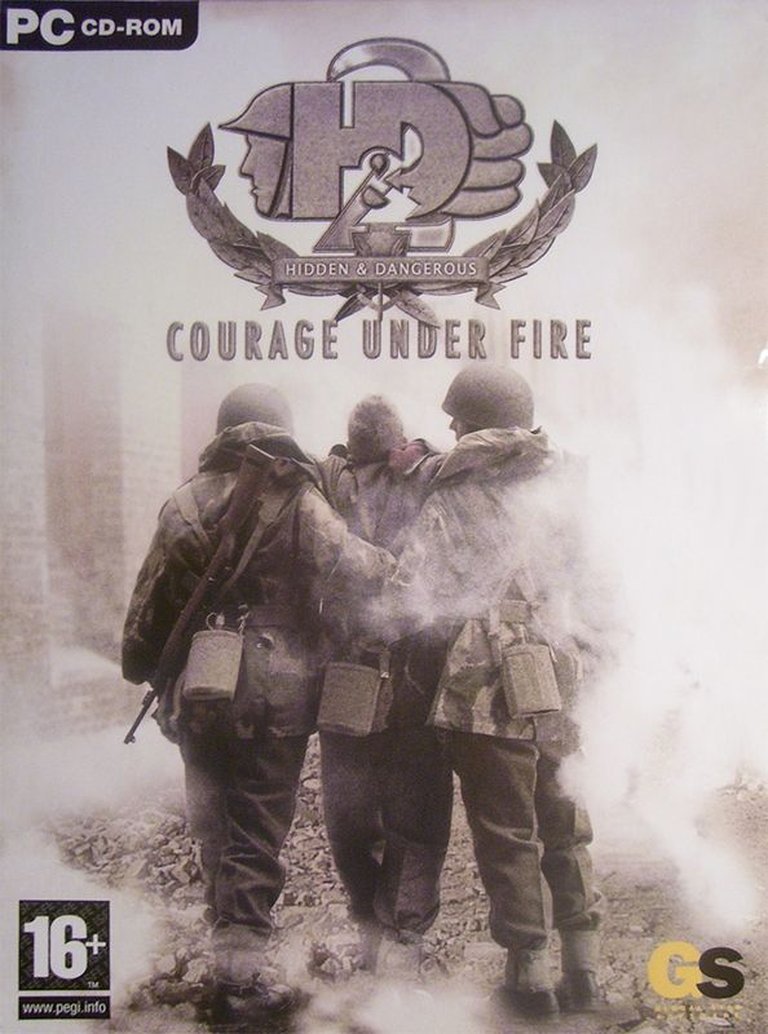
Hidden & Dangerous 2: Courage Under Fire is a tactical first- and third-person shooter set during World War II, where players command an elite SAS team across multiple campaigns in Europe, Africa, and Burma. The game offers a mix of stealth and combat strategies, allowing players to engage in missions solo or cooperatively, utilizing a variety of weapons and vehicles to outmaneuver the Axis Powers.
Gameplay Videos
Where to Buy Hidden & Dangerous 2: Courage Under Fire
Hidden & Dangerous 2: Courage Under Fire Cracks & Fixes
Hidden & Dangerous 2: Courage Under Fire Patches & Updates
Hidden & Dangerous 2: Courage Under Fire Mods
Hidden & Dangerous 2: Courage Under Fire Guides & Walkthroughs
Hidden & Dangerous 2: Courage Under Fire Reviews & Reception
steambase.io (95/100): A triumphant return to form for the series.
metacritic.com (75/100): It takes all that was good about the original, improves every element, successfully adds new features and delivers a well-rounded game that will demand more from you than perhaps any other title you’ll play this year.
Hidden & Dangerous 2: Courage Under Fire Cheats & Codes
PC (Console Commands)
Press ~ to open the console, then enter one of the following codes.
| Code | Effect |
|---|---|
| heal 1 | Get health for yourself |
| heal 4 | Heal entire team |
| happyammo 1 | Turn unlimited ammo on |
| happyammo 0 | Turn unlimited ammo off |
| kill | Die instantly |
| hydroshock | God mode; does not work on first version |
| anorexy [0 or 1] | See through player model skin |
| sniper 1 | Gives you 75 shooting and allows you to hold your gun dead still |
| giveitem (ITEM) | Get an item (replace ITEM with a keyword) |
PC (Menu Commands)
Hold [Shift] and type ‘iwillcheat’ or ‘iamcheater’ at the opening menu to enable cheat mode, then enter one of the following codes.
| Code | Effect |
|---|---|
| quickload | Load your saved game |
| nohits | No damage to you |
| goodhealth | Maximum life |
| openalldoor | All doors are now open |
| allitems | Gives all items |
| killthemall | Kills all enemies/civilians |
| showtheend | Skip to the end of the game |
| gamedone | Win current mission |
| gamefail | Fail current mission |
| resurrect | Resurrect all team members |
| funnyhead | Big heads on men |
| enemyf | Skip to enemy view |
| debugdrawwire | Wireframe |
| playercoords | Your Current Position |
| laracroft | Sex change for your men (Alternate Uniforms) |
| debugdrawvolumes | Wireframe view |
Hidden & Dangerous 2: Courage Under Fire: A Tactical Masterpiece of WWII
Introduction
In the pantheon of tactical shooters, few titles evoke the same blend of reverence and frustration as Hidden & Dangerous 2: Courage Under Fire. Released in 2004 as a compilation bundling the critically acclaimed base game and its expansion, Sabre Squadron, this Czech-developed WWII epic plunges players into the grim, high-stakes world of the British Special Air Service (SAS). Over two decades later, it remains a benchmark for hardcore tactical simulation, demanding meticulous planning, squad coordination, and adaptability under fire. Though its aging visuals and technical quirks are undeniable, Hidden & Dangerous 2 transcends these shortcomings through unparalleled depth, historical authenticity, and a gameplay loop that rewards patience over reflexes. This review deconstructs its legacy, examining how a product of early 2000s constraints became a cult classic and what makes it essential for students of military gaming history.
Development History & Context
TacnoSoftworks—later rebranded as Illusion Softworks and ultimately absorbed into 2K Czech—emerged from the post-communist gaming landscape of the Czech Republic as a studio obsessed with verisimilitude. Founded by Marek Španěl, the team cut its teeth on flight simulators before pivoting to tactical shooters with the original Hidden & Dangerous (1999). Their vision for the sequel was nothing short of revolutionary: a “sandbox WWII” experience where player choice dictated every outcome, from infiltration routes to equipment loadouts.
Developed on the proprietary LS3D Engine, Hidden & Dangerous 2 pushed the boundaries of early-2000s hardware. Its 2003 release coincided with a golden era for tactical shooters—Rainbow Six 3, Ghost Recon, and Operation Flashpoint dominated the market—but Illusion Softworks distinguished itself through sheer scale. The team reconstructed 30+ authentic WWII firearms, modeled vehicles from motorcycles to Stuka dive bombers, and crafted sprawling, destructible environments across theaters like Burma, Sicily, and Norway. However, this ambition came at a cost: the game launched plagued by bugs, from squadmates pathfinding into walls to save-corrupting crashes. Yet, the studio’s refusal to compromise on realism—implementing realistic ballistics, weight-based stamina, and limb-specific damage—cemented its reputation as uncompromising purists.
The gaming landscape of 2003–2004 saw WWII saturate shooters, often prioritizing cinematic spectacle over tactical depth. Hidden & Dangerous 2 defiantly bucked this trend, positioning itself as a “thinking person’s shooter.” Its 2004 compilation release (Courage Under Fire) added the Sabre Squadron expansion, refining the base game’s formula with nine new missions and multiplayer support, further solidifying its niche appeal.
Narrative & Thematic Deep Dive
Abandoning traditional character arcs, Hidden & Dangerous 2 adopts a documentary-style narrative that simulates the SAS’s actual WWII operations. The story unfolds through mission briefings, war diaries, and interstitial cutscenes, framing the player as a rotating cast of commanders rather than a fixed protagonist. This approach emphasizes the collective trauma of war: soldiers rotate in and out of your squad based on performance, injuries, or even death, creating emotional weight as loyal team members are lost to mortar fire or capture.
The narrative’s strength lies in its theematic authenticity. Missions are drawn from historical SAS operations, like the 1941 Crete sabotage campaign or the 1944 assault on the German-held island of Leros. Dialogue reinforces this realism—squaddakers bark orders in thick Cockney accents, briefings reference real officers like David Stirling (SAS founder), and radio intercepts crackle with coded German. While voice acting occasionally stumbles (some lines feel stilted), it reinforces the game’s commitment to immersion.
Themes of leadership and sacrifice permeate the experience. Players must balance risk and reward: sending a medic into a minefield to rescue a teammate or sacrificing a sniper’s position to save the squad. The disguise system, though flawed, adds thematic tension—wearing a Wehrmacht uniform offers infiltration opportunities but risks instant discovery if spotted by an officer. Ultimately, the game’s narrative isn’t told through characters but through player-driven consequences: a mission succeeded through daring improvisation feels more rewarding than any scripted cutscene.
Gameplay Mechanics & Systems
At its core, Hidden & Dangerous 2 is a squad-based sandbox where every decision cascades. Players recruit from a roster of 30+ soldiers, each with unique skills (e.g., sharpshooters, engineers, medics) and backstories. Pre-mission planning is exhaustive: you choose gear from a 100+ weapon arsenal, allocate explosives, and even select camouflage patterns. This depth extends to vehicles—capturing a Panzer to storm a bunker or piloting a Stuka for strafing runs is not just possible but often tactically optimal.
Combat revolves around the pause-and-order system, a precursor to tactical RPGs like XCOM. Freezing time allows issuing granular commands: “Sniper, suppress that MG nest,” “Demo team, plant charges on the bridge,” or “Medic, stabilize Jenkins.” In real-time, squadmates exhibit emergent behaviors—taking cover, flanking, or panic-fleeing under fire. However, the AI’s unpredictability is a double-edged sword: teammates might disobey orders or get stuck on geometry, forcing manual overrides.
The game’s flexibility defines its replayability. A single mission can be approached via stealth, brute force, or a hybrid approach. Stealth relies on sound masking, foliage concealment, and the aforementioned disguises, though detection logic is inconsistent. Combat, meanwhile, rewards tactical positioning: suppressing fire, flanking, and using terrain. The “Lone Wolf” mode caters to individualists, stripping squad control but amplifying tension.
Progression feels organic: soldiers gain rank, unlocking new skills, while captured weapons and intel persist between missions. Yet, the UI is clunky—inventory management is a drag-and-drop nightmare, and keybinds are non-customizable. Sabre Squadron enhances this with verticality-focused missions (e.g., scaling Italian cliffs) and new objectives like destroying V2 rocket launchers, demanding more dynamic tactics.
World-Building, Art & Sound
The game’s world-building is a love letter to historical detail. Levels span diverse theaters: Normandy’s bombed-out villages, North African deserts with mirage-shimmered heat haze, and Burma’s monsoon-soaked jungles. Environmental storytelling is subtle—bullet-riddled walls, abandoned supply trucks, and propaganda posters all weave a cohesive tapestry of war. Even minor elements, like the weight of a soldier’s backpack affecting sprint speed, enhance immersion.
Visually, the LS3D Engine’s limitations are apparent: low-poly models, repetitive textures, and rudimentary animations. Yet, the attention to detail compensates. Weapons are lovingly rendered, down to the rifling on a Lee-Enfield; uniforms sport period-accurate insignias; and vehicles interior cabins are fully explorable. Sabre Squadron expands this with new biomes—like Sicilian citrus groves and Norwegian fjords—using lighting to heighten tension (e.g., sun-drenched fields exposing flanks versus shadowed alleys for ambushes).
Sound design is the game’s unsung hero. Gunfire echoes realistically in stone corridors, while distant artillery rumbles with a bass-heavy thump. Voice lines are sparse but impactful—squaddakers yell “Grenade!” with visceral urgency. The soundtrack, though minimal, uses military marches and ambient silence to underscore tension. Even the menu’s static-laden radio chatter reinforces the era’s technological constraints.
Reception & Legacy
At launch, Hidden & Dangerous 2 received generally favorable reviews (Metacritic: 75). Critics lauded its depth and authenticity, with Eurogamer calling it “the most demanding tactical shooter of the year.” Yet, technical issues drew ire: GameSpot lamented that a “wonderful game is hidden amongst major bugs,” while Computer Gaming World criticized AI inconsistencies. Sales were modest but steady, buoyed by budget re-releases.
Over time, its reputation evolved. Modding communities patched AI quirks, added modern controls, and enhanced visuals, breathing new life into the title. Steam and GOG releases introduced it to new generations, earning a 95% positive rating on Steam from 922+ reviews. Players praise its “unmatched tactical depth” and “historical soul,” with one noting, “It’s not just a game—it’s a WWII simulator.”
Influence-wise, Hidden & Dangerous 2 prefigured modern tactics games like Hell Let Loose and Sons of the Forest. Its emphasis on player agency over linear scripting shaped open-world design, while the LS3D Engine’s legacy endured in Vietcong and Mafia. Today, it stands as a cult classic—a flawed masterpiece that rewards perseverance with unmatched immersion.
Conclusion
Hidden & Dangerous 2: Courage Under Fire is a time capsule of tactical ambition. Its clunky UI, dated visuals, and erratic AI are undeniable, but they are overshadowed by its uncompromising design. Few games today capture the tension of coordinating a four-man squad through a minefield, the satisfaction of a perfectly executed ambush, or the tragedy of watching a veteran soldier fall to a sniper’s bullet.
The compilation’s greatest strength is its authenticity. By eschewing Hollywood heroics for the grim reality of covert warfare, Illusion Softworks created a experience that feels less like a game and more like a military exercise. For fans of tactical shooters and WWII history, it remains essential—a challenging, rewarding artifact from an era of uncompromising PC gaming. While modern titles offer glossier surfaces, none replicate the sheer depth of Hidden & Dangerous 2. In the annals of military gaming, this isn’t just a classic—it’s a benchmark.