
- Release Year: 2011
- Platforms: Windows
- Publisher: Microsoft Corporation
- Genre: Compilation
- Game Mode: Single-player
- Average Score: 91/100
Description
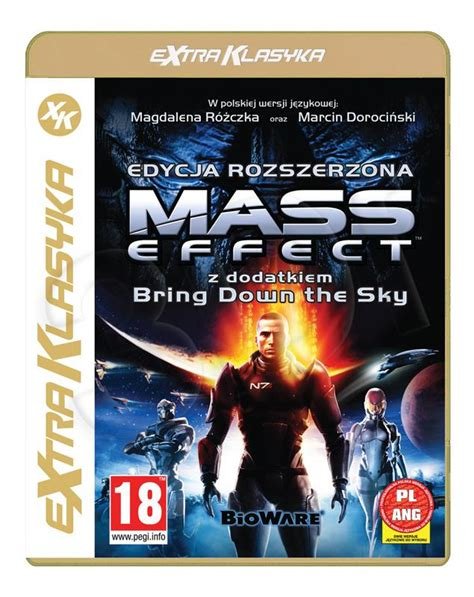
Mass Effect: Edycja Rozszerzona is a compilation that bundles the original Mass Effect game and its DLC expansion, Bring Down the Sky. Set in a vast science fiction universe where humanity has discovered ancient technology enabling interstellar travel, the game follows Commander Shepard’s mission to prevent a galactic extinction by the Reapers, an ancient race of machines threatening all organic life. This extended edition provides the complete first Mass Effect experience with added content, presented in multiple language versions including English and Polish voiceovers with subtitles.
Mass Effect: Edycja Rozszerzona Cracks & Fixes
Mass Effect: Edycja Rozszerzona Patches & Updates
Mass Effect: Edycja Rozszerzona Guides & Walkthroughs
Mass Effect: Edycja Rozszerzona Reviews & Reception
metacritic.com (91/100): There’s a ton of variation throughout the entire game, and an amazing amount of detail to be explored. I’d say it’s an absolute must buy for anyone that loves gaming, and I hope you’ll get as much out of the experience as I have.
Mass Effect: Edycja Rozszerzona Cheats & Codes
Mass Effect Legendary Edition – PC
Enable the console by editing Documents/BioWare/Mass Effect/Config/BIOInput.ini, adding the line “ConsoleKey=Tilde” under the [Engine.Console] section. Launch the game, press the tilde (~) key to open the console, then type the following codes.
| Code | Effect |
|---|---|
| fly | Enables fly mode (awkward controls). |
| GiveAllArmor xs | Gives all armor from manufacturer xs. |
| GiveAllGrenades xs | Gives all grenades from manufacturer xs. |
| GiveAllArmorHuman xs | Gives all human armor from manufacturer xs. |
| GiveAllArmorKrogan xs | Gives all Krogan armor from manufacturer xs. |
| GiveAllArmorQuarian xs | Gives all Quarian armor from manufacturer xs. |
| GiveAllArmorTurian xs | Gives all Turian armor from manufacturer xs. |
| GiveAllXMods | Gives all weapons and armor mods. |
| GiveAllWeapons xs | Gives all weapons from manufacturer xs. |
| givesuperarmor | Gives super armor (humans and Asari only). |
| givesupergun | Gives super gun. |
| givebonustalent # | Gives a bonus talent, replace # with talent ID. |
| GiveAllArmor | Gives all armors. |
| GiveAllBioamps | Gives bio amps, replace xs with manufacturer. |
| GiveAllOmniTools | Gives omni tools, replace xs with manufacturer. |
| giveall | Gives everything except armor. |
| AdjustCredits | Adjusts party credits; add a plus or minus number after the command. |
| teleport | Teleports player to the point under the cross‑hair. |
| givexp # | Gives experience points; replace # with amount. |
| setparagon # | Gives Paragon points; replace # with amount. |
| setrenegade # | Gives Renegade points; replace # with amount. |
| set bioattributespawnparty m_TalentPoints # | Sets troop talent points for the party; replace # with amount. |
| adjustcredits # | Sets party credits to specified amount; replace # with amount. |
| givetalentpoints # | Gives talent points; replace # with amount. |
| walk | Disables fly mode, returns to normal foot control. |
| initgrenades # | Sets number of grenades; replace # with number. |
| initmedigel X | Sets Medigel amount; replace X with amount. |
| InitCredits (number) | Sets party credits to specified number. |
| superspeed | Enables super speed. |
| unlockachievement # | Unlocks achievement; replace # with achievement ID. |
| ghost | Enables walking through walls. |
| initsalvage ### | Gives omni‑gel up to 999; replace ### with desired amount. |
| enablepowercooldown 0 | Removes ability cooldowns for the player. |
Mass Effect: Edycja Rozszerzona: Review
Introduction
In the vast cosmos of interactive storytelling, few franchises have left as indelible a mark as Mass Effect. Its first entry, released in 2007, redefined the role-playing game genre by blending cinematic narrative depth with real-time combat and player-driven choice. Now, presented in Mass Effect: Edycja Rozszerzona (Extended Edition), this landmark experience is reborn as a meticulously curated compilation for Windows. This edition bundles the original Mass Effect with the pivotal DLC Bring Down the Sky, offering not only a technical port but a cultural artifact—a fully localized experience in English, Polish (with voiceovers and subtitles), and hybrid English-Polish options. As a professional game historian, I contend that Edycja Rozszerzona transcends mere re-packaging; it is a vital preservation of a masterpiece that laid the groundwork for one of gaming’s most revered sagas. This review dissects its development, narrative, gameplay, artistry, and enduring legacy to affirm its place in the pantheon of interactive art.
Development History & Context
Mass Effect emerged from the visionary crucible of BioWare, a studio renowned for narrative-rich RPGs like Star Wars: Knights of the Old Republic. Directed by Casey Hudson, the project was ambitiously conceived as the first chapter of a trilogy from its inception in 2004. Development spanned three-and-a-half years, leveraging the Xbox 360’s superior hardware and tools—unprecedented for BioWare at the time. The team, numbering 130, prioritized technological innovation, building atop Unreal Engine 3 to create proprietary systems for digital actors, space exploration, and squad-based combat. This was BioWare’s largest programming endeavor to date, aimed at establishing a reusable framework for the trilogy. Key constraints included the need to balance RPG depth with shooter accessibility, resulting in a hybrid combat system, and the daunting task of crafting a believable galaxy with over 400,000 words of dialogue—equivalent to 4–5 novels.
The gaming landscape of 2007 was dominated by console exclusives, with Microsoft’s Xbox 360 serving as the primary platform. Mass Effect was unveiled at X05 in 2005 as an Xbox 360 exclusive, generating immense hype through E3 awards for “Best RPG” and “Most Innovative Design.” Its Windows port, handled by Demiurge Studios in 2008, optimized controls and visuals for PC, while Edycja Rozszerzona (2011) further refined this by integrating Polish localization. This edition, coinciding with the series’ rising prominence, addressed accessibility for new markets, ensuring the game’s foundational story reached a broader audience without compromising its original scope.
Narrative & Thematic Deep Dive
At its core, Mass Effect is an epic space opera centered on Commander Shepard, a customizable human Spectre tasked with thwarting the rogue turian Spectre Saren Arterius and his quest to unleash the Reapers—a cyclical, machine race that annihilates galactic civilizations every 50,000 years. The narrative unfolds across the Milky Way in 2183, a universe where humanity is a newcomer amid established alien factions like the asari, turians, and krogan. The plot’s complexity is enriched by prequel lore from the Mass Effect expanded universe (e.g., comics like Evolution and Revelation), which contextualizes key events such as the First Contact War and Saren’s motivations.
Bring Down the Sky, included in this compilation, deepens the narrative with a standalone mission where Shepard prevents a batarian extremist from crashing an asteroid onto a human colony, introducing themes of collateral damage and moral pragmatism. Character development is paramount: Shepard’s relationships with squadmates—like the idealistic asari archaeologist Liara T’Soni, the stoic krogan mercenary Urdnot Wrex, or the conflicted human soldier Ashley Williams—unfold through nuanced dialogue. BioWare’s innovative Dialogue Wheel system, a cornerstone of the experience, allows players to shape interactions through Paragon (diplomatic) or Renegade (aggressive) choices, branching conversations with thousands of permutations.
Thematic resonances permeate the story. Indoctrination—the slow corruption of free will by Reaper technology—explores the fragility of autonomy against overwhelming power. The Reapers’ galactic harvest cycle raises existential questions about organic life’s place in a mechanized universe, while subplots like the rachni queen’s fate or the genophage’s impact on krogan society examine prejudice, redemption, and the ethics of control. Shepard’s journey culminates in a sacrifice on Virmire, forcing players to confront loss and the weight of command, elevating the narrative from a simple hero’s quest to a profound meditation on legacy and survival.
Gameplay Mechanics & Systems
Mass Effect’s gameplay marries RPG depth with third-person shooter immediacy. Players control Shepard in real-time combat, pausing to issue tactical commands to two squadmates via a radial menu. The system emphasizes synergy between classes (Soldier, Adept, Vanguard, etc.) and abilities—biotic powers like Throw or tech skills such as Overload—creating strategic depth despite occasional AI pathfinding issues. Cover-based shooting feels visceral but suffers from imprecise hit detection and squadmates’ occasional unresponsiveness, flaws critics noted at launch.
Exploration occurs at multiple scales. The galaxy map facilitates traversal to star systems, with planetary surveys resource-gathering via orbital probes. On foot, missions blend combat, puzzle-solving, and dialogue, while the Mako—a six-wheeled All Terrain Vehicle—enables traversal of uncharted worlds. Its terrain-climbing mechanics were divisive; praised for freedom but criticized for bouncy physics and repetitive outpost designs.
Character progression is robust, with Talent Points spent across 12 ranks per ability, encouraging specialization. Inventory management, however, became cumbersome late-game, cluttered with weapon mods and armor. The Windows port in Edycja Rozszerzona streamlined this with an improved UI, though frame rate dips and loading times persisted. Despite these flaws, the system’s innovation lay in its seamless integration of choice—paragon/renegade points unlocking unique dialogue and options—making every playthrough feel distinct.
World-Building, Art & Sound
Mass Effect’s universe is a masterclass in world-building. The galaxy is a tapestry of meticulously crafted civilizations: the Citadel’s bureaucratic elegance, Illium’s neon-drenched capitalism, and Feros’ crumbling Prothean ruins evoke a sense of history and scale. This is bolstered by the game’s lore, accessible through codex entries and environmental storytelling, which details alien cultures, technologies like mass relays, and the enigmatic Protheans.
Artistically, the game draws inspiration from sci-fi classics (Blade Runner, Alien) and anime (Final Fantasy: The Spirits Within). Character models boast unprecedented detail, with facial animations conveying emotion through subtle micro-expressions, though lip-sync occasionally falters. Environments contrast the sterile geometry of the Normandy with the organic decay of Ilos, while enemy designs—from the geth’s mechanical aesthetic to the husks’ visceral horror—underscore the Reapers’ dread.
Jack Wall’s score, supplemented by Sam Hulick and Richard Jacques, is a character in itself. The main theme merges electronic synths with orchestral grandeur, evoking both wonder and foreboding. Sound design is equally immersive, from the crackle of biotic powers to the silence of space, with voice acting—featuring talents like Keith David and Seth Green—lending authenticity to every line. Together, these elements forge an atmosphere that is both epic and intimate, making the galaxy feel lived-in and dynamic.
Reception & Legacy
At launch, Mass Effect was a critical darling, lauded for its narrative ambition and cinematic presentation. Metacritic scores of 91 (Xbox 360) and 89 (PC) reflected universal acclaim, with outlets like Game Informer hailing it as “the future of RPGs.” However, combat and AI drew criticism, as did technical inconsistencies. Commercially, it sold over 1.5 million copies by January 2008, cementing BioWare’s status as a AAA powerhouse.
Edycja Rozszerzona’s 2011 release, while notwidely reviewed, served as a gateway for Polish-speaking audiences, enhancing the game’s accessibility without altering its core. Over time, Mass Effect’s reputation has solidified as a classic, frequently appearing in “greatest games” lists. Its influence is undeniable: the Dialogue Wheel and choice-driven narrative became industry standards, while the trilogy’s success paved the way for games like The Witcher 3 and Cyberpunk 2077. The DLC Bring Down the Sky, though narrative light, expanded the universe and demonstrated BioWare’s commitment to post-launch content, a model now ubiquitous in live-service games.
Conclusion
Mass Effect: Edycja Rozszerzona is more than a compilation; it is a time capsule of interactive storytelling’s evolution. By bundling the original game with Bring Down the Sky and offering robust Polish localization, it honors BioWare’s vision while ensuring its legacy endures. Despite combat and AI shortcomings, the narrative’s emotional weight, world-building’s richness, and thematic depth remain unmatched. For historians, it stands as a pivotal artifact—proof that games could be both commercial successes and profound artistic statements. For players, it remains an essential journey into a galaxy where every choice echoes. In the grand tapestry of gaming history, Edycja Rozszerzona’s inclusion of Mass Effect is not just a re-release; it is a testament to a game that, like its universe, continues to inspire and endure. Verdict: A masterpiece preserved, this compilation is indispensable for both newcomers and fans—a cornerstone of RPG history.