
- Release Year: 2013
- Platforms: PlayStation 3, Windows, Xbox 360
- Publisher: ak tronic Software & Services GmbH, Electronic Arts, Inc.
- Developer: Electronic Arts Canada, Electronic Arts Romania
- Genre: Sports
- Perspective: 3rd-person (Other)
- Game Mode: Online PVP, Single-player
- Gameplay: Career mode, Creation Mode, Player Build, Simulation, Ultimate Team
- Setting: European Football
- Average Score: 86/100
Description
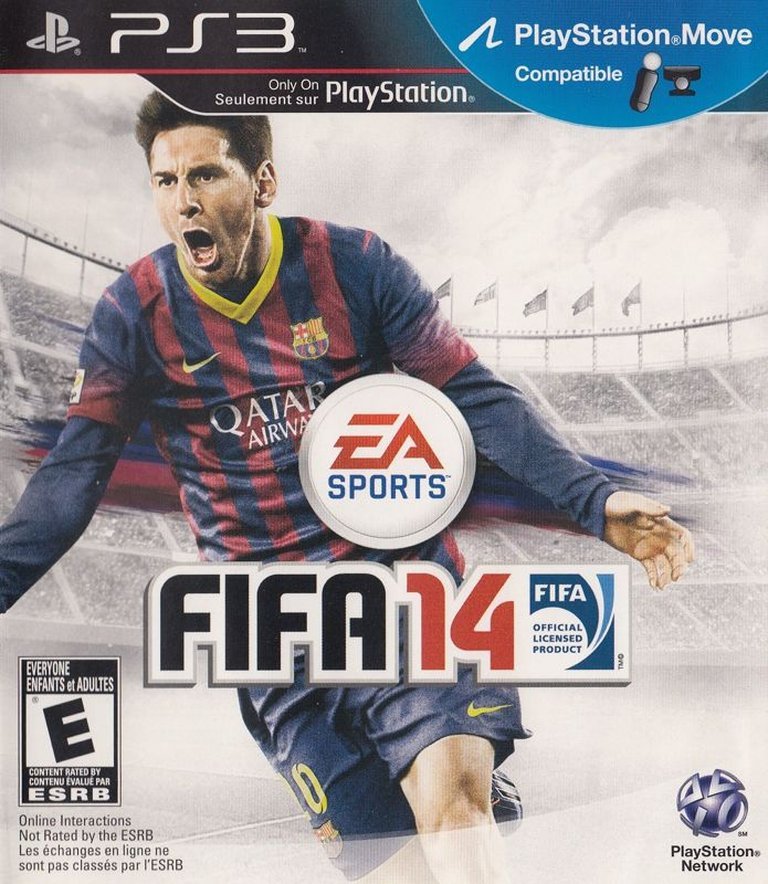
FIFA 14 is a football simulation game that offers refined gameplay mechanics with improved ball physics and animations, alongside a slower playing pace compared to its predecessor. The game features an extensive selection of licensed leagues and teams, alongside popular modes including Ultimate Team (a trading card-based team-building experience) and Career Mode (which allows players to manage teams through scouting and managerial features).
Gameplay Videos
FIFA 14 Free Download
PC
FIFA 14 Cracks & Fixes
FIFA 14 Patches & Updates
FIFA 14 Mods
FIFA 14 Guides & Walkthroughs
FIFA 14 Reviews & Reception
metacritic.com (84/100): Realism in football games reaches its maximum.
opencritic.com (86/100): Better than the 360/PS3 instalments in more than just looks, this is the best version of FIFA 14 you can buy.
ign.com (91/100): FIFA 14 on next-gen is a more refined, polished, and pleasing version of a brilliant sports game.
opencritic.com (86/100): FIFA 14 for the Xbox One is quite simply an impressive launch game.
ign.com : This time around it’s more attacking, more polished, and will keep you coming back throughout the season.
FIFA 14: Review
Introduction
In the annals of sports gaming, few franchises command the reverence and annual scrutiny that EA Sports’ FIFA series has cultivated since its inception in 1993. Released on September 24, 2013, FIFA 14 arrived at a pivotal crossroads in gaming history—simultaneously marking the twilight of the PlayStation 2 era and the dawn of the PlayStation 4 and Xbox One generation. As the 21st installment in a series that had already sold over 100 million copies by 2010, FIFA 14 was positioned not just as a roster update, but as a refinement of the digital football experience. This review argues that while FIFA 14 lacked the groundbreaking innovation of some predecessors, it excelled as a masterclass in accessibility, tactical depth, and licensed authenticity, solidifying its status as a cornerstone entry in the series’ evolution. Its legacy lies in its role as a bridge between generations—a polished culmination of the old-gen era while laying the groundwork for the next-gen revolution.
Development History & Context
FIFA 14 was developed primarily by EA Canada, with EA Romania handling handheld versions (PSP, 3DS). The studio, a veteran of the series since the late 1990s, aimed to transition FIFA from arcade-like dynamics toward a more cerebral, simulation-focused experience. Senior gameplay producer Aaron McHardy articulated a vision emphasizing “precision movement,” “greater midfield build-up,” and “team intelligence,” transforming gameplay into a “chess match” rather than a reliance on wing play. This strategic shift was a direct response to community feedback requesting more authentic football.
Technologically, FIFA 14 navigated a unique split: the PlayStation 4 and Xbox One versions debuted EA’s new Ignite Engine, featuring advanced AI, “True Player Motion” animations, and dynamic crowd/weather physics. PC, PS3, and Xbox 360 versions, however, utilized the older Impact Engine due to hardware constraints. EA explicitly cited “low spec machines” among PC players as the reason for this discrepancy, sparking debate about platform parity. The gaming landscape in 2013 was dominated by anticipation for next-gen consoles, with FIFA 14 serving as a launch title for PS4 and Xbox One. This context placed immense pressure on EA to deliver a seamless experience across all platforms, balancing fidelity with accessibility.
Narrative & Thematic Deep Dive
FIFA 14 eschews traditional narrative in favor of authentic recreation of the 2013–2014 football season. The “plot” is the sport itself—a global tapestry of leagues, cups, and rivalries, all meticulously licensed. Characters are real-world athletes, from Lionel Messi on the cover to over 16,000 player likeness scans. Their stories emerge organically through gameplay: a young prospect rising through Career Mode or a veteran player’s signature goal celebration (e.g., Cristiano Ronaldo’s “Calm Down” or Messi’s “Point to the Sky”). Dialogue is minimal but impactful, handled by veteran commentators Martin Tyler and Alan Smith, whose play-by-play calls (“It’s up for grabs now!”) evoke the drama of real matches. Thematically, the game celebrates football as a universal language, with licenses for 33 leagues—including debut entries from Argentina, Chile, and Colombia—emphasizing the sport’s global reach. The “beauty of the game” is a recurring motif, underscored by refined ball physics that reward skillful build-up play over arcadey rushes.
Gameplay Mechanics & Systems
FIFA 14’s gameplay pivoted on tactility and unpredictability. Key innovations included:
– Pure Shot & Real Ball Physics: Shooting became more nuanced, with off-balance and rushed shots affecting accuracy. The ball’s trajectory now reflected real-world physics, demanding players find optimal angles for powerful strikes.
– Precision Movement: Players planted their feet realistically, reducing momentum-based exploits and encouraging positional awareness.
– Team Intelligence: AI teammates made smarter runs, mimicking real-world tactics like Argentina’s 24-pass buildup against Serbia in the 2006 World Cup.
– Career Mode: A revamped “Global Scouting Network” allowed year-round talent searches, while Ultimate Team expanded to 10 divisions and introduced chemistry-based squad building.
– Exclusives: This version added tournaments, FIFA Interactive World Cup, and the Creation Centre for custom kits/players. However, defense controls were criticized as less intuitive than attacking mechanics.
The UI prioritized clarity, with menus streamlined for quick access to modes like Be a Pro (controlling a single athlete) or head-to-head seasons. While praised for depth, the game’s slower pace divided critics—some saw it as strategic, others as plodding.
World-Building, Art & Sound
FIFA 14’s world-building is a triumph of licensed authenticity. It featured 69 stadiums, including real venues like Camp Nou, Goodison Park, and La Bombonera, alongside generic arenas. Player models were lifelike, capturing individual physiques and animations, while crowds reacted dynamically to match events, a leap forward on next-gen. The art direction balanced realism with vibrancy, with kits and emblems rendered with meticulous detail.
Sound design elevated immersion: Tyler and Smith’s commentary paired with crowd chants specific to each club (e.g., “You’ll Never Walk Alone” at Anfield). The soundtrack, curated by EA Sports, blended global artists—CHVRCHES, Vampire Weekend, and Bloc Party—creating an energetic backdrop. Next-gen versions enhanced environmental audio, with rain affecting pitch acoustics. This symphony of visuals and sound transformed matches into spectacles, even if current-gen versions lacked the graphical fidelity of their successors.
Reception & Legacy
FIFA 14 received critical acclaim at launch, with aggregate scores of 82% on GameRankings and 87/100 on Metacritic (PC). Critics lauded its tactical depth and licensed breadth:
– GameStar (PC): 91% – “A hervorragende, im Vergleich zum Vorgänger weiter verbesserte Fußball-Simulation.”
– IGN: 90% – “More attacking, fun, welcoming, and attractive.”
– Eurogamer: 85% – “A very good football game” though criticizing generic pacing.
However, some detractors, like PC Invasion, deemed it “dependable rather than revelatory.” Commercially, it was a juggernaut, winning “Sports Game of the Year” at the D.I.C.E. Awards and contributing to FIFA’s record as the best-selling sports franchise.
Its legacy is dual-edged. On old-gen consoles, it refined the series into a simulation benchmark, while on next-gen, the Ignite engine set new standards for AI and visuals. The game’s Ultimate Team mode became a cornerstone of EA’s monetization strategy, though its lack of female players (despite petitions) highlighted franchise limitations. Today, FIFA 14 is remembered as a transitional masterpiece—finishing the PS2’s era with polish while launching FIFA into a new graphical era.
Conclusion
FIFA 14 stands as a testament to EA Sports’ ability to iterate and perfect. Though it didn’t reinvent the wheel, its blend of tactical gameplay, exhaustive licenses, and next-gen aspirations made it an essential experience. For football fans, it delivered a refined, authentic simulation that rewarded strategy over spectacle. Its legacy is cemented by its role as a bridge between generations—a high note for the old guard and a launchpad for FIFA’s future. In a series often criticized for annual sameness, FIFA 14 achieved something rare: it felt both a culmination and a beginning. For that, it earns its place as a defining chapter in gaming history.