
- Release Year: 2021
- Platforms: Macintosh, Nintendo Switch, PlayStation 4, Windows
- Publisher: Microids SA
- Developer: it Matters Games
- Genre: Simulation
- Perspective: 3rd-person (Other)
- Game Mode: Single-player
- Gameplay: Life simulation, Social simulation
- Average Score: 82/100
Description
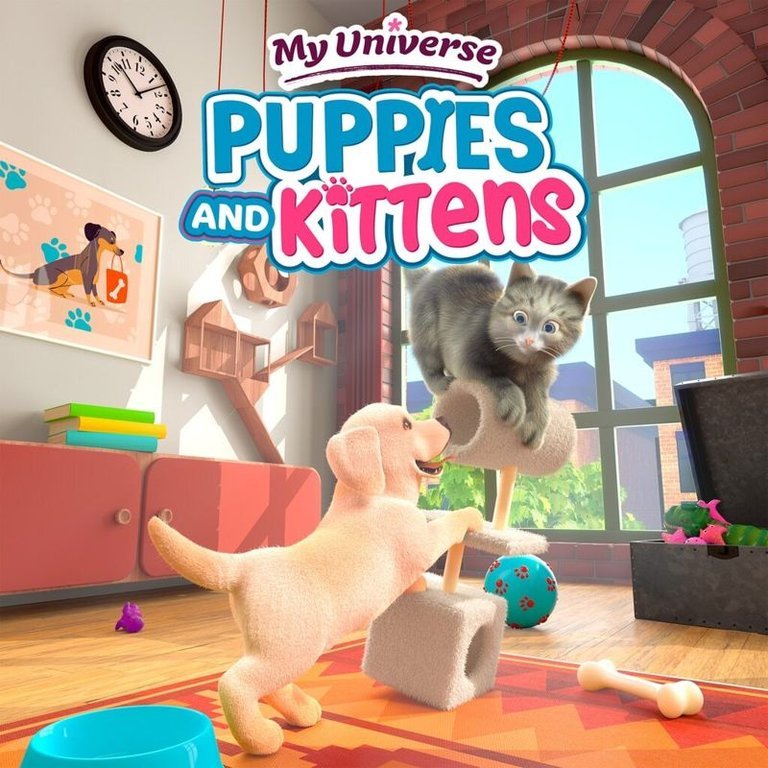
My Universe: Puppies and Kittens is a life simulation game developed by it Matters Games and published by Microids SA, where players can raise and care for adorable puppies and kittens in a virtual environment. Featuring a point-and-select interface and accessible third-person perspective, the game offers a nurturing experience suitable for all ages, as indicated by its PEGI 3 rating. Released across multiple platforms including PlayStation 4, Nintendo Switch, Windows, and Macintosh in 2021, it allows players to engage in interactive pet care activities within the beloved My Universe series.
Gameplay Videos
Where to Buy My Universe: Puppies and Kittens
My Universe: Puppies and Kittens Guides & Walkthroughs
My Universe: Puppies and Kittens Reviews & Reception
familyfriendlygaming.com (82/100): This game is very family friendly. This game is also a bit boring and repetitive.
My Universe: Puppies and Kittens: Review
Introduction
In the ever-expanding landscape of casual simulation games, few niches evoke as much universal warmth and nostalgia as virtual pet ownership. My Universe: Puppies and Kittens (2021), developed by It Matters Games and published by Microids, arrives as the latest entry in the family-friendly “My Universe” series—a franchise known for gentle, educational experiences. Targeted at young players and families, this title promises a heartwarming journey into puppy and kitten care, blending nurturing, training, and exploration. Yet, while it excels in accessibility and wholesome appeal, the game’s repetitive loops and technical limitations reveal a product designed strictly for its demographic, offering little depth for seasoned gamers. This review dissects its execution within the context of its genre, developer heritage, and design philosophy, ultimately asking whether it successfully delivers on its promise of joyful companionship or merely scratches the surface of pet-sim potential.
Development History & Context
It Matters Games, a studio with a portfolio of casual titles like My Universe: Pet Clinic Cats & Dogs (2020), crafted Puppies and Kittens as a deliberate refinement of its pet-care formula. Under publisher Microids—a veteran French studio famed for adventure games like Syberia—the project aimed to capitalize on the enduring appeal of the Nintendo Switch and PS4 family markets during 2021. The game’s development was anchored by a unified vision: to simplify pet ownership into bite-sized, colorful interactions for children aged 6+, leveraging Unity’s cross-platform versatility to ensure broad accessibility.
Released first on PS4 (October 2021) and Switch (November 2021), followed by PC/Mac ports in 2022, Puppies and Kittens entered a market saturated with pet sims. Its predecessors Nintendogs (Nintendo DS) and My Baby (Wii) set high bars for emotional attachment, but 2021 saw fewer AAA entries, leaving room for accessible alternatives. Microids’ marketing emphasized safety (PEGI 3 rating) and educational value, positioning the game as a tool for teaching responsibility. With 108 credited staff—including production director François Coulon and producer Élodie Francillonne—the project reflected a streamlined approach, prioritizing iterative design over innovation.
Narrative & Thematic Deep Dive
There is no overarching plot in Puppies and Kittens; instead, the narrative is a microcosm of daily pet ownership. Players adopt puppies or kittens, each procedurally assigned unique personalities (e.g., “playful” or “shy”) dictating preferences for toys or food. The story unfolds through cyclical routines: feeding, bathing, and cuddling to maintain the pet’s happiness, punctuated by explorations of the neighborhood or competitions. Dialogue is sparse and functional—limited to text prompts like “Your kitten is hungry!”—replacing storytelling with tactile feedback.
Themes center on responsibility and empathy. Feeding schedules, litter-box maintenance for cats, and grooming reinforce care rituals, while teaching tricks (dogs only) encourages patience. Social elements like walking pets to meet other owners subtly promote community. However, the lack of narrative depth renders the experience a series of disconnected tasks. A child might learn that neglect leads to a sad pet, but there are no consequences beyond temporary mood shifts, and no emergent stories emerge from player choices. The result is a sterile, mechanical world where pets react predictably, rather than organically.
Gameplay Mechanics & Systems
The core loop revolves around three pillars: care, training, and exploration.
- Care Mechanics: Players engage in point-and-click mini-games: feeding via timed button presses, bathing with scrubbing motions, and playing fetch or laser-pointer chases. Each pet has individual needs—e.g., a lazy cat may resist play—but these feel superficial, as preferences reset arbitrarily. Grooming and hygiene lack nuance, reducing interactions to rote repetition.
- Training & Progression: Dogs can learn tricks (e.g., “sit,” “roll over”) through repetitive QTEs, unlocking competitions for rewards like accessories. Cats, however, are confined to indoor care—a baffling limitation noted in reviews. Progression is mission-based: “Play fetch 10 times” or “Adopt three pets” yield cosmetic unlocks (collars, toys), but the grind feels hollow.
- Exploration: Walking dogs in a 3D neighborhood (cats cannot explore) allows digging for treasures or socializing with AI pets. The world is small and static, with no dynamic events beyond scripted encounters.
UI & Flaws: The interface is a cluttered, pastel-colored grid of icons, designed for simplicity but lacking intuitiveness. Animations are janky—pets clip through objects, and walking motions are unnatural. A critical flaw is the asymmetry between species: dogs get exploration and tricks; cats do not, undermining the “puppies and kittens” premise. The absence of save-on-exit mechanics forces players to complete tasks manually, exacerbating frustration.
World-Building, Art & Sound
The game’s world is a sanitized, idyllic suburbia—lush meadows, sunny parks, and cozy homes—rendered in a vibrant, low-poly art style. Pets adopt exaggerated “chibi” proportions (oversized heads, tiny limbs), emphasizing cuteness over realism. Environments, while charming, are texture-light and unresponsive: grass doesn’t sway, houses lack detail, and lighting is flat.
Sound design leans into whimsy: upbeat piano melodies play during care routines, while barks and meows are digitized and repetitive. Audio cues (e.g., a happy pet sound) provide feedback, but the absence of voice acting or ambient noise (birds, wind) creates a sterile atmosphere. The result is a visually appealing yet emotionally sterile space—more diorama than living world.
Reception & Legacy
Upon release, Puppies and Kittens received muted critical attention, with Metacritic reporting no critic reviews. Family-centric outlets like Family Friendly Gaming praised its safety and educational value (scoring 82/100), noting how it “promotes responsibility in children.” However, adult gamers found it soporific; one reviewer admitted falling asleep during streams. Commercially, it performed moderately, priced at £24.99, but was overshadowed by Switch titles like Animal Crossing: New Horizons.
Its legacy lies as a functional, if unmemorable, entry in the casual pet-sim genre. It expanded the “My Universe” brand alongside titles like Doctors & Nurses and Interior Designer, cementing Microids’ foothold in family gaming. Yet, it failed to innovate: compared to Nintendogs’ lasting impact, Puppies and Kittens lacks the same charm or mechanical depth. Modern retrospectives position it as a “baby’s first pet sim”—a safe, disposable experience rather than a classic.
Conclusion
My Universe: Puppies and Kittens is a paradox: a meticulously crafted yet emotionally hollow experience. It succeeds as a preschool-friendly tool, offering bite-sized lessons in empathy through its gentle care loops and charming aesthetics. For a child, the thrill of unlocking a new collar or teaching a dog to “shake” may spark joy. Yet, for anyone beyond its target demographic, the game reveals itself as a shallow, repetitive grind, undermined by technical jank and asymmetrical design.
In the pantheon of pet simulations, it stands as a footnote—a competent but uninspired entry that prioritizes accessibility over ambition. While its legacy may be ephemeral, it fulfills its niche: a digital babysitter that, for a few hours, can make a child feel like a responsible pet owner. For the rest of us, it’s a reminder that not every game needs to revolutionize a genre—but neither should it settle for mediocrity. Final Verdict: A Well-Meaning but Ultimately Forgettable Pet Sim.