
- Release Year: 2019
- Platforms: Blacknut, Nintendo Switch, Windows
- Publisher: VLG Publishing, WhisperGames
- Developer: Studio V
- Genre: Adventure, Mystery, Thriller, Visual novel
- Perspective: Fixed / flip-screen
- Game Mode: Single-player
- Gameplay: Choice-based gameplay, Evidence gathering, Interrogation, Puzzle elements, Visual novel
- Setting: Cyberpunk, Dystopian, Fictional future city
- Average Score: 69/100
Description
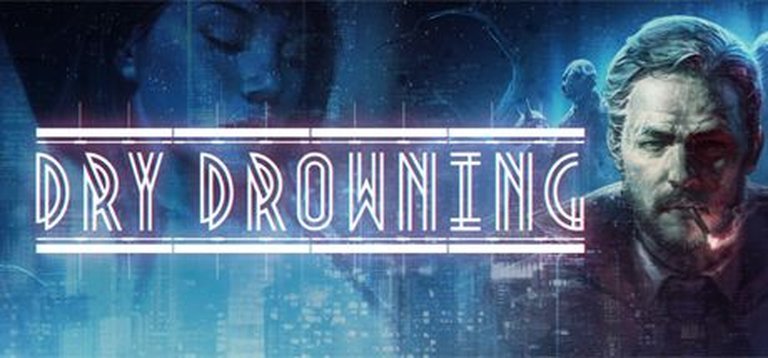
Dry Drowning is a single-player murder mystery visual novel set in a dystopian future city where player choices drive the narrative toward one of three possible endings. The game follows Mordred Foley, a private detective recently released from investigation after being accused of fabricating evidence in a previous serial killing case. As a new ritual killing emerges, players must navigate through investigations presented as chapters in a book, solving puzzles and unraveling mysteries while dealing with the oppressive atmosphere of this futuristic world.
Gameplay Videos
Where to Buy Dry Drowning
Dry Drowning Patches & Updates
Dry Drowning Guides & Walkthroughs
Dry Drowning Reviews & Reception
metacritic.com (68/100): Dry Drowning is a very good game with great narrative experience.
opencritic.com (71/100): Dry Drowning is an intriguing, engaging, if flawed visual novel.
keengamer.com : Despite this, the effects of these decisions don’t really make for a branching narrative per se; everything progresses towards a few endings with a few details mixed and matched in.
nfornerds.com : This is a beautifully illustrated game.
videogamer.com : Early on, I found myself fidgeting with boredom, but the more I played the more its writing drew me in.
Dry Drowning: Review
Introduction
In the neon-drenched, rain-slicked streets of 2066’s dystopian metropolis, shadows whisper secrets and lies wear monstrous visages. Dry Drowning, the debut narrative opus from Italian studio Studio V, plunges players into a cyberpunk noir labyrinth where a disgraced private detective, Mordred Foley, hunts a mythologically-inspired serial killer named “Pandora.” Though initially overshadowed by bigger titles, this visual novel has carved a niche for itself through its relentless atmosphere, morally complex characters, and a narrative that feels both painfully timely and tragically timeless. Despite its technical imperfections and occasional narrative stumbles, Dry Drowning stands as a compelling, if flawed, testament to the power of interactive storytelling in a genre defined by choice. This thesis argues that while hindered by localization issues and mechanical roughness, Dry Drowning succeeds through its masterful world-building, gripping psychological tension, and a story that lingers long after the final, haunting revelation.
Development History & Context
Dry Drowning emerged from the fertile ground of Italy’s burgeoning indie scene, helmed by Studio V, a small team led by director Giacomo Masi. Masi’s vision was clear: to forge a “psychological investigative thriller” that married the hard-boiled cynicism of classic film noir with the technological paranoia of cyberpunk, all filtered through a lens of Greek mythology. The game’s development leveraged the Unity engine, providing the flexibility to realize their hand-painted aesthetic and integrate the game’s core mechanics without requiring AAA resources. Released on PC in August 2019, the game arrived during a significant period for narrative-driven experiences. The PC platform was thriving with visual novels and indie adventures like Steins;Gate 0 and Doki Doki Literature Club, while the Nintendo Switch was rapidly becoming a haven for such titles, offering a portable ideal for text-heavy journeys. Studio V’s roots in Italy are reflected in the game’s initial Italian screenplay by Masi and Lorenzo Latini, which, despite later translation efforts, would leave a subtle linguistic fingerprint on the English dialogue. The subsequent port to Nintendo Switch in 2021, alongside releases on Blacknut and other services, broadened its audience, solidifying its place as a cult favorite among fans of the genre.
Narrative & Thematic Deep Dive
The narrative unfurls as a tapestry woven from noir tropes, political intrigue, and mythological horror. Players step into the battered shoes of Mordred Foley, a private detective recently cleared after a two-year ordeal where he faced execution for fabricating evidence in a serial killer case. Haunted by the ghosts of those he helped convict, Foley is thrust back into action when “Pandora” begins ritualistic murders echoing Greek tragedies – a victim bound like Prometheus, another sacrificed like Iphigenia. The core mystery is compelling, driving players through a labyrinth of corruption centered around the powerful pharmaceutical conglomerate Hephaestus Tech and its revolutionary AI, “AquaOS.”
The characters are the game’s lifeblood. Foley, a chain-smoking “unscrupulous” cynic, grapples with guilt and sees grotesque masks superimposed on the faces of those who lie, a mechanic representing his fractured psyche. His partner, Hera, serves as his conscience, a haunted figure with a tragic past, their dynamic evolving from professional partnership to a complex bond laced with shared trauma and residual attraction (“The only difference is, you’re a gorgeous monster,” Foley quips, a line emblematic of the game’s tonal awkwardness). Supporting figures like the tough-as-nails Chief Freya (“the only bastard I couldn’t arrest”) and enigmatic corporate figures add layers to the city’s power struggles. The dialogue, translated from Italian, often carries a slightly unnatural cadence, moments of earnest noir (“Pureness is a bullet’s favourite food”) colliding with awkward bravado or cringeworthy flirtation. Thematically, Dry Drowning is rich and unsettling. It dissects the cyclical nature of violence, the seductive and destructive nature of power, the ethics of surveillance and AI control, and the pervasive nature of state-sponsored fear. The parallels drawn to contemporary political climates, even noted by players in 2021, are striking, lending the dystopian setting a chilling immediacy.
Gameplay Mechanics & Systems
Dry Drowning primarily adheres to the visual novel template but intersperses it with adventure game mechanics. The core loop involves investigating crime scenes through point-and-click exploration, meticulously searching static hand-painted environments (like Foley’s cluttered office or rain-slicked alleys) for clues. These clues are catalogued within the game’s in-universe “AquaOS,” an augmented reality interface that overlays holographic reconstructions of crimes, allowing players to “see” past violence amidst the sterile digital decay – a genuinely innovative and atmospheric touch.
The central gameplay pillar is the “Living Nightmares” interrogation system. Drawing clear inspiration from the Ace Attorney series, players must present evidence to contradict statements during character dialogues. Successfully breaking down a lie triggers a chilling visual effect as the liar’s face distorts into one of Foley’s perceived masks. The stakes are high, with a system of three “eyes” representing the chances to extract the truth; fail three times, and the conversation resets. While mechanically sound, these sections can occasionally feel simplistic or linear, relying more on pattern recognition than deep deduction. Environmental puzzles, like cracking a safe code, appear sporadically but feel largely incongruous, serving as minor speedbumps rather than integrated challenges. The most significant flaw lies in the lack of a text skip function, making replays to uncover other endings (there are three) a tedious exercise in re-reading vast swathes of dialogue. The UI, particularly on the Switch, is another Achilles’ heel, with small, sometimes low-contrast text (white on light cyan) causing readability issues. Choices are frequent and heavily promoted with dramatic vein-veiled interfaces, and while not all carry immediate, massive consequences, they demonstrably shape character relationships and the path towards different endings, offering genuine narrative weight in key moments.
World-Building, Art & Sound
Nova Polemos is Dry Drowning‘s true star. Studio V’s art direction, led by Giulia Carli, crafts a world that is both visually stunning and oppressively atmospheric. The city is rendered primarily in stark black and white, a visual choice that evokes classic film noir while emphasizing the bleakness of the setting. This monochrome palette is punctuated by vibrant neon accents – the harsh blues, pinks, and cyans of holographic advertisements, the glow of the AquaOS interface, and the lurid lights of seedy bars – creating a stark contrast that screams “opulent decay.” The level of detail in backgrounds is exceptional, from the cluttered authenticity of Foley’s office to the rain-slicked grandeur of the city’s underbelly, each location telling a story of its own through environmental storytelling.
The sound design, under Giorgio Maioli’s direction, is exceptional and profoundly enhances the mood. A melancholic piano-driven soundtrack dominates, its mournful melodies perfectly mirroring Foley’s tortured psyche and the pervasive gloom of Nova Polemos. Standout tracks like “A te” and “Ricordi” become emotional anchors. Sound effects, from the crackle of holograms to the distant wail of sirens, further immerse the player in the city’s oppressive soundscape. The game notably lacks voice acting, a surprising omission for a genre where it’s increasingly standard. While the written performances are strong, the absence of vocal delivery removes a layer of potential emotional depth and polish, leaving the dialogue to sometimes feel flat, especially during more intense moments.
Reception & Legacy
Upon its 2019 PC release, Dry Drowning received a mixed-to-positive reception, reflected in a Metacritic score of 68 (PC) and a 74% average on MobyGames. Critics often highlighted its strengths: Adventure Gamers (70%) praised the “visual novel-styled journey,” while Digitally Downloaded (Switch, 90%) lauded its “bold willingness to discomfort the audience” and intensity, comparing it favorably to Tokyo Dark. KeenGamer (Switch, 70%) noted the “thrilling story and mystery” and “great lore.” However, flaws were consistently cited: Jump Dash Roll (60%) deemed the writing “clichéd,” and Screen Rant (Switch, 67%) found puzzles “overly cryptic.” The Switch port in 2021 brought renewed attention, with Way Too Many Games (75%) calling it “pleasantly surprised” and eShopper Reviews (67%) acknowledging its “setting, characters, and story” despite frustrations.
Legacy-wise, Dry Drowning hasn’t revolutionized the genre but has secured a respected place within it. Its distinct fusion of cyberpunk, noir, and mythology, combined with its strong atmospheric presentation, has earned it a dedicated following among visual novel enthusiasts. It serves as a solid example of how small studios can create deeply atmospheric, choice-driven experiences that resonate emotionally. While it may not have spawned imitators in the same way as Doki Doki Literature Club, its success on multiple platforms demonstrates the continued viability and appeal of the narrative-focused visual novel model, proving that compelling stories and distinctive worlds can overcome technical limitations and narrative imperfections.
Conclusion
Dry Drowning is a fascinating, frustrating, and ultimately rewarding experience. Studio V crafted a world that feels both alien and eerily familiar, a dystopia that mirrors contemporary anxieties through the prism of retro-futuristic noir. The narrative core – Foley’s hunt for Pandora amidst the rot of Nova Polemos – is gripping, driven by complex characters and themes that resonate far beyond the game’s runtime. The artistic and aural presentation is a triumph, with the stark visuals and haunting soundtrack creating an atmosphere unmatched in many of its peers. The core mechanics of investigation and interrogation are engaging, even if occasionally undermined by simplistic puzzles and a lack of quality-of-life features like text skipping.
However, the game is undeniably held back by its flaws. The translated dialogue, while often evocative, suffers from unnatural phrasing and jarring tonal shifts. The UI, particularly on console, actively hinders immersion. And while the choices matter, the narrative structure can feel constricted, with the weight of some pivotal decisions feeling disproportionate to the surrounding context.
Verdict: Dry Drowning is a flawed gem, an ambitious and atmospheric dive into cyberpunk noir that deserves to be experienced by fans of the genre and narrative-driven games. It succeeds not through mechanical perfection or flawless execution, but through the sheer power of its world, the depth of its themes, and the indelible imprint of its dystopian vision. It is a testament to the idea that sometimes, the most memorable journeys are the ones that leave you slightly breathless, slightly unsettled, and eager to dive back in, even knowing the waters might be murky. For those willing to tolerate its imperfections, Dry Drowning offers a profound and haunting dive into the depths of a broken future.