
- Release Year: 2024
- Platforms: iPhone, Nintendo Switch, PlayStation 3, PlayStation 4, PlayStation 5, PS Vita, Windows Apps, Windows, Xbox One, Xbox Series
- Genre: Action
- Perspective: Behind view
- Game Mode: Single-player
- Gameplay: Block Pushing, Puzzle
- Setting: Greek mythology
- Average Score: 68/100
Description
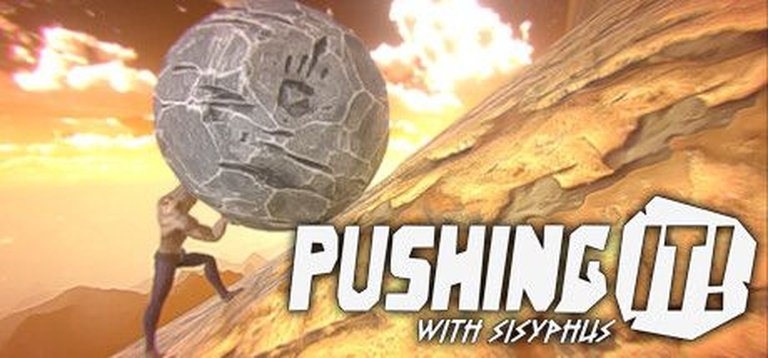
Pushing It! With Sisyphus is an indie action game that plunges players into the eternal punishment of Greek mythology, where they control Sisyphus laboriously pushing a massive boulder up a perilous hill. Set against a challenging, behind-view perspective, the game intensifies difficulty after each goalpost, featuring steep slopes, slippery controls, and a mocking tone that openly derides failures. When Sisyphus perishes, a Dark Souls-style death screen appears before Zeus resurrects him to restart the cycle, creating an unforgiving loop of struggle and dark humor.
Gameplay Videos
Where to Buy Pushing It! With Sisyphus
PC
Pushing It! With Sisyphus Guides & Walkthroughs
Pushing It! With Sisyphus: Review
1. Introduction
In an era defined by blockbuster spectacles and polished AAA experiences, Pushing It! With Sisyphus emerges as a defiant, minimalist manifesto of futility and perseverance. Released on September 10, 2024, this indie title from Bashir “ManliestDev” Kashalo distills the ancient Greek myth of Sisyphus into a brutally honest, darkly humorous, and punishingly difficult simulation. While the broader gaming landscape was saturated with open-world epics and narrative-driven RPGs, Pushing It! carves its niche by stripping gameplay to its most primal essence: pushing a boulder up a hill, only to watch it roll back down. This review argues that Pushing It! With Sisyphus is not merely a game but a philosophical meditation on absurdity, resilience, and the hollow promise of reward. Its genius lies in transforming a 2,000-year-old existential dilemma into an interactive experience that is as hilarious as it is harrowing, cementing its place as a cult classic in the pantheon of punishing indies.
2. Development History & Context
Pushing It! With Sisyphus was developed almost single-handedly by Bashir “ManliestDev” Kashalo, a solo indie operating under the ManliestDev label. The project arose from a desire to authentically adapt the myth of Sisyphus, a figure condemned by Zeus to eternally push a boulder up a hill, only to have it tumble back each time he neared the summit. Kashalo explicitly stated his goal was to create “an accurate representation of the ancient Myth,” promising players “levels of frustration not previously thought possible.” Built on the Unity engine, the game leveraged accessible tools to focus on core mechanics rather than graphical fidelity, reflecting the constraints of a small-scale indie production.
Technologically, Pushing It! embraces simplicity: a third-person perspective with direct control, where the player character physically interacts with a massive boulder. This minimalist approach contrasts sharply with the AAA titles dominating the 2024 market, such as Black Myth: Wukong or Star Wars: Outlaws, which emphasized cinematic storytelling and expansive worlds. Instead, Kashalo’s work taps into a long-standing indie tradition of punishing gameplay, echoing titles like Getting Over It With Bennett Foddy (2017) and the Dark Souls series. The gaming landscape in 2024 was ripe for such a title, with audiences increasingly drawn to high-difficulty “souls-like” experiences and philosophical indie games. Notably, Kashalo himself expressed exhaustion during development, admitting in a Steam post-release announcement, “THIS GAME SPENT ITS WHOLE DEVELOPMENT CYCLE TORTURING ME, AND NOW I PASS THAT PAIN ON TO YOU.” This candid statement underscores the game’s identity as a labor of love—and torment.
3. Narrative & Thematic Deep Dive
Pushing It! With Sisyphus rejects traditional narrative exposition in favor of environmental storytelling and thematic resonance. The plot is deceptively straightforward: players control Sisyphus, a “very happy guy” (as cheekily described in the Steam store blurb), tasked with pushing a boulder up an impossibly steep hill. There are no cutscenes, no dialogue, and no NPCs—only the player, the boulder, and the relentless slope. The narrative unfolds through the player’s repeated failures and the developer’s omnipresent mockery. When Sisyphus falls, a Dark Souls-style “You Died” banner appears, followed by a jarring revival where Zeus electrocutes the character back to life, emphasizing the cyclical nature of punishment. This mechanic directly mirrors the myth’s essence: death is not an escape but a continuation of torment.
Thematically, the game is a masterclass in existentialist and absurdist philosophy. Albert Camus’ essay “The Myth of Sisyphus” famously recasts the hero as a figure of defiance in the face of absurdity, finding meaning in the struggle itself. Pushing It! translates this into gameplay: the journey—not the destination—becomes the focus. The game’s tagline, “There is an end. You just probably won’t make it,” encapsulates this tension. The promise of a summit (a “carrot” dangled as Polygon notes) is perpetually out of reach, forcing players to confront their own perseverance.
Character progression reinforces these themes. Sisyphus begins comically “skinny” but grows “buffer” with each ascent, transforming into a “muscular, hulking monster.” This mechanic symbolizes the futility of effort: physical strength provides no advantage against the boulder’s physics, only a grotesque testament to wasted labor. The game’s dark humor further explores the absurd, with Kashalo’s developer notes and Steam announcements dripping with sarcasm. One Steam post mocks players for daring to believe the summit was reachable, framing their ambition as foolish. This playful cruelty transforms the player’s frustration into a shared joke, blurring the line between the developer, the myth, and the player’s own existential struggle. Ultimately, Pushing It! argues that happiness—like the summit—is unattainable, but the act of pushing is what defines us.
4. Gameplay Mechanics & Systems
Pushing It! With Sisyphus centers on a single, deceptively simple mechanic: the player must push a massive boulder up a hill by walking or running into it. The controls are direct and physics-based, requiring precise momentum and timing to avoid slipping. This core loop is both intuitive and maddeningly complex. The boulder behaves with realistic inertia, sliding away at the slightest misstep and plummeting into an “abyss below” as Polygon describes. A single mistake sends Sisyphus tumbling back to the starting point, erasing all progress—a design choice Kashalo defends as “a metaphor for life.”
The gameplay systems are brutally minimalist but deeply layered. Progression is tied to Sisyphus’s physical transformation: as the player ascends, the character grows larger and stronger. This “buffer” mechanic, while superficially rewarding, introduces new challenges. A bulkier Sisyphus becomes harder to control, making precise movements more difficult. This creates a punishing feedback loop where effort breeds complications, mirroring the myth’s irony. There are no traditional upgrades, abilities, or RPG elements; the sole “reward” is the incremental visual change and the psychological satisfaction of inching higher.
Combat is nonexistent, but the game nails a unique form of tension through environmental hazards. Slopes grow steeper, terrain becomes treacherous, and the physics engine feels increasingly unforgiving at higher altitudes. The UI is sparse, focusing on the third-person perspective and minimal HUD elements. This design choice immerses players in the struggle, with no distractions from the task at hand. While the core mechanic is innovative in its authenticity, it also harbors flaws. The physics can feel inconsistent, with occasional bounces or slides defying logic. Some players criticize the lack of subtle checkpoints or save states, arguing that the game’s “not impossible” promise is undermined by its unforgiving nature. Yet for its target audience, this precision is a feature, not a bug—a true test of skill and patience that elevates it above casual “simulation” games.
5. World-Building, Art & Sound
The world of Pushing It! With Sisyphus is a masterclass in minimalist design. The setting is confined to a single, imposing hill, rendered in stark, geometric landscapes. As players ascend, the environment subtly shifts—crumbling cliffs give way to jagged outcrops, and the sky may darken, symbolizing the inexorable weight of Sisyphus’s task. The absence of a detailed backstory or lore forces players to project their own interpretations onto the desolate landscape, enhancing the game’s existential atmosphere. This minimalism is deliberate; by stripping away distractions, Kashalo ensures the player’s focus remains solely on the struggle between humanity and the boulder.
Artistically, the game leverages Unity’s capabilities to create a surprisingly expressive visual style. Sisyphus’s transformation from a lanky figure to a hulking behemoth is both comical and tragic, a visual metaphor for futility. The boulder itself is rendered with impressive weight, casting dynamic shadows and leaving indents in the terrain. The color palette is muted—browns, grays, and occasional flashes of lightning from Zeus’s interventions—reinforcing the bleak tone. Animation is key to conveying emotion; Sisyphus’s exaggerated movements and comical stumbles inject dark humor into despair.
Sound design complements the visuals with a sparse, oppressive ambiance. Footsteps crunch on gravel, the groan of the boulder’s weight permeates the audio, and distant thunderclaps foreshadow failure. There is no traditional soundtrack, only subtle environmental cues that heighten tension. When Sisyphus falls, a jarring crash is followed by silence, emphasizing the void of his achievement. This auditory restraint makes moments of “success”—like reaching a new plateau—feel euphoric yet fleeting. Together, the art and sound create a unified experience that is both a parody of “happiness” and a grim tribute to perseverance.
6. Reception & Legacy
Upon release, Pushing It! With Sisyphus polarized audiences but quickly garnered attention for its audacity. As Polygon reported, by September 17, 2024, “no one has managed to beat it,” cementing its reputation as a “notoriously difficult” title. Critical reception at launch was sparse, with Metacritic listing no critic reviews, reflecting its indie obscurity. However, player reviews on Steam told a different story. The game holds a “Mixed” rating (67% positive as of November 2025, based on 86 reviews), with players divided between masochistic praise and frustrated condemnations. Positive reviews called it “a true test of patience” and “philosophically brilliant,” while negative ones deemed it “a scam” or “unfinishable.”
Commercially, Pushing It! found success as a niche phenomenon, priced at $7.99 on Steam and GOG. Its legacy began evolving almost immediately. The game inspired a sequel, Pushing It! Together (2025), adding co-op gameplay, and joined a subgenre of “Sisyphus-themed” games like Sisyphus Reborn (2014) and Little Sisyphus (2023). More broadly, it influenced the “falling game” trend, alongside titles like Getting Over It and Downwell, by proving that extreme difficulty could drive community engagement. Steam user tags like “Souls-like,” “Philosophical,” and “Psychological Horror” highlight its crossover appeal.
Culturally, Pushing It! became a meme. Steam forums erupted with posts of anguish and dark humor, such as a user’s 180-character scream of pure frustration. Kashalo’s developer notes—mocking players for their ambition—went viral, positioning him as a modern mythmaker. The game’s legacy is thus twofold: it is both a cautionary tale about the limits of game design and a celebration of indie creativity. For players, it offers a rare, unforgiving experience that mirrors life’s struggles; for the industry, it demonstrates that even the simplest concepts can yield profound impact when executed with unwavering vision.
7. Conclusion
Pushing It! With Sisyphus is a triumph of concept over execution—a game that wears its absurdity as both armor and weapon. In its purest form, it is a punishing, hilarious, and deeply philosophical experience that strips gaming to its essence: the struggle to overcome an impossible task. Kashalo’s vision, born from exhaustion and dark humor, transforms Camus’ existential hero into a playable figure, forcing players to confront their own limits and resilience. The game’s minimalist design, brutal mechanics, and cyclical narrative create a loop of frustration and dark comedy that is as compelling as it is exhausting.
Yet for all its flaws—unforgiving physics, repetitive gameplay, and a lack of traditional rewards—Pushing It! stands as a significant work. It redefines the “difficult game” not as a gimmick but as a medium for exploring futility, perseverance, and the absurd. Its legacy is secure, influencing a wave of philosophical indies and proving that the most profound stories can be told with a single boulder and a steep hill. In the end, Pushing It! With Sisyphus is not about reaching the summit. It is about the act of pushing itself—an eternal, maddening, darkly beautiful dance with futility that every player must experience to understand. For those brave enough to endure, it offers not victory, but the unsettling, exhilarating truth of Sisyphus: we must imagine him happy.