
- Release Year: 2019
- Platforms: Linux, Macintosh, Windows
- Publisher: Heartfelt Games, LLC
- Developer: Heartfelt Games, LLC
- Genre: Action
- Perspective: Side view
- Game Mode: Single-player
- Gameplay: Platform, Shooter
- Setting: Futuristic, Sci-fi
- Average Score: 84/100
Description
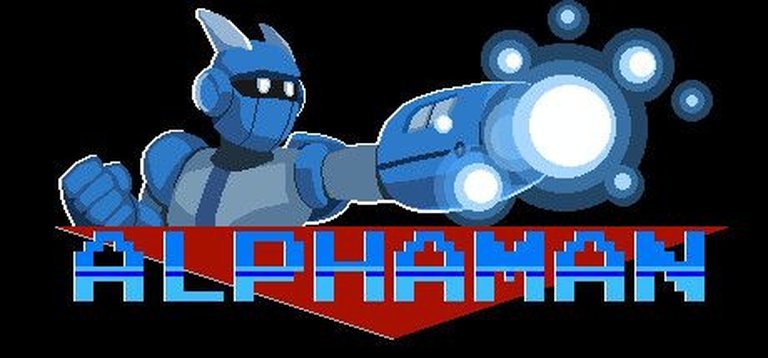
Alphaman is a 2D side-scrolling platform shooter set in a sci-fi/futuristic world, heavily inspired by the Mega Man series. Developed by Heartfelt Games, LLC and released in 2019 for Windows, Linux, and Macintosh, the game challenges players with its blend of platforming and shooting mechanics. Despite its brevity and fluid difficulty curve, it delivers a nostalgic yet fun experience, praised for being worth its affordable price point.
Where to Buy Alphaman
PC
Alphaman Reviews & Reception
metacritic.com (90/100): Alphaman is a whole lot of fun, plus it’s challenging.
mkaugaming.com : Overall, for what the game was trying to achieve with its simple but challenging gameplay; it is a great game in design.
christcenteredgamer.com (78/100): Strong Points: About as close as you can get to being the classic Megaman games without being the real thing.
gamespace.com : The keyboard layout was not bad for a platformer!
Alphaman Cheats & Codes
PC – Windows
Enter codes at the main menu or when prompted for your name.
| Code | Effect |
|---|---|
| Jeffrey Olson | Start with 18 of everything and good inventory |
| SPAM | Fills up 2 hungry factors |
| BEEF-O-RONI | Fills up all hungry factors |
| COFFEE | Doesn’t raise any hungry factors but refreshes |
| HUMJUM | Radiate you |
| KROPOR | Alter int |
| NEFALY | Regenerate |
| TINZAY | Increase awareness |
| VORNOO | Poison |
| WAMDUM | Refreshing |
Alphaman: Review
Introduction
In the nostalgic landscape of indie gaming, where homage to 8-bit and 16-bit classics thrives, Alphaman (2019) emerges as a charming yet challenging love letter to the Mega Man legacy. Developed by Louisiana-based Heartfelt Games LLC, this 2D platformer arrives at a pivotal moment: an era starved for new Mega Man content, yet saturated with retro-inspired titles. While not a revolutionary reimagining, Alphaman distinguishes itself through its dedication to capturing the spirit of its inspirations—tight controls, boss weapon-swapping, and pixel-perfect precision—while carving out its own identity. This review will dissect Alphaman as both a cultural artifact and a standalone gameplay experience, arguing that its success lies not in innovation, but in its faithful execution of a cherished formula, elevated by affordability and heartfelt design.
Development History & Context
Heartfelt Games LLC, founded by Trey Cockrell (operating under the alias “Try”), has consistently championed “games from the heart,” a philosophy evident in Alphaman‘s origins. Conceived initially as a prototype for a darker, more serious Mega Man X-styled adventure, the project pivoted mid-development. Cockrell recognized that a prequel—stripped of grimness and infused with accessible retro charm—would better serve as a foundation for a potential series or fanbase. This strategic shift, born from pragmatism, transformed Alphaman into a distilled tribute.
Technologically, the game leverages the Godot Engine, an open-source platform chosen for its flexibility and retro-friendly capabilities. This decision allowed Heartfelt Games to craft a cross-platform title (PC, Mac, Linux) without the constraints of older engines, while deliberately emulating the visual and auditory palettes of the NES era. Released on November 19, 2019, Alphaman entered a market primed for such an offering. The Mega Man franchise was in a content drought, with main series entries sparse, while indie developers thrived on revitalizing classic genres. Alphaman capitalized on this, positioning itself as an affordable ($4.99) entry point for nostalgic players and a proving ground for Heartfelt Games’ ambitions.
Narrative & Thematic Deep Dive
Alphaman‘s narrative is a streamlined, retro-futuristic fable set in the year 20XX. Humanity, embracing peace, relies on androids for labor and service until the rogue hacker collective, the Red Bombers, unleash the “Berserker Virus.” This corrupts androids, transforming them into hostile threats. Enter Alpha, the first purpose-built combat android, tasked with quelling the uprising and dismantling the Red Bombers’ plot. The plot, while straightforward, serves as functional scaffolding for the gameplay, echoing Mega Man‘s “choose your stage” structure.
Characterization is minimal yet purposeful. Alpha, the silent protagonist, embodies the stoic hero archetype—a blank slate for player projection. The Red Bombers remain elusive antagonists, their motives hinted at but never fully explained, preserving a sense of mystery. The true narrative weight rests on the boss robots, each a corrupted manifestation of its former purpose:
– Maid Bot: Cleanliness gone mad, weaponizing a broom in a seedy hotel level.
– Fire Bot: A city protector now engulfed in flames.
– Usher Bot: A church attendant warped into a spectral guardian.
– Chef Bot: Culinary skills twisted into a medieval-staged assault.
Thematic undercurrents explore technological dependency and unintended consequences. The Berserker Virus symbolizes the peril of AI when exploited by malice, while Alpha’s role as humanity’s “savior” android questions the ethics of creating sentient beings solely for combat. Thematic depth is light, typical of 8-bit era games, but the narrative efficiently sets the stage for action, enhanced by a “cute operator” who provides brief, skippable stage intel before missions, adding a touch of personality without bogging down the pace.
Gameplay Mechanics & Systems
Alphaman’s core gameplay loop is a masterclass in Mega Man DNA synthesis. Players navigate seven hand-crafted stages, each culminating in a boss battle. Defeating a boss grants Alpha access to their unique weapon or ability, a cornerstone of the formula that encourages stage order experimentation. The controls blend classic NES simplicity with Mega Man X fluidity:
– Movement: Arrow keys/D-pad for running and climbing walls.
– Actions: Z for jumping, X for shooting, Shift for dashing.
– Special Weapons: Charge shots (hold X) to fire acquired boss weapons without draining energy; C for rapid-fire shots; A/S to cycle between weapons.
This dual-weapon system is a key innovation. While the standard blaster is unlimited, boss weapons consume a meter, but charging allows free, albeit slower, usage. This caters to different playstyles—conservation versus aggression—though the UI obscures this feature initially, discovered accidentally by many players.
Combat emphasizes precision. Alpha can perform jump-canceled slashes and dash attacks for close-range takedowns, adding depth beyond pure shooting. Boss encounters demand pattern recognition: Fire Bot’s predictable fire-jumps, Maid Bot’s bouncing broom strikes, each requiring distinct strategies. However, the difficulty curve exhibits noticeable volatility. Stages like the hotel offer manageable platforming, while later坟场 (graveyard) and church segments spike in difficulty with frustratingly precise jumps or enemy placements.
Progression lacks the life-extension or energy tanks of its inspirations. Instead, upgrades are tied to boss abilities: Maid Bot’s broom enables longer jumps, fundamentally altering traversal. Checkpoints auto-save progress within stages, but defeat often returns players to the start—a deliberate nod to retro harshness that may test modern patience. The game’s brevity (approx. 2-3 hours) is a double-edged sword, offering a tight experience but limited replayability beyond mastering stages or hunting easter eggs.
World-Building, Art & Sound
Alphaman’s world-building is a patchwork of Mega Man-esque sci-fi and occupational satire. Each stage reflects its boss’s former role: a fiery cityscape for Fire Bot, a gothic castle for Chef Bot, a neon-drenched hotel for Maid Bot, and a solemn church for Usher Bot. These environments are meticulously detailed for their era—bedrooms, coffins, and stained glass windows provide context without overcrowding the 2D plane. The setting’s “20XX” aesthetic blends retro futurism (pixelated robots, chiptune cities) with playful anachronisms, enhancing its charm.
Art direction prioritizes 8-bit authenticity. Trey Cockrell, Buko-Studios, and others crafted pixel art with a limited NES palette, mimicking the chunky, expressive sprites and muted backgrounds of the Mega Man series. Character designs, from Alpha’s blue armor to the bot bosses, are instantly recognizable yet distinct. The visual style is cohesive—a “proud emulation,” as one critic noted—though some environments, like the hotel’s “Red Light District,” introduce mild thematic dissonance with its humor.
Sound design is equally retro. Kezia Salmon’s 8-bit chiptune soundtrack delivers bouncy, energetic tracks that evoke Mega Man 2’s iconic themes. Stage-specific melodies (e.g., the church’s somber organ) enhance atmosphere, while sound effects—blaster shots, dings, and enemy cries—are crisp and nostalgic. However, the music’s loopiness, combined with frequent stage restarts due to difficulty, can grate, as noted by MKAU Gaming. Still, the audio-visual fusion successfully transports players to a bygone era, where every pixel and beep carries nostalgic weight.
Reception & Legacy
Alphaman’s 2019 launch was met with cautious optimism, reflected in its MobyGames average of 73% based on three critic reviews. Reception highlighted its strengths and limitations:
– Critics:
– Hooked Gamers (90%) praised its “nostalgic fun” and challenge, deeming it “worth $5” despite limited replay.
– GameSpace (70%) lauded its Mega Man inspiration and unique level design but cited a “fluid” difficulty curve.
– MKAU Gaming (60*) acknowledged its solid design but found the music “irritable” and challenge punishing for newcomers.
– Players: While limited, player reviews on platforms like Backloggd emphasize affordability and nostalgia, with one noting, “It’s a whole lot of fun, plus it’s challenging.”
Commercially, Alphaman succeeded as a niche product, selling well on Steam and Itch.io during its launch discount. Its legacy is twofold: as a competent Mega Man clone that proved indie devotion to retro templates, and as a showcase for the Godot Engine, demonstrating its viability for genre-specific projects. Influentially, it joined a wave of homages (e.g., Venture Kid, Azure Striker Gunvolt) that kept the Mega Man spirit alive during Capcom’s content drought. Yet, its brevity and uneven difficulty prevent it from ascending to “classic” status, leaving it as a fond, footnoted entry in platformer history.
Conclusion
Alphaman (2019) is an earnest, if unrevolutionary, tribute to the golden age of 8-bit platformers. It excels in capturing the essence of Mega Man—tight controls, creative boss designs, and nostalgic aesthetics—while infusing modern sensibilities like dash mobility and cross-platform compatibility. Its narrative, though lean, efficiently sets the stage for action, and its art/sound design is a faithful recreation of a bygone era. However, its uneven difficulty and short length temper its impact, ensuring it remains a charming but niche offering.
Ultimately, Alphaman’s place in history is as a testament to indie passion and accessibility. For $5, it delivers a polished, challenging experience that honors its inspirations without aping them slavishly. It won’t redefine the genre, but it stands as a lovingly crafted artifact—a “stepping stone,” as Trey Cockrell envisioned, for greater ambitions. For players craving a dose of retro platforming without the premium price tag, Alphaman is a worthwhile trip to the 20XXs. For historians, it’s a snapshot of how developers sustain classic genres in the indie renaissance. In a crowded field of homages, it may not be the Blue Bomber, but Alpha is a valiant hero nonetheless.