
- Release Year: 2003
- Platforms: Windows
- Publisher: Just Play, Matrix Games, Ltd.
- Developer: Strategic Studies Group Pty Ltd.
- Genre: Strategy, Tactics
- Perspective: Top-down
- Game Mode: Hotseat, Online PVP, Single-player
- Gameplay: Hexagonal map, Military strategy, Turn-based combat, Victory points
- Setting: Historical events, World War II
Description
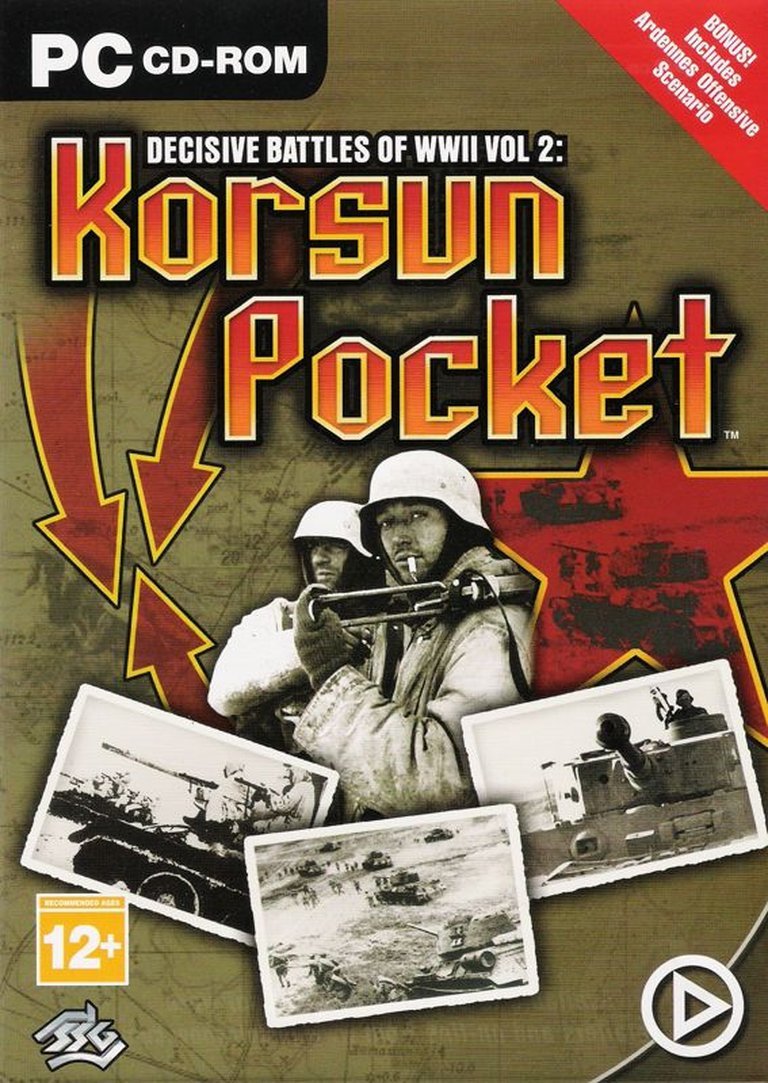
Decisive Battles of WWII Vol 2: Korsun Pocket is a turn-based operational wargame set during the January 1944 Korsun Pocket battle of World War II, where players command either German or Soviet forces on a hex-based map. Each turn represents 12 hours of real time, with the objective of accumulating Victory Points by destroying enemy units and capturing strategic objectives, while also offering Play-by-Email multiplayer and including an updated version of the predecessor game, The Ardennes Offensive.
Decisive Battles of WWII Vol 2: Korsun Pocket Cracks & Fixes
Decisive Battles of WWII Vol 2: Korsun Pocket Patches & Updates
Decisive Battles of WWII Vol 2: Korsun Pocket Reviews & Reception
oldpcgaming.net : This is traditional wargaming at its best.
gamefaqs.gamespot.com : The whole thing fits together elegantly, quickly becoming intuitive and fluid, which isn’t something you can say about many computer wargames… This is traditional wargaming at its best.
metacritic.com : Somehow, Korsun Pocket manages to capture everything that’s compelling about historical wargaming and presents it as a tremendous game.
Decisive Battles of WWII Vol 2: Korsun Pocket: Review
1. Introduction
In the annals of video game history, few genres command the reverence and intellectual rigor of computer wargames. Amidst the pixelated expanses of 2003, a masterpiece emerged that would redefine operational-level World War II simulations: Decisive Battles of WWII Vol 2: Korsun Pocket. Developed by Australia’s Strategic Studies Group (SSG) and published by Matrix Games, this title eschewed the era’s obsession with 3D spectacle for a hex-based, turn-based experience of profound strategic depth. It placed players not in the shoes of a soldier, but as a field marshal, commanding the Soviet or German forces during the desperate Battle of Korsun Pocket in January 1944. This game is not merely a relic of a bygone era; it is a towering achievement that seamlessly blended historical authenticity with accessible yet intricate gameplay. Its legacy as a benchmark for wargame design is undeniable—a thesis this review will substantiate by dissecting its development, narrative, mechanics, artistry, and enduring impact.
2. Development History & Context
Decisive Battles of WWII Vol 2: Korsun Pocket emerged from the crucible of SSG’s decades-long expertise in wargaming. Announced in October 2001 via a partnership with Matrix Games, the game was meticulously crafted by SSG’s core team—designers Roger Keating, Ian Trout, and Steve Ford—whose vision was to create the definitive operational-level WWII simulation. This vision was constrained by the technological landscape of the early 2000s, where polygonal 3D engines dominated the industry. SSG deliberately bucked this trend, opting for a 2D hex-based system. This choice wasn’t a limitation but a design philosophy: to prioritize clarity, unit density, and simulation fidelity over graphical spectacle. The result was a game that ran on modest hardware (Pentium II 450 MHz, 128MB RAM), making it accessible to a broader audience than contemporary resource-hungry titles.
The gaming landscape in 2003 was characterized by the rise of real-time strategy (RTS) games like Warcraft III and Age of Mythology. Turn-based wargames, meanwhile, were a niche market, often perceived as intimidating relics of the 1980s board-game era. SSG’s challenge was to reverse this perception by crafting a game that retained the genre’s complexity but presented it with unprecedented accessibility. They succeeded by refining the “Decisive Battles” engine first used in 1997’s The Ardennes Offensive, which was included as a bonus. The development culminated in an August 2003 release, with an expansion, Across the Dnepr, released in December 2003. This iterative approach underscored SSG’s commitment to post-launch support, a rarity at the time.
3. Narrative & Thematic Deep Dive
The game’s narrative is rooted in the brutal historical reality of the Korsun Pocket. In January 1944, the German Army Group South, under Field Marshal Erich von Manstein, clung to a salient on the Dnepr River in Ukraine. Soviet marshals Georgy Zhukov and Ivan Konev encircled 56,000 German troops in a pocket centered on the town of Korsun. The game masterfully translates this scenario into a playable drama of attrition, desperation, and strategic brilliance. There are no cinematic cutscenes or character arcs; instead, the narrative emerges organically from the player’s decisions. Playing as the Soviets, the objective is to annihilate the pocket before German relief arrives. As the Germans, the goal is to break the encirclement or hold the pocket until reinforcements arrive.
Thematic depth permeates every aspect. The game embodies the Eastern Front’s industrialized slaughter, where logistics and timing outweigh individual heroism. Victory Points (VPs) are earned through historical objectives—capturing airfields, destroying enemy units, or maintaining supply lines—echoing the real battle’s contested outcomes. The absence of “faction flavor” text or dialogue is deliberate; it forces players to engage with the mechanics of war, not its romanticized tropes. Even the AI’s behavior reinforces the theme: it executes historical-inspired maneuvers like flanking attacks or costly assaults, reflecting the Red Army’s doctrinal evolution or the Wehrmacht’s tactical flexibility. This abstraction of history into systemic interaction creates a narrative unique to each campaign, where victory or defeat is etched by the player’s choices.
4. Gameplay Mechanics & Systems
Korsun Pocket’s genius lies in its seamless integration of movement and combat into a single, fluid turn-based system. Each turn represents 12 hours, with alternating Soviet and German phases—a structure that demands careful planning and adaptability. The core loop revolves around unit movement, combat, and supply, all governed by a layered yet accessible ruleset.
-
Hexagonal Grid & Movement: The battlefield is divided into hexagons, providing clear sightlines and range calculations. Units (infantry, armor, artillery) have varying movement points, affected by terrain (forests slow movement, roads accelerate it). A unique “Integrated Move/Fight” system allows units to move and engage in combat within a single turn, eliminating the rigid “I Go, You Go” (IGOUGO) tedium common in older wargames.
-
Combat System: Combat is resolved through dice rolls (simulated on-screen), but the odds are influenced by a staggering number of factors: unit experience, leadership, armor values, entrenchment, flanking, air support, and artillery pre-registration. The “Combat Results Table” (CRT) provides granular feedback, showing why a unit routed or held its ground. This transparency demystifies outcomes, turning potential frustration into strategic learning.
-
Supply & Logistics: The game’s most innovative feature. Units require supply to fight effectively; disconnected from supply lines, they suffer attrition. Players must manage railheads, truck columns, and even “Air Supply” drops for the encircled Germans. This mechanic transforms logistics from a background detail to a central pillar of strategy.
-
AI & Multiplayer: SSG’s AI was hailed as revolutionary. It counters aggressively, exploits weaknesses, and executes complex maneuvers, offering a formidable single-player challenge. Multiplayer is enabled via Play-by-Email (PBeM), allowing asynchronous warfare. The inclusion of a scenario editor and campaign designer extended the game’s lifespan exponentially.
-
UI & Accessibility: Despite its depth, the game avoids overwhelming newcomers. A comprehensive tutorial, tooltips for every mechanic, and a clean UI make it approachable. The manual, a 200-page PDF, is a masterclass in documentation, turning dense rules into digestible concepts.
5. World-Building, Art & Sound
Decisive Battles eschews photorealism in favor of functional, evocative artistry. The hex-based map is rendered in a top-down perspective, using hand-drawn terrain tiles that convey elevation, forest density, and river crossings with clarity. Unit counters are crisp icons representing historical divisions (e.g., SS Panzer, Soviet Guards Rifle), with color-coded nationalities. This minimalist aesthetic focuses attention on strategy, not spectacle.
Sound design is equally utilitarian yet effective. Unit acknowledgments (“Panzer Division ready!”) and subtle audio cues (artillery impacts, engine rumbles) ground the experience without melodrama. The absence of a bombastic score is deliberate; instead, tension arises from the game’s silence punctuated by combat feedback. This restraint enhances the sense of isolation and gravity inherent in commanding a battlefield.
The world-building is achieved through historical meticulousness. The map accurately depicts the Korsun Pocket’s geography—the Dnepr River, snow-covered fields, and critical crossroads. The scenario authentically reflects the balance of forces: Soviet numerical superiority versus German elite Panzer divisions. Even the weather system, though abstracted, influences combat, mirroring the brutal winter of 1944. Together, these elements create an atmosphere of palpable dread and urgency, where every decision feels weighty.
6. Reception & Legacy
Upon release, Korsun Pocket was met with universal acclaim, cementing its status as a genre benchmark. Critics lauded its blend of depth and accessibility. PC Gamer US awarded it 93%, declaring it “the Mount Everest, Beethoven’s Ninth, and Moby Dick of PC wargames,” while Computer Gaming World gave it a rare 100%, calling it “a textbook example of outstanding game design” and its “Wargame of the Year.” GameSpot (86%) praised it as “easily the best 2D wargame for the PC to date,” and GameSpy (100%) crowned it “PC Wargame of the Year.” Player reviews echoed this, with a 4.5/5 average on MobyGames, citing hundreds of hours of replayability.
Commercially, it resonated within the hardcore wargaming community, driven by word-of-mouth and Matrix Games’ dedicated marketing. Its legacy endures in several ways:
– Influence on Genre: It revitalized hex-based wargames, proving that 2D systems could compete with 3D titles. Its integration of logistics and combat became a template for later games like Gary Grigsby’s War in the East.
– Historical Preservation: SSG’s commitment to accuracy set a standard, encouraging developers to prioritize historical fidelity over gameplay abstraction.
– Enduring Community: The game’s moddability and PBeM fostered a vibrant, multi-decade community. Expansion packs like Across the Dnepr and sequels (Battles in Normandy) built upon its foundation.
– Cultural Impact: It remains a touchstone for wargame historians, often cited as the pinnacle of “traditional” wargaming design—a niche it continues to dominate.
7. Conclusion
Decisive Battles of WWII Vol 2: Korsun Pocket is more than a game; it is a monument to strategic simulation. In an industry often chasing graphical fidelity, SSG demonstrated that timeless gameplay and historical depth could create an experience that transcends eras. Its hex-based systems, while retro, remain a paragon of clarity and depth, marrying the rigor of board wargames with the accessibility of digital interfaces. The Battle of Korsun is not just a setting but a crucible for strategic thought, where every VP earned feels hard-won, and every lost unit echoes the tragedy of war.
Critically acclaimed and revered by its community, Korsun Pocket secured its place as the “best hex-based wargame ever made” (Computer Gaming World). Its influence permeates the genre, while its legacy as a work of art endures in the hearts of strategists and historians alike. For players willing to invest their intellect, it offers not just entertainment, but a profound connection to the past—a digital Stalingrad etched in logic and consequence. In the pantheon of wargaming, Korsun Pocket stands not as a relic, but as an eternal sentinel, its hexagons gleaming with the cold fire of strategic perfection.