
- Release Year: 2002
- Platforms: Windows
- Publisher: 1C Company, Axel Springer Polska Sp. z o.o., Enigma Software Productions, S.L.
- Developer: Enigma Software Productions, S.L.
- Genre: Sports
- Perspective: 3rd-person (Other)
- Game Mode: Hotseat, Single-player
- Gameplay: Dynamic environments, Football, Passing mechanics, Tackling mechanics, Team strategies
- Setting: International, Tournament
- Average Score: 57/100
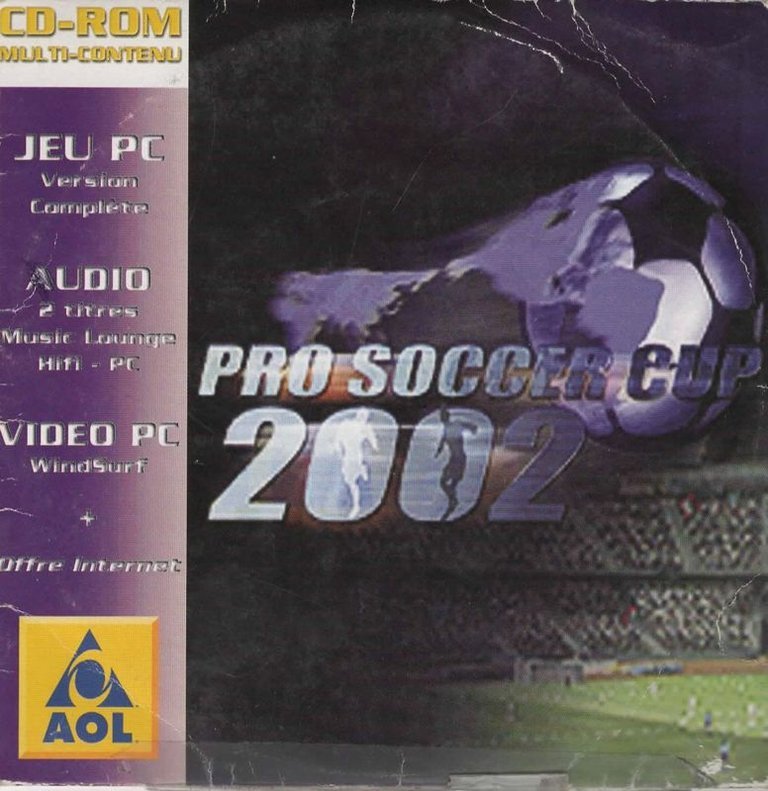
Description
Pro Soccer Cup 2002 is a Windows soccer game released in 2002 to coincide with the World Cup, featuring all tournament phases and 32 national teams with fictional player names. It offers friendly matches and a full World Cup experience across 4 stadiums, with fast-paced gameplay lacking injuries, quick shooting, and easy tackling. Players can pass short, long, or ahead of teammates, make tackles or fouls when not in possession, adjust formations, and substitute players—all rendered in full 3D with dynamic weather and time-of-day changes. Matches support eight camera angles, no commentary, and local two-player multiplayer.
Pro Soccer Cup 2002 Free Download
Pro Soccer Cup 2002 Cracks & Fixes
Pro Soccer Cup 2002 Reviews & Reception
gamepressure.com (66/100): Era Football 2002 is an arcade football simulation created especially for the needs of Polish players on the occasion of the World Cup in Japan and Korea.
myabandonware.com (50/100): POLSKA GUROM! 😀
mobygames.com (44/100): Pro Soccer Cup 2002 is a football game, released just before the 2002 World Cup in Korea and Japan.
sockscap64.com (69/100): Era Football 2002 is an arcade football simulation created especially for the needs of Polish players on the occasion of the World Cup in Japan and Korea.
Pro Soccer Cup 2002: Review
Introduction
In the pantheon of football video games, the early 2000s were dominated by EA Sports’ FIFA series and Konami’s Winning Eleven. Yet, amidst these giants emerged a regional underdog: Pro Soccer Cup 2002. Released just ahead of the 2002 FIFA World Cup in Korea and Japan, this title promised an accessible, arcade-infused take on the beautiful game. Developed by Spanish studio Enigma Software Productions and published across Europe and Russia, it aimed to capitalize on World Cup fever with its full 3D graphics and 32-team tournament mode. However, while its ambition was noble, Pro Soccer Cup 2002 ultimately stands as a fascinating relic—an artifact of a pre-digital-rights era, where licensing costs and technological constraints forced developers into creative compromises. This review dissects the game’s place in history, dissecting its mechanics, cultural context, and enduring legacy as a “so-bad-it’s-charming” footnote in sports gaming.
Development History & Context
Pro Soccer Cup 2002 was crafted by Enigma Software Productions, a Spanish developer with a modest portfolio (including the puzzle game ExcaliBug). The project’s core vision, as evidenced by its credits, was a lean, team-driven effort: Oscar Vaquero Puerta served as both Art Director and lead designer, while Alberto Domínguez Aguilar handled programming and project management. The team’s ambitions were tempered by the technological constraints of 2002. With a minimum spec of a Pentium II 300MHz and 64MB RAM, the game prioritized performance over fidelity, resulting in blocky player models and rudimentary physics.
The gaming landscape of 2002 was fiercely competitive. FIFA 2002 and Winning Eleven 6 set the standard with licensed rosters, realistic ball physics, and deep tactical systems. Pro Soccer Cup 2002 entered this arena as an outsider, but it possessed a unique strategic advantage: timing. Released ahead of the World Cup, it capitalized on regional fervor, particularly in Poland. There, it was bundled with the “Dobra GRA” series and licensed by the Polish Football Association, ensuring the Polish national team appeared with its authentic lineup—a rare honor for a non-EA/Konami title. International distribution via publishers like Axel Springer Polska (Poland), 1C Company (Russia), and CD Expert in Brazil further cemented its niche as a budget-friendly alternative. Yet, its lack of official player licenses—replaced by generic names and attributes—exposed the limits of its budget, forcing it to compete with gameplay alone.
Narrative & Thematic Deep Dive
As a sports simulation, Pro Soccer Cup 2002 eschews traditional narrative in favor of tournament-driven storytelling. The game’s “plot” is the player’s journey through the World Cup, from group stages to the final. While devoid of scripted cutscenes or character arcs, it subtly explores themes of national pride and underdog triumph. The inclusion of Poland—with its authentic lineup—resonated deeply with Polish gamers, who could relive their team’s qualification run (its first since 1986). This regional focus created a micro-narrative of local identity, contrasting with the globalized spectacle of the actual World Cup.
Characters are limited to player avatars, each bearing a generic name (e.g., “G. Smith” for England’s Michael Owen). This anonymity extends to dialogue, which is absent entirely—commentary is nonexistent, and crowd reactions are reduced to generic cheers. The result is a sterile, almost surreal atmosphere, where matches feel like abstract exercises in strategy rather than emotional contests. Thematically, the game reflects the era’s preoccupation with accessibility: its fast-paced gameplay and simplified mechanics prioritize arcade fun over simulation, positioning football as a communal experience rather than a professional sport.
Gameplay Mechanics & Systems
Pro Soccer Cup 2002’s gameplay is defined by its speed and simplicity. Matches unfold at a frantic pace, with ball physics favoring quick passes over buildup play. Three pass types—short, long, and through-ball—form the core offensive toolkit, each executed with minimal input. Defending relies on rudimentary tackling, described as “easy” in source material, allowing players to dispossess opponents with single-button presses. This accessibility comes at a cost: the game lacks injury simulations, stamina management, or fouls beyond basic tackles, reducing depth to a series of rapid-fire exchanges.
Key systems include:
– Tournament Structure: A full World Cup mode with group stages and knockout rounds, mirroring the real 2002 format.
– Team Customization: Formation adjustments and player substitutions, though without individual attribute edits.
– Multiplayer: Local co-op for two players on one PC, a rare feature for budget titles of the era.
– Camera Options: Eight dynamic camera angles, praised in forums for their uniqueness (e.g., low-angle shots mimicking broadcast views).
The UI is utilitarian, with a top-down menu for tactics and substitutions. However, the game is marred by bugs: adjusting settings often forces defaults to “low” due to a known glitch, and a NoCD patch is required for modern compatibility. SoccerGaming forums criticized the “terrible” gameplay speed and “poor” player models, noting that goalkeepers “look like flaming homosexuals” during free-kicks—a jab at their exaggerated animations. Yet, these flaws became part of its charm, offering unintended humor amid the action.
World-Building, Art & Sound
The game’s world is built on a foundation of four generic stadiums, each rendered with varying weather (rain, sun) and times of day (dawn, dusk, night). While stadiums lack distinct architectural flair, the dynamic lighting and weather effects create a sense of atmosphere. Rain-soaked pitches make ball control slippery, while night matches are bathed in artificial floodlighting—details that enhanced immersion despite limited environmental detail.
Visually, the art direction is a product of its constraints. Player models are polygonal and stiff, with kits featuring only generic designs (each team has one home kit). Notably, player names appear on jerseys—a seven-year head start over EA’s FIFA series, per SoccerGaming. The crowd is a flat-textured mass, and stadium stands are sparse, emphasizing the game’s budget focus. Sound design is equally minimalist: Gustavo Polo Antequera’s soundtrack is an upbeat, looping melody that fails to escalate with match intensity. Crowd sounds are basic, and the absence of commentary leaves players to rely on the thud of the ball and whistle blows—a design choice that backfired for many, yet fostered a sense of “pure” football gameplay.
Reception & Legacy
Upon release, Pro Soccer Cup 2002 received minimal critical attention, with MobyGames listing no professional reviews. Player reactions were mixed but largely dismissive. SoccerGaming forums dismissed it as a “good attempt” but “decent at best,” with one user quipping it looked like “3 guys made this game.” MyAbandonware’s single user vote awarded it 2.2/5, though one Polish commenter nostalgically hailed it with “POLSKA GUROM! :D”—a testament to its cultural resonance in its core markets. Commercially, it succeeded as a budget title, distributed via magazine cover discs (e.g., CD Expert in Brazil) and budget lines in Eastern Europe.
Its legacy is twofold. As a historical artifact, it documents a transitional era in sports gaming—before licenses dominated development and indie studios could leverage digital distribution. Its Polish licensing deal also foreshadowed the region’s later emergence as a gaming hub (e.g., CD Projekt Red). Culturally, it became a guilty pleasure for retro gamers, preserved on sites like MyAbandonware and the Internet Archive. While it influenced no major titles, its flaws—particularly its physics and animations—serve as a cautionary tale about the pitfalls of prioritizing speed over simulation. Today, it’s a curiosity, remembered for its ambition and its place in the pre-social media, pre-streaming zeitgeist.
Conclusion
Pro Soccer Cup 2002 is a microcosm of early 2000s sports gaming: ambitious yet hamstrung by budget, timed for cultural moments yet overshadowed by giants. Its gameplay, fast and flawed, offers a glimpse into an alternate football universe—one where licenses were optional and mechanics could thrive on simplicity. While its art and sound are dated, and its systems are shallow, its regional charm and nostalgic value cannot be dismissed. For historians, it’s a study in compromise; for players, it’s an imperfect but earnest ode to the World Cup. In the grand history of video games, Pro Soccer Cup 2002 won’t be remembered as a classic, but as a footnote—a reminder that even in the shadow of titans, there’s room for the underdog’s roar. Final Verdict: A flawed, fascinating relic of a bygone era.