
- Release Year: 2005
- Platforms: Windows
- Publisher: Xing Interactive, Inc.
- Developer: IQ Publishing s.c.
- Genre: Grand strategy, Strategy, Tactics
- Perspective: Top-down
- Game Mode: Single-player
- Gameplay: Army training, City building, Real-time strategy, Territory control
- Setting: Fantasy
- Average Score: 73/100
Description
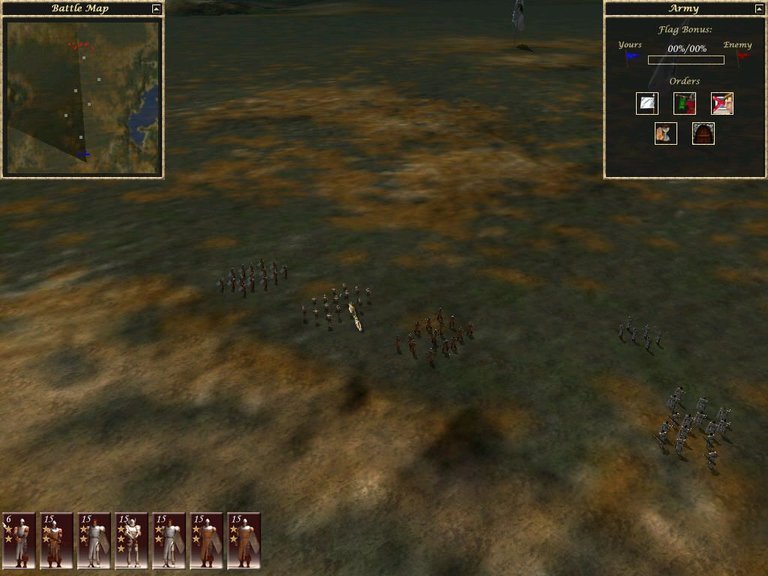
Cloven Crania Meadow is a real-time strategy game set in a standard fantasy world where players control a human kingdom surrounded by hostile nations, monsters, and evil creatures. The core gameplay involves developing the capital by constructing key buildings and managing resources, training military units to defend against invaders, and engaging in battles focused on controlling strategic battlefield areas rather than solely destroying enemy forces, ultimately aiming to defeat aggressive neighbors and monsters to ensure prosperity.
Cloven Crania Meadow Free Download
Cloven Crania Meadow Cracks & Fixes
Cloven Crania Meadow Patches & Updates
Cloven Crania Meadow Reviews & Reception
mobygames.com (60/100): Average score: 3.0 out of 5
worthplaying.com : Cloven Crania Meadow is a fantasy RTS where you are put in control of a human Kingdom.
gamepressure.com (60/100): The player’s task is to develop his city and provide the subjects with food, military facilities play an important role.
myabandonware.com (100/100): 5 / 5 – 2 votes
Cloven Crania Meadow: A Forgotten Meadow of Strategic Ambition
Introduction
In the sprawling, often derivative landscape of mid-2000s real-time strategy (RTS) games, Cloven Crania Meadow emerges as a peculiar, almost spectral artifact. Released in 2005 by Polish developer IQ Publishing s.c. (under the Unicejo Entertainment banner) and published by Xing Interactive, this title arrived amidst the towering shadows of genre titans like Warcraft III and Age of Empires III. Its evocative, gothic title promises a dark fantasy epic, yet the reality is a humble, mechanically ambitious RTS that prioritizes tactical nuance over spectacle. Cloven Crania Meadow is not a masterpiece; it is a fascinating failure—a testament to the experimental spirit of small developers constrained by budget, time, and market saturation. This review dissects its legacy by examining its development context, the ingenious yet flawed mechanics at its core, its neglected world-building, and its enduring, albeit niche, place in gaming history. Ultimately, it is a game of unfulfilled potential, remembered not for its execution, but for the boldness of its central idea: that victory on the battlefield is won not by annihilation, but by the quiet, methodical control of territory.
Development History & Context
Cloven Crania Meadow was forged in the crucible of Eastern European development studios during a pivotal moment for RTS games. Developed by IQ Publishing s.c. (a Polish studio) and published by the relatively obscure Xing Interactive, the project clearly operated with limited resources. Its release date of July 2005 placed it directly in the crosshairs of genre giants, who dominated shelves and marketing with AAA budgets and polished 3D engines. The game’s technology reflected its budget-conscious origins: it adhered to modest system requirements (a Pentium III 500 MHz CPU, 256MB RAM, and a 64MB graphics card), favoring functional 2D sprite-based visuals over the 3D vistas of contemporaries. This technological constraint was both a limitation and a defining characteristic; it forced the team to innovate mechanically where it couldn’t compete visually.
The creators’ vision, as gleaned from sparse documentation, was to offer a more “tactical” RTS experience. They aimed to shift the genre’s focus from resource micromanagement and base-rushing to pure battlefield command. The result was the game’s signature mechanic: controlling “key areas” to influence unit morale. This was an ambitious attempt to inject a layer of psychological warfare into RTS combat, drawing inspiration from historical military theory where terrain control and morale were decisive factors. However, the execution was inevitably hampered by development constraints. The rapid release of a v1.05 patch just days after launch (July 28, 2005) hints at a rushed development cycle, likely prioritizing feature implementation over polish. The gaming landscape of 2005 was unforgiving; Cloven Crania Meadow entered a market saturated with high-profile competitors, ensuring its obscurity from the outset. Its Russian title, Поле брани (Field of Battle), underscores its regional release strategy, further limiting its global reach and critical visibility.
Narrative & Thematic Deep Dive
The narrative of Cloven Crania Meadow is a masterclass in minimalist fantasy tropes, offering little beyond the bare scaffolding for its strategic gameplay. The player assumes control of a generic human kingdom, a bastion of civilization besieged on all fronts. Hostile nations—presumably orcs, goblins, and other dark fantasy staples—and rampaging monsters form a perpetual threat, creating a siege mentality that drives the core gameplay loop. There is no named protagonist, no memorable antagonist, and no intricate political backstory. The conflict is primal: survival through expansion and conquest.
This stark simplicity serves the gameplay but leaves the narrative feeling hollow. Dialogue is nonexistent beyond perfunctory unit acknowledgments, and character depth is nonexistent. The “characters” are faceless legions, their identities reduced to faction affiliation and unit type. The thematic weight, therefore, rests entirely on the abstract mechanics. The game’s central theme is the fragility of order and the necessity of dominance. The player’s kingdom must constantly balance internal prosperity (ensuring food, building infrastructure) with external aggression. This duality reflects the precariousness of civilization itself—a theme amplified by the game’s title. “Cloven Crania” suggests shattered heads, a brutal metaphor for the cost of failure. The meadow, a symbol of pastoral peace, becomes a field of relentless, tactical carnage.
The most profound thematic element, however, is the morale system. By tying unit effectiveness directly to territorial control, the game posits that battlefield dominance is psychological as much as physical. Holding ground provides tangible advantages, echoing real-world military doctrines where high ground or key locations demoralize opponents. This transforms the battlefield from a simple kill-zone into a dynamic chessboard of influence. It’s a sophisticated idea, suggesting that true power lies not in destruction, but in the psychological and spatial control of the enemy. Unfortunately, the generic setting and lack of narrative framing prevent this theme from resonating beyond the mechanical level. The world feels like a placeholder—a “standard fantasy world” as described by the developers—rather than a lived-in, consequential realm.
Gameplay Mechanics & Systems
Cloven Crania Meadow’s gameplay is defined by its ambitious core loop and its significant flaws. The player’s primary objectives are twofold: develop the capital city and conquer hostile neighbors. City management is a classic RTS exercise: constructing essential buildings (barracks, farms, resource gatherers) to generate the necessary resources (primarily food and gold) to fuel military production. The emphasis on feeding the populace adds a subtle layer of economic pressure, ensuring that expansion cannot be mindless. The system is functional if unsophisticated, lacking the depth of economic simulators but serving its purpose as a foundation for warfare.
The combat system, however, is the game’s unique selling point. Instead of the traditional focus on wiping out enemy armies, victory hinges on controlling designated “key areas” on the battlefield. This is executed through a top-down perspective that clearly delineates territory. Units positioned to hold ground gain a morale boost, directly increasing their combat effectiveness. A large, well-trained force controlling significant territory becomes a juggernaut, while a scattered or outflanked army crumbles. This mechanic encourages strategic positioning, flanking maneuvers, and the defense of crucial points, adding a layer of tactical depth absent from many contemporary RTS titles. It rewards patience and map awareness over brute-force tactics.
Despite this innovation, the gameplay suffers from significant issues. The AI is reportedly rudimentary, offering little challenge beyond initial skirmishes. Unit pathfinding and controls feel clunky by modern standards, often leading to frustrating micro-management headaches. The progression system is shallow; there’s no complex research tree or hero development, limiting long-term strategic variety. The absence of a meaningful campaign (the sources imply only a loose series of scenarios) and no multiplayer severely diminishes replay value. The UI, while serviceable, lacks the polish of larger titles, making resource management and unit selection a chore. Ultimately, the game is a fascinating concept hampered by execution: the “key area” system is brilliant underdeveloped, and the surrounding mechanics feel like a budget compromise.
World-Building, Art & Sound
The world of Cloven Crania Meadow is its most strikingly underdeveloped aspect. Described consistently as a “standard fantasy world,” it presents a generic amalgamation of familiar tropes: human kingdoms, monster hordes, and hostile neighbors. There are no named regions, unique cultures, or compelling factions detailed in the available sources. The setting feels like a blank canvas, existing purely to facilitate the territorial conflicts. This lack of distinct identity is a significant missed opportunity; the evocative title suggests a rich, dark lore (cloven crania imply sacrifice, ancient battles, or dark rituals), but the game delivers none of that narrative texture.
Visually, the game adheres strictly to its budget constraints. The top-down perspective showcases a flat, isometric landscape populated by simple, sprite-based units and buildings. While functional for tactical clarity, the art direction lacks detail and personality. Units are recognizable archetypes (foot soldiers, archers, cavalry) but lack the charm or menace of characters from Warcraft or Warhammer. The environments are static, with no dynamic weather or lighting to enhance atmosphere. The overall aesthetic is one of utility over artistry—a clear visual indicator of its development priorities.
Sound design is equally sparse and undocumented. The sources provide no information on a musical score or sound effects, but we can infer a basic soundscape typical of mid-budget RTS games: the clash of steel, the thud of projectile impacts, and perhaps a simple, repetitive background track. Without a compelling score to underscore the tension of territorial conquest or the dread of monster incursions, the atmosphere remains muted. The game fails to leverage audio to compensate for its visual limitations or to immerse the player in its world. Consequently, Cloven Crania Meadow feels more like a technical demo showcasing its core mechanic than a fully realized fantasy realm.
Reception & Legacy
At launch, Cloven Crania Meadow received a collective shrug from the gaming world. Its reception was defined by obscurity rather than criticism. Metacritic records no critic reviews, and user scores from platforms like MobyGames (an average of 3.0 out of 5 based on a single rating) and GamePressure (6.0 out of 10) suggest indifference or mild disappointment. The game sold poorly, a victim of its minimal marketing budget and the overwhelming presence of genre giants in 2005. It was quickly relegated to bargain bins and, eventually, abandonware. Its legacy, however, has evolved in the years since, becoming a niche subject of curiosity among strategy game enthusiasts and historians.
The game’s reputation has shifted from “commercial failure” to “cult classic” within specific circles. Its availability on abandonware sites like MyAbandonware (where it maintains a 5/5 user rating based on just 2 votes) and the Internet Archive has preserved it, allowing a new generation of players to experience its unique mechanics. Discussion forums and retro-gaming communities occasionally rediscover it, often praising the ambition of the “key area” control system while acknowledging its rough execution. Its primary influence, however, is negligible. It did not spawn sequels or inspire major design shifts in subsequent RTS titles. Its innovation remained isolated, a footnote in the genre’s evolution rather than a blueprint for the future.
Interestingly, its legacy is tied to its very obscurity. Cloven Crania Meadow represents the untold stories of mid-2000s development studios—small teams with big ideas but limited resources. It stands as a historical artifact, illustrating the risks and rewards of trying to innovate in a competitive market. For those willing to look past its dated graphics and simplistic presentation, it offers a glimpse into an alternative path for RTS design, one that prioritizes tactical control over spectacle. Its enduring presence in abandonware archives ensures it won’t be entirely forgotten, a ghost in the machine of gaming history.
Conclusion
Cloven Crania Meadow is a deeply flawed, yet undeniably fascinating relic of a bygone era. As a piece of entertainment, it falls short; its generic fantasy setting, simplistic narrative, and dated presentation prevent it from achieving true greatness. The clunky controls, rudimentary AI, and lack of replay value make it a challenging experience for modern players. Yet, as a historical artifact, it possesses a unique and compelling significance. The game’s core innovation—the “key area” control system tied to unit morale—was a bold and prescient attempt to inject tactical depth into the RTS formula. It demonstrated that compelling strategy could emerge from mechanics beyond resource gathering and base-building, a concept that would resonate more strongly in later, more polished titles.
Its legacy is one of unfulfilled potential. Constrained by its modest development resources and the brutal market of 2005, IQ Publishing s.c. could not realize the full vision suggested by their intriguing mechanic. Cloven Crania Meadow remains a testament to the ambition of small developers, a game that dared to be different even when it couldn’t be spectacular. For the historian, it offers a valuable case study in mid-budget game development and the experimental spirit of the mid-2000s RTS landscape. For the strategist, it provides a unique, if flawed, tactical puzzle centered on the subtle art of controlling ground.
Ultimately, Cloven Crania Meadow earns its place not as a classic, but as a curiosity—a forgotten meadow where a single, brilliant idea bloomed amidst the thorns of limitation. Its story is a reminder that innovation can spring from unexpected places, and that even the most humble games can hold a mirror to the creative ambitions of their time. It is not a game to be played for enjoyment, but to be studied for its ambition—a genuine, if flawed, piece of gaming history.