
- Release Year: 2004
- Platforms: Windows
- Publisher: RTL Playtainment
- Developer: Aruba Studios GmbH
- Genre: Action
- Perspective: Third-person
- Game Mode: Single-player
- Gameplay: Game show, Mini-games, quiz, trivia
- Setting: Jungle, Reality TV
- Average Score: 47/100
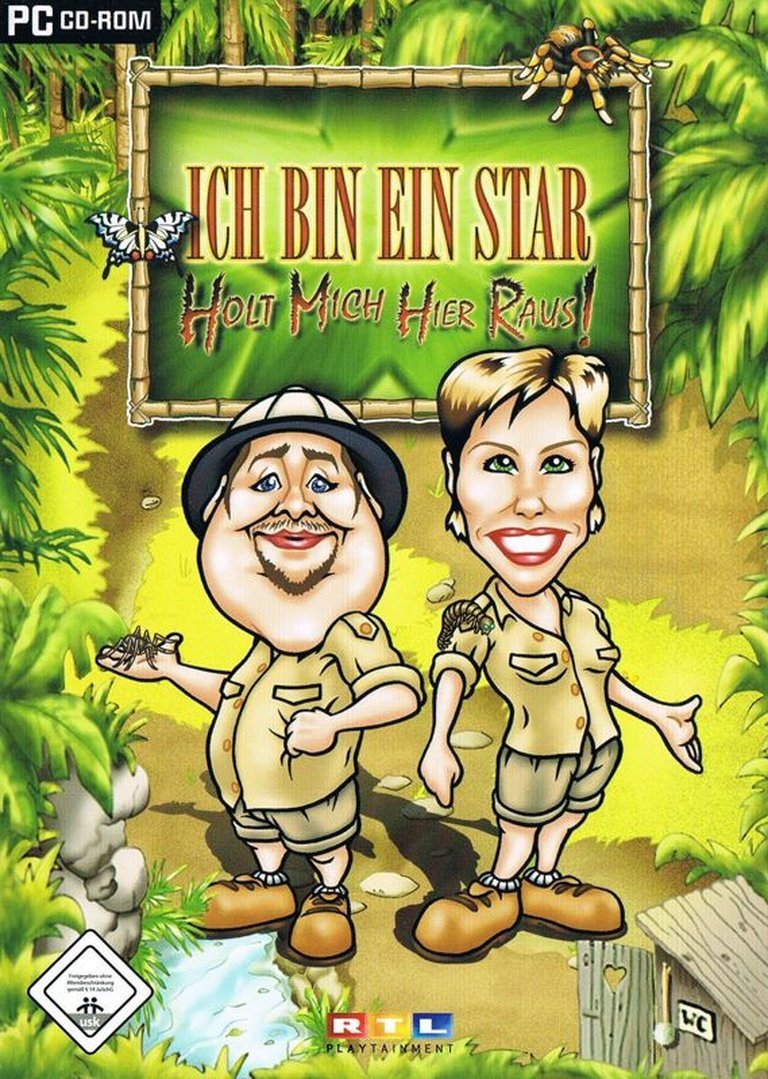
Description
Ich bin ein Star: Holt Mich Hier Raus! is a Windows game released in October 2004 that lets players step into the role of a producer for the German reality TV show ‘Dschungelcamp’ (Jungle Camp). Based on the original ‘I’m a Celebrity…Get Me Out of Here!’ franchise, the game tasks players with selecting cast members from the first season or other candidates, managing daily tasks, food distribution, and camp mood, while setting up jungle challenges and treasure hunts to drive the show’s success.
Ich bin ein Star: Holt Mich Hier Raus! Reviews & Reception
imdb.com (47/100): The best Reality show ever
Ich bin ein Star: Holt Mich Hier Raus!: Review
1. Introduction
In the pantheon of licensed video games, Ich bin ein Star: Holt Mich Hier Raus! stands as a curiously artifacted relic—a digital extension of Germany’s most infamous reality TV franchise. Released in October 2004 by RTL Playtainment for Windows, this game transplants the chaotic, celebrity-humiliating spectacle of Dschungelcamp (Jungle Camp) into the player’s hands. As the show’s self-proclaimed “producer,” players manipulate the lives of washed-up stars, ration their food, and orchestrate cringe-inducing trials. Yet despite its bizarre premise, the game remains a fascinating cultural fossil: a snapshot of early 2000s German pop culture, the zenith of reality TV’s golden age, and the nascent ambition of developers to capitalize on television’s most controversial formats. This review dissects Ich bin ein Star not merely as a game, but as a historical document—one that captures the zeitgeist of its era while revealing the pitfalls of translating live television into interactive media.
2. Development History & Context
Ich bin ein Star emerged from a perfect storm of cultural and technological circumstances. Its development, led by Aruba Studios GmbH with publishing support from RTL Playtainment, coincided with the TV show’s explosive debut on RTL in January 2004. The show, an adaptation of the British I’m a Celebrity… Get Me Out of Here!, was Germany’s first foray into the “celebrity jungle” genre, immediately igniting public fascination with its mix of backstabbing, eating challenges (involving beetles and testicles), and psychological deprivation. The game’s creators, including producer Arnold Scheele and art director Anke Gehlen, aimed to leverage this frenzy by positioning players as puppet masters of the camp.
Technologically, the game was constrained by the era’s mid-2000s standards: it utilized a fixed/flip-screen perspective and keyboard/mouse controls, with CD-ROM distribution limiting its scope. The development team—comprising 25 credited individuals, including programmers Christian Kaufmann and Oliver Mistarz, and character designer Joachim Krause (JoJo)—focused on replicating the show’s core mechanics rather than pushing graphical boundaries. This was a commercial endeavor, pure and simple: RTL sought to monetize its IP, while Aruba Studios sought credibility in the burgeoning casual gaming market. The result was a title that felt less like a standalone game and more like an interactive souvenir—a digital “producer’s diary” for fans to reexperience the season’s drama.
3. Narrative & Thematic Deep Dive
The game’s narrative is a meta-commentary on reality TV’s artificiality. Players begin by casting celebrities from the first season of Dschungelcamp, including Costa Cordalis (the winner), Lisa Fitz, and the infamous Daniel Küblböck. These characters, though digitized, retain their public personas: Cordalis as the schlager singer, Fitz as the sharp-tongued actress, and Küblböck as the Deutschland sucht den Superstar finalist turned meme. The game’s “plot” is dictated by the player’s choices: who to starve, who to humiliate, and who to reward. This mirrors the show’s core theme—the erosion of human dignity for entertainment.
Dialogues are sparse, largely restricted to canned reactions during trials (e.g., “I can’t do this!” or “Hosen voll!”—“Pants full!”). The true narrative emerges from systemic interactions: denying food creates tension, while forcing contestants into tasks like the “Schlangengrube” (Snakepit) or “Terroraquarium” amplifies their desperation. The game’s themes are cynical and unflinching, reflecting public debates about reality TV’s ethics. Media scientists and critics had already lambasted the show for “injuring human dignity”; the game doubles down on this by making cruelty the player’s primary tool. It’s a disturbing thesis: reality TV isn’t just observed—it’s engineered.
4. Gameplay Mechanics & Systems
Ich bin ein Star’s gameplay is a loop of micromanagement and sadism. As producer, players must:
– Cast & Manage Celebrities: Select from the original cast or create new candidates. Each has hidden stats influencing morale and trial success.
– Control Resources: Distribute limited food rations. Starving contestants reduces their “mood,” increasing drama but risking meltdowns.
– Design Challenges: Set up Dschungelprüfungen (Bushucker trials), such as the “Kakerlakensarg” (Cockroaches Coffin) or “Höllische Bootsfahrt” (Hellish Boat Trip). Success earns stars for meals; failure punishes the group.
– Monitor Camp Dynamics: Mood meters track relationships. Alliances form or shatter based on food allocation and task assignments.
The systems are rudimentary but functional. The UI is a cluttered grid of menus, while combat is absent—instead, “battles” are psychological, plying contestants against their fears. Character progression is invisible; stats adjust subtly based on player decisions. Flaws abound: repetitive tasks, limited trial variety, and a punishing difficulty curve (one bad decision can doom a contestant’s morale). Yet the game’s innovative element is its meta-layer: players aren’t just playing as the producer—they are the show’s villain.
5. World-Building, Art & Sound
The “world” of Ich bin ein Star is a compressed approximation of the Australian jungle camp. Art direction prioritizes recognizability over realism: pixelated bamboo huts, murky waterholes, and cartoonish fauna evoke the show’s set. Character sprites, designed by Joachim Krause, are caricatures—Costa Cordalis’s perm, Lisa Fitz’s scowl—ensuring instant recognition for fans. The visual style is static and flip-screen, with backgrounds resembling painted backdrops from the show’s studio.
Sound design is minimal but effective. Ambient chirps and rustling leaves create a thin veneer of atmosphere, while trial sound effects—screams, retching—reinforce the grotesquerie. The title theme, lifted from the TV show, is a jaunty, jarring contrast to the gameplay’s cruelty. Together, these elements craft a world that feels both authentic and artificial, mirroring the show’s own curated reality. It’s a place where authenticity is the ultimate gimmick.
6. Reception & Legacy
Ich bin ein Star arrived to tepid reception. The lone critical review, from PC Games (Germany), scored it 56%—a verdict summed up as “Für die Mittagspause noch okay” (“Okay for a lunch break”). Critics dismissed its shallow mechanics and reliance on TV nostalgia. Commercially, it faded quickly, overshadowed by the show’s growing dominance. Its legacy, however, is more nuanced.
Historically, the game is a footnote in the Dschungelcamp saga—a footnote nonetheless cited in discussions of licensed games’ limitations. It prefigures modern reality TV spin-offs like Big Brother or Love Island games, which similarly prioritize player-as-creator roles. Yet Ich bin ein Star’s enduring relevance lies in its unflinching portrayal of media manipulation. In an era of influencer culture and algorithmic cruelty, the game’s core question—“Is this entertainment, or exploitation?”—resonates more than ever. Tragically, its developers, including Aruba Studios, dissolved after producing niche titles like Hinter Gittern Vol. II, leaving this game as their most audacious, if flawed, artifact.
7. Conclusion
Ich bin ein Star: Holt Mich Hier Raus! is not a “good” game by conventional standards. Its mechanics are simplistic, its visuals are dated, and its reliance on ephemeral TV fame dates it irrevocably. Yet as a historical document, it is indispensable. It captures a moment when reality TV was raw, unpolished, and culturally potent—and when gaming dared to dissect that spectacle with interactivity. The game’s true achievement is forcing players to confront their role in the voyeuristic ecosystem: are we producers, or just another audience?
In the grand tapestry of video game history, Ich bin ein Star is a jagged, uncomfortable thread. It’s a relic of a bygone era, a cautionary tale about licensing, and a surprisingly prescient critique of digital media’s dehumanizing potential. For historians, it’s a must-play curiosity. For gamers, it’s a reminder that some legacy IPs deserve to stay buried in the jungle. Verdict: A fascinating, flawed artifact of early 2000s pop culture—more compelling as a cultural study than as entertainment.