
- Release Year: 2002
- Platforms: PlayStation 2, PlayStation, Windows
- Publisher: Davilex Games B.V.
- Developer: Davilex Games B.V.
- Genre: Driving, Racing
- Perspective: 1st-person / Behind view
- Game Mode: Hotseat, Single-player
- Gameplay: Arcade, Street racing, Vehicle simulator
- Setting: Edinburgh, France, Las Vegas, London, Lyon, Marseilles, Paris
- Average Score: 50/100
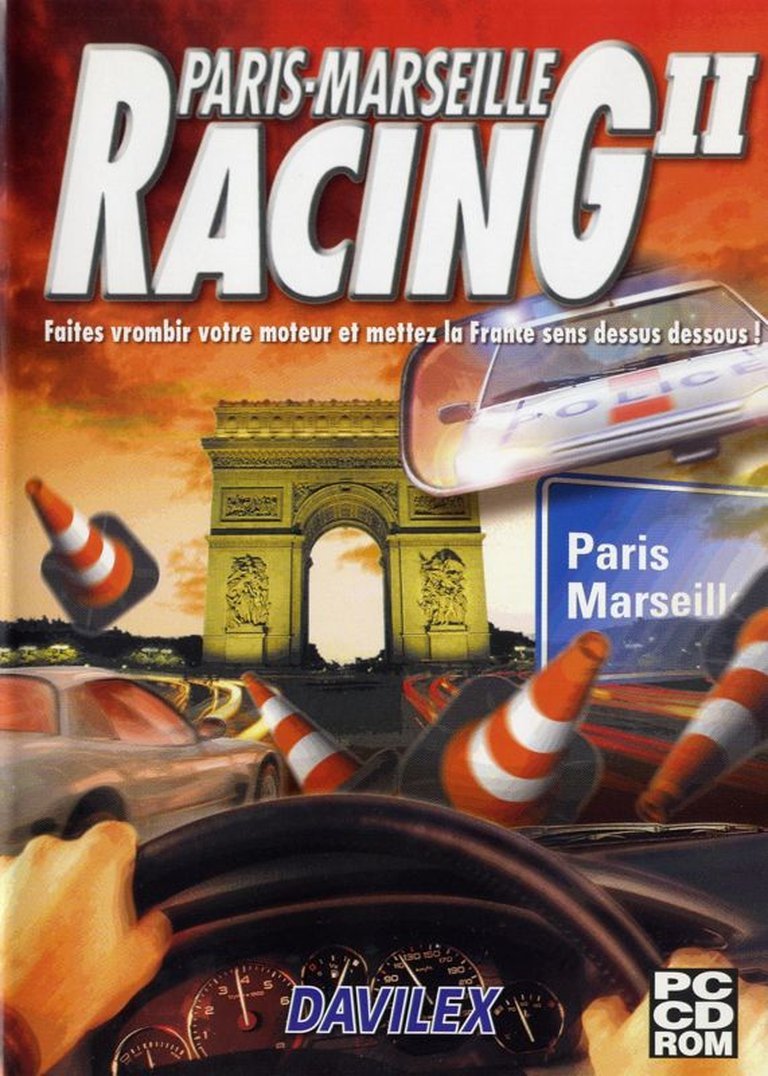
Description
Paris-Marseille Racing II is an arcade-style street racing sequel set primarily on the roads of France, including cities like Paris, Marseille, and Lyon, with bonus races in London, Edinburgh, and Las Vegas. Players choose from six drivers with unique skills, competing in single-player modes such as tournament, time attack, and single race, or new two-player modes like head-to-head Duel and Driver vs. Police, complete with skill levels, car tuning, and enhanced graphics.
Gameplay Videos
Paris-Marseille Racing II Free Download
PlayStation 2
Paris-Marseille Racing II Cheats & Codes
PlayStation PAL (SLES-03918)
GameShark codes
| Code | Effect |
|---|---|
| 800D5C20 869F 800D5C22 0001 |
Have 99999 money |
Paris-Marseille Racing II: Review
Introduction
In the early 2000s, as AAA racing titans like Gran Turismo 3 and Need for Speed: Hot Pursuit 2 redefined high-fidelity speed on PlayStation 2, a peculiar underdog emerged from the budget bin: Paris-Marseille Racing II. This 2002 sequel from Dutch developer Davilex Games B.V. promised illicit thrills tearing through France’s urban sprawl, with bonus jaunts to London, Edinburgh, and Las Vegas. Building on its 2000 predecessor, it epitomized the era’s rash of localized “raser” games—arcade street racers tailored for regional markets. Yet, beneath its flashy premise lies a title marred by technical woes and unpolished execution. This review argues that while Paris-Marseille Racing II captures the chaotic spirit of underground racing in a post-millennial budget landscape, its legacy is one of infamy: a cautionary tale of ambition outpacing capability, preserved today as abandonware curios for retro enthusiasts.
Development History & Context
Davilex Games B.V., a Netherlands-based studio known for pumping out low-cost racers, spearheaded Paris-Marseille Racing II as both developer and publisher. Released on October 25, 2002, for Windows (CD-ROM), PlayStation, and PlayStation 2, it arrived amid a crowded 2002 racing scene dominated by polished simulations like Colin McRae Rally 3 and arcade romps like Burnout. Davilex’s vision was clear: expand their “Racer” series—flanked by siblings like London Racer II (previous entry), Autobahn Raser IV (next), A2 Racer (Dutch), and London Racer (UK)—into a pan-European franchise of street-racing romps. This French installment targeted Gallic gamers with iconic routes from Paris to Marseille, capitalizing on national pride while tossing in international bonus tracks for variety.
The 33-person credits list (28 developers, 5 thanks) reveals a tight-knit team navigating 2002’s tech constraints. Game design fell to Martin Janse, with graphical lead André van Rooijen overseeing art from talents like track artists Jack Hageraats and Remi van Loenen, car/FX modelers Alejandro Gasch Kühne and Peter van Dranen, and animators Paul Claessens and Wiek Luijken. Technical lead Brian Fa-Si-Oen handled engine quirks, while audio came from Mike van Dalm (effects), Pascal van Lammeren (DJ voice), and Monique Kuypers (music). Product manager Rudolf Wolterbeek-Muller and project head John Belmer guided a budget production, likely using a custom engine (later tied to Gamebryo in PCGamingWiki notes) with Direct3D support.
Era-specific hurdles abounded: Windows versions relied on keyboard/mouse input and SafeDisc 2 DRM, which fails on Vista+, capping frames at 25 FPS without hex-edits or dgVoodoo wrappers. Console ports (SLES-03918 for PS1, SLES-50994 for PS2) used 3D cartoonish graphics on aging hardware—PS1’s ePSXe emulation today demands tweaks for vibration and analog sticks. Davilex’s “spam the shelves” strategy (per critic barbs) reflected the budget market’s volume-over-quality ethos, where games like this undercut premiums at €20-30, flooding European bargain bins.
Narrative & Thematic Deep Dive
Paris-Marseille Racing II eschews deep storytelling for arcade immediacy, but its “narrative” unfolds through driver selection and progression, evoking the gritty allure of illegal street racing. Players choose from six drivers—one female—each with “unique driving skills,” implying archetypes like speed demons or cornering masters, though specifics remain unelaborated in sources. No voiced protagonists or cutscenes exist; instead, a loose championship arc pits you against “drivers from all over France,” earning cash for upgrades amid police pursuits.
Thematically, it’s a love letter to bagnole culture: roaring from Paris’s boulevards to Marseille’s ports, Lyon’s twists, and bonus exotics like Vegas neon or Edinburgh cobblestones. Tournament mode structures three cups—Paris-Lyon, Paris-Marseille, International—mirroring real long-haul rallies like Paris-Dakar (nodded in related games). Driver vs. Police mode flips the script, letting one player hunt as a cop, thematizing cat-and-mouse tension central to street racing lore (The Fast and the Furious vibes, pre-2001 film boom).
Dialogue is sparse—Nathalie van Eijk’s text likely menus/DJ banter via Pascal van Lammeren’s voice—emphasizing themes of rebellion, customization (repairing/fine-tuning), and escalation from solo time attacks to multiplayer duels. Subtle nationalism shines: France as vibrant playground, with Las Vegas/London as aspirational prizes. Critically, the “story” falters without cohesion; it’s procedural chaos, not epic saga, underscoring Davilex’s focus on modes over mythos. Yet, in context, it romanticizes urban velocity, a blue-collar counterpoint to sim racers’ sterility.
Gameplay Mechanics & Systems
At its core, Paris-Marseille Racing II loops arcade racing: qualify, race, upgrade, repeat. Single-player offers Tournament (three skill levels, with repairs/tuning between heats), Time Attack, and Single Race. Multiplayer shines with splitscreen Duel (head-to-head) and Driver vs. Police (evade or pursue), supporting 1-2 players offline—innovative for budget fare, fostering couch chaos.
Controls blend behind-view (third-person primary, per PCGamingWiki) and 1st-person, using keyboard/mouse (PC) or D-pad/analog (consoles): X accelerate, Square brake, Circle nitro, R1/R2 camera swap, L1 rearview. Cars handle as “vehicle simulators” with arcade physics—drifty streets, crash deformation implied via repairs. Progression ties cash to tuning (engine, tires?), unlocking bonus tracks. UI is basic: presets only for remapping, no deep customization, with menus in French.
Flaws abound: 25 FPS cap (hex-fixable to 60), no widescreen/AA, mouse-free steering. Innovative? Police mode’s asymmetry adds replayability, and skill levels scale AI aggression. Loops feel repetitive—tight French circuits demand memorization—but multiplayer elevates it. Per GameFAQs, “Just Right/Tough” difficulty and 21-hour length suit grinders. Overall, solid budget skeleton, undermined by jank.
World-Building, Art & Sound
The game’s world pulses with 2002 urban fantasy: France’s A6 autoroute from Paris’s Arc de Triomphe to Marseille’s Vieux-Port, Lyon’s Saône bridges, rendered in “new and enhanced graphics” via track artists’ low-poly 3D. Cartoonish stylings (per PS1 notes) prioritize speed over realism—blocky cars by Kühne/van Dranen, FX/animations by the team. Bonus locales (London, Edinburgh, Vegas) expand via groups like “Setting: City – Las Vegas,” evoking globetrotting glamour amid French focus.
Atmosphere thrives on chaos: traffic-dodging streets, police sirens in chases. Perspectives (1st/behind) immerse in cockpit/hood views, though FOV lacks tweaks. Sound design elevates: Mike van Dalm’s effects (tires screeching, crashes), Pascal van Lammeren’s DJ voice hyping races, Monique Kuypers’ thumping soundtrack. Separate music/effects volumes help, but Miles Sound System middleware feels dated. Collectively, it crafts a seedy, adrenaline-fueled Eurocity vibe—functional for arcade thrills, forgettable for artistry.
Reception & Legacy
Launch reception was brutal. MobyGames logs critics at 30% (Jeuxvideo.com: 6/20 Windows/PS2, 1/20 PS1), decrying Davilex’s “déchets” (trash) and begging them to quit. Players averaged 1.7/5 (5 ratings, no reviews), GameFAQs “Fair” (6 votes). French press hammered repetition, controls, graphics; no Metacritic aggregate.
Commercially, it spam-sold as budget fodder, but flopped critically, tarnishing Davilex’s rep (echoed in London Racer kin). Legacy endures in niches: abandonware on MyAbandonware (3.5/5 user votes), PCGamingWiki fixes (dgVoodoo for Win10+), IGCD car database. Influences? Minimal direct—spawned sub-series (Paris-Marseille Racing: Edition Tour du Monde, Destruction Madness) but highlighted budget pitfalls, paving for modern indies like Art of Rally. In history, it’s a footnote: Davilex’s fall (bankrupt 2005?) underscores quality’s cost, now emulated for nostalgia.
Conclusion
Paris-Marseille Racing II is no hidden gem—its clunky mechanics, dated tech, and abysmal scores cement it as Davilex’s nadir. Yet, as a historian, I salute its pluck: capturing 2002’s budget racer zeitgeist with French flair, multiplayer asymmetry, and globetrotting ambition. For retro chasers wielding emulators/hex editors, it’s playable folly (6/10 modernized); for purists, a skip. In video game history, it resides in the bargain-bin pantheon—a relic reminding us speed alone doesn’t win races. Verdict: Obscure Curiosity, Not Classic.