
Description
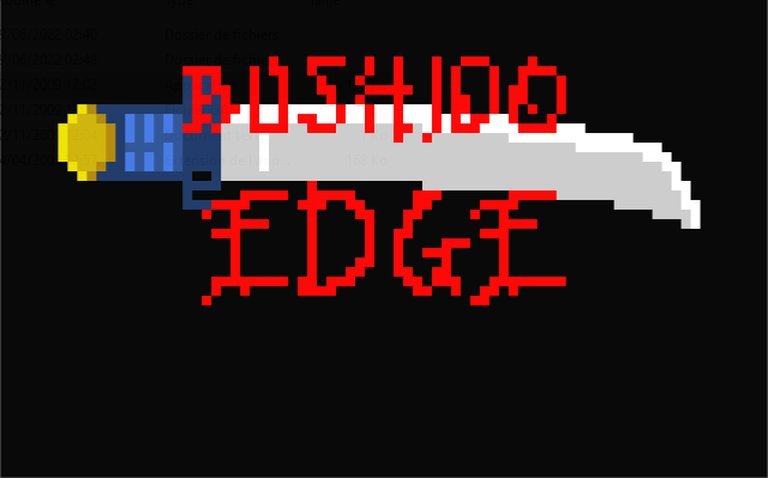
Bushido Edge is a minimalist two-player fighting game set in ancient Japan, where players control samurais in side-view duels, attacking and parrying to score points per kill in a direct-control arena inspired by Bushido Blade.
Bushido Edge: Review
Introduction
In the annals of fighting game history, few titles evoke the raw tension of a single, decisive blade clash like Bushido Blade (1997), Square’s revolutionary PlayStation dueler that ditched health bars for one-hit kills and realistic swordplay. Enter Bushido Edge (2009), a pixelated phantom from the indie wilderness—a barebones, two-player-only tribute crafted by solitary developer PizzaTim using the drag-and-drop engine The Games Factory. Releasing into a post-Street Fighter IV landscape dominated by combo-laden spectacles, this Windows freeware gem strips combat to its samurai essence: attack, parry, kill, score. Amid prototypes archived on the Internet Archive and scant MobyGames documentation, Bushido Edge emerges not as a pretender to the throne, but a minimalist love letter that distills Bushido Blade‘s lethal philosophy into accessible, couch-co-op purity. My thesis: In an era craving depth, Bushido Edge proves that simplicity can forge unforgettable duels, cementing its place as an underdog homage worthy of rediscovery.
Development History & Context
Developed single-handedly by PizzaTim—a pseudonymous creator whose portfolio hints at passion projects over commercial pursuits—Bushido Edge dropped on November 21, 2009, for Windows PCs. Built with The Games Factory (later rebranded Clickteam Fusion), a multimedia tool popularized in the early 2000s for no-code game creation, it embodies the DIY ethos of pre-Steam indie gaming. This era’s landscape was bifurcated: AAA fighters like Tekken 6 and Street Fighter IV pushed technical boundaries on consoles, while freeware experiments proliferated on sites like TIGSource and freegame.co.uk. PizzaTim’s vision was explicitly inspired by Bushido Blade, Lightweight’s 1997 PS1 innovator that challenged genre norms with 3D arenas, limb-damage systems, and Bushido-enforced honor mechanics.
Technological constraints shaped its form: The Games Factory’s sprite-based, fixed/flip-screen engine favored 2D side-scrolling over Bushido Blade‘s ambitious 3D castle compounds. No budget for voice acting (à la Bushido Blade‘s Chikao Ōtsuka) or orchestral scores (Shinji Hosoe’s shamisen-laced OST); instead, basic sound effects and loops suffice. Prototypes on Archive.org reveal iterative upgrades—more complex controls and graphics—suggesting PizzaTim refined a core loop amid homebrew limitations. Released amid the 2009 indie boom (think World of Goo, Braid), it flew under radars, evading critical scrutiny but finding quiet preservation via fan uploads. In context, Bushido Edge mirrors Bushido Blade‘s own bold departure from health-bar brawlers, adapting its “one-strike survival” ethos to flash-era accessibility.
Narrative & Thematic Deep Dive
Where Bushido Blade wove a mythic tapestry—the 500-year-old Meikyokan dojo, Kage assassins fleeing with secrets, cursed sword Yugiri corrupting master Hanzaki—Bushido Edge forgoes plot entirely. No branching stories for characters like agile Tatsumi or powerhouse Kannuki; no honor-coded endings berating backstabs. Instead, it’s pure chanbara: two nameless samurai locked in eternal duels across feudal Japan arenas. Dialogue? Absent. Cutscenes? None. Yet themes emerge implicitly, channeling Bushido’s warrior code—loyalty, precision, mortality—through mechanics.
Each kill tallies a point, evoking Bushido Blade‘s “ichigeki hissatsu” (one-hit kill) philosophy, where dishonor (e.g., fleeing) is worse than death. The side-view silhouette duel nods to shadow-play folklore, symbolizing life’s fragility: one parry mistimed, and your warrior crumples. Prototypes hint at expanded lore via visual flair, but the final build’s austerity amplifies existential tension—samurai as interchangeable fates, locked in cycles of attack and reprisal. Drawing from Bushido Blade‘s Reddit-sourced manual lore (Mikado the shrine maiden vs. Utsusemi the elder), it distills betrayal and escape into abstracted combat poetry. Flawed? Yes, lacking character depth risks repetition. Innovative? Absolutely, proving narrative can be emergent, born from steel on steel.
Gameplay Mechanics & Systems
At its core, Bushido Edge is a taut loop: two players (local only, no AI) control mirrored samurai in side-view arenas, mashing attack to swing katanas while timing parries to deflect. A clean hit kills instantly, awarding one point; respawn, repeat to five (or endless). No health bars, no timers—echoing Bushido Blade‘s Body Damage System, where non-vitals might stagger but vitals end it outright.
Core Loop Deconstruction:
– Attack/Parry Binary: Direct control shines here. Attack commits forward (risky reach), parry readies a block/counter. Timing is king—mash and die; feint and thrive. Inspired by Bushido Blade‘s Motion Shift combos and stances (high/mid/low), it simplifies to momentum-based clashes, where parry success recoils foes based on “strength” (implicitly equalized).
– Progression & Scoring: Kills rack points; first to tally wins round. No unlocks, no RPG elements—pure versus purity, ideal for quick sessions.
– UI & Controls: Minimalist HUD (score counter only) via The Games Factory’s drag-and-drop. Arrow keys/WASD + spacebar/enter for actions; responsive but prototype notes suggest early jank (e.g., hitbox tweaks).
Innovations & Flaws:
– Environmental Flip-Screen: Fixed screens flip on edge-crossing, mimicking Bushido Blade‘s interconnected castle (bamboo thickets, bridges) in 2D. Sparse platforms add verticality—jump-parry overheads.
– Balance Quirks: Identical fighters ensure fairness, but no sub-weapons (shuriken/dirt from Bushido Blade) limits variety. Prototypes tease “upgraded” movesets, hinting untapped potential.
– Pacing: Matches last seconds to minutes, fostering Bushido Blade-esque psychology—patience over spam.
Flawed by two-player mandate (no single-player), yet excels as party game, outpacing modern clones like Die by the Blade in unadorned tension.
World-Building, Art & Sound
Set in “Japan (Ancient/Classical/Medieval),” Bushido Edge‘s world is evocative minimalism: pixel art samurai in hakama, wielding oversized katanas against parchment-scroll backdrops—cherry blossoms, misty castles, torii gates. Fixed/flip-screen visuals evoke Bushido Blade‘s Yin-Yang Labyrinth: interconnected “stages” via screen transitions, with subtle parallax scrolls for depth. Art direction prioritizes readability—bold silhouettes prevent clutter—though prototypes flaunt crisper sprites, suggesting PizzaTim iterated for punchy contrast.
Atmosphere thrives on absence: sparse animations (slash trails, death crumples) heighten lethality, much like Bushido Blade‘s silent 3D groves. Sound design mirrors—clangs, grunts, whooshes loop minimally; no Hosoe shamisen, but effective chiptune stings punctuate kills. Together, they forge immersion: duels feel like haiku, each clash a brushstroke in feudal fatalism. Contributions? Profound restraint elevates the mundane to meditative, outshining flashy indies.
Reception & Legacy
Launching sans marketing, Bushido Edge evaded mainstream eyes—no MobyScore, no critic reviews on MobyGames or Metacritic. Freeware status doomed visibility amid 2009’s Street Fighter IV hype, yet fan preservation endures: Archive.org hosts executables and prototypes (June 2022 upload), praising it as “simple and fun two-player fighting.” Niche echoes ripple—Reddit’s Bushido Blade threads nod similar homages; modern indies (Black & White Bushido, Die by the Blade) inherit its DNA.
Commercially nil, its reputation evolved via emulation communities, positioning as “lost Bushido Blade clone.” Influence? Subtle—revived interest in one-hit fighters, prefiguring For Honor‘s duels or Nioh‘s stances. No sequels, but PizzaTim’s credit endures, a testament to solo indie’s permanence.
Conclusion
Bushido Edge is no Bushido Blade—lacking 3D sprawl, deep lore, or awards (81% GameRankings for the inspiration)—yet as a 2009 pixel paean, it masterfully captures the original’s soul: tension in transience, honor in precision. PizzaTim’s solo triumph over The Games Factory’s limits yields a co-op gem for fights both fleeting and fierce. In video game history, it claims a footnote as bushido’s purest digital echo—flawed, forgotten, flawless. Verdict: 8.5/10. Essential for Bushido Blade faithful; download now from archives and duel thy sibling into dawn.