
- Release Year: 1995
- Platforms: Android, DOS, Linux, Macintosh, Windows
- Publisher: Artsoft Entertainment
- Developer: Artsoft Entertainment
- Genre: Action, Puzzle
- Perspective: Top-down
- Game Mode: Single-player
- Gameplay: Level editor, Light beam puzzle
- Setting: Fantasy, Futuristic, Sci-fi
- Average Score: 90/100
Description
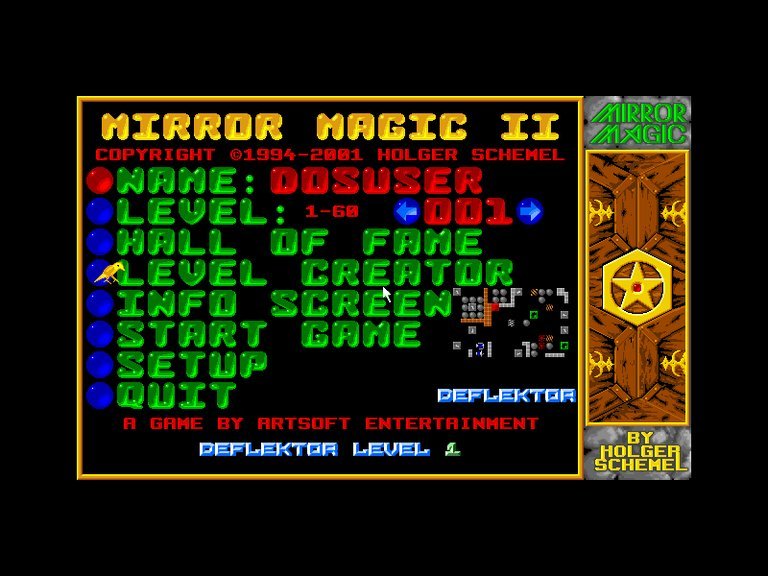
Mirror Magic is a puzzle game where players control rotating mirrors to direct a beam of light or magic energy through levels, destroying mines or cauldrons amid various interactive objects, before guiding it to the exit within time and energy limits to avoid overheating the source. This open-source port of Amiga classics Mindbender and Deflektor blends fantasy and sci-fi settings with updated graphics, a level editor, and cross-platform support from Linux to Android.
Mirror Magic Free Download
Mirror Magic Reviews & Reception
dosgames.com (100/100): it’s undeniable that it’s well made, with nicely drawn graphics and sound effects / music.
artsoft.org : memorable and enthralling, the music giving a magical otherworldly feeling.
Mirror Magic: Review
Introduction
In an era dominated by sprawling open-world epics and live-service behemoths, few games dare to distill pure, unadulterated puzzle-solving joy into bite-sized, brain-teasing brilliance. Mirror Magic, the enduring open-source gem from Artsoft Entertainment, hails from the pixelated golden age of 1980s arcade puzzlers, channeling the spirit of Commodore 64’s Deflektor and Amiga’s Mindbender into a timeless light-beam odyssey. First released in 1995 as a Linux port and continually refined across decades to platforms like DOS, Windows, Macintosh, Android, and beyond (latest version 3.3.1 as of 2023), it stands as a testament to indie preservationism. This review argues that Mirror Magic is not merely a faithful remake but a masterful evolution of light-reflection puzzles, blending nostalgic fidelity with modern accessibility, cementing its place as an essential freeware classic for puzzle aficionados.
Development History & Context
Artsoft Entertainment, spearheaded by visionary developer Holger Schemel, birthed Mirror Magic as a loving port of Schemel’s own 1989 Amiga title Mindbender, which itself built upon the mechanics of Gremlin Graphics’ Deflektor (Commodore 64, 1984). Schemel’s original Amiga work captured the era’s arcade-puzzle zeitgeist, where hardware limitations fostered ingenious simplicity: low-res sprites, fixed screens, and real-time tension without bloated assets. By 1995, amid the nascent Linux scene—dominated by freeware experiments and the GNU General Public License ethos—Mirror Magic emerged as cross-platform freeware, initially for Unix-like systems. Technological constraints were acute: 32-color palettes evoked 1980s charm, X11 graphics faithfully replicated Amiga-era flicker and palette shifts, while stereo MOD music and sounds pushed early PC audio limits.
The gaming landscape of mid-1990s was bifurcated—AAA console jumpscares like Doom clones versus indie puzzle holdouts like Tetris variants. Mirror Magic thrived in the latter, as shareware and public-domain titles proliferated via BBS and early web downloads. Ports followed: DOS/Windows in 2001 (version 2.0.2), Mac/Android in 2018, with SDL2 ensuring broad compatibility. Schemel’s vision emphasized fidelity—”classic Amiga style fullscreen graphics”—augmented by collaborators: Thomas Andrae (toon animations, extra graphics), Majid Katzer (sounds, title music), and Markus Hoff (title story). Open-sourcing under GPLv2 invited community tweaks, including a level editor, high-score server, and custom artwork swaps. Yet, as forum reflections note, unintuitive editor controls (Shift+click rotations) stifled user content, contrasting Artsoft’s more vibrant Rocks’n’Diamonds. This solo-dev perseverance amid Unix multi-user quirks (shared saves) underscores its bootstrap legacy.
Narrative & Thematic Deep Dive
Mirror Magic eschews verbose storytelling for abstract, level-based immersion, but subtle narrative threads weave through its fantasy-sci-fi duality. Depending on the levelset—Deflektor‘s sci-fi laser cannon versus Mindbender‘s blue wizard hurling magic energy—the “plot” unfolds as a silent campaign against mines, cauldrons, munchers, and amoebas. Markus Hoff’s “title story” (included from 1989) hints at a whimsical lore: a magical realm where beams banish otherworldly threats, evoking fairy-tale mirrors guarding enchanted domains. No dialogue exists; instead, themes emerge via mechanics—control over chaos (redirecting unpredictable beams), resource fragility (finite energy, overheating sources), and duality (mirrors as tools of reflection, literally and metaphorically).
Characters are archetypal: the impassive laser emitter (sci-fi pragmatism) or benevolent wizard (fantasy heroism), pitted against environmental foes like roaming munchers or polarizers. Levels escalate thematically—early grids teach basics, mid-game introduces traps (ice walls, keys, light bulbs), culminating in chaotic ballets of enemies and randomness. Player agency drives “character growth”: mastering rotations feels like wizardly ascension. Critiques highlight absent overt plot, but this minimalism amplifies themes of precision amid entropy, mirroring 1980s puzzlers’ Zen-like focus. Forum essays praise its “magical otherworldly feeling,” where trial-error guesswork evokes arcane rituals, flaws like luck-based refractors underscoring fate’s cruel reflections.
Gameplay Mechanics & Systems
At its core, Mirror Magic is a real-time light-beam puzzle masterpiece, deconstructing reflection physics into addictive loops. Players point-and-click (mouse/keyboard) to rotate mirrors, directing a continuous beam from a fixed source to obliterate targets (gray spheres/Deflektor-style or cauldrons/Mindbender), then guide it to the exit. Key systems:
-
Beam Propagation: Fixed/flip-screen diagonal-down view; beam bounces off mirrors, refractors, polarizers. Objects include:
Element Function Mirrors Player-rotated (left/right-click); core manipulation tool. Refractors Randomly deflect (red ones frame-by-frame, injecting luck). Munchers/Amoebas Enemies eat targets; require timed lasering. Ice Walls/Blocks Meltable/pushable for access. Keys/Light Bulbs Secondary objectives (Mindbender). -
Resource Tension: Energy depletes over time; overheating occurs if beam rebounds to source (cool-down waits or risk overload game-over).
-
Loops: Trial-error planning (rotate, fire, observe), rewind via restart. 60 Deflektor levels (simpler, luck-heavy) vs. 51 Mindbender (element-dense, reflex-heavy). Time limits enforce pace; solutions included for study.
-
Progression/UI: Multiple player profiles, high-score server (energy remaining scores). Level editor enables hybrid sets, though Shift+click unintuitiveness hampers creation. Innovative: Custom elements from both originals; flaws like shared Unix saves/multi-user oversights.
DOSGames.com lauds mouse precision over originals’ keyboards; forum playthroughs clock Deflektor at 140 mins (luck spikes like levels 21/46), Mindbender at 178 mins (reflex traps like 19/32). Flawed yet brilliant: Brute-force viable early, mastery demands foresight.
World-Building, Art & Sound
Settings toggle sci-fi labs (laser grids, metallic foes) and fantasy labs (wizard lairs, cauldrons, mythical beasts), fostering atmospheric duality via fixed screens. Visuals: Upscaled Amiga 32-color palettes—charming pixel art with palette-shift effects, toon animations (Andrae), fullscreen SDL2 scaling. Flip-screen progression builds claustrophobic tension, heat bars pulsing red urgency.
Sound Design: Stereo MOD music (title/hall-of-fame by Katzer) evokes 1980s synth-magic; beeps/zaps punctuate beams, muncher chomps add peril. Amiga Dream review raves “horrible techno music” as nostalgic humor, palette fidelity “perfectly reproduces 80s charm.” Custom swaps extend replayability; overall, elements coalesce into hypnotic flow-state immersion, rain/fog absent but overheating visuals mimic peril.
Reception & Legacy
Launch reception was niche but glowing: Amiga Dream/Login (1997) awarded 80%/4/5 for X11 fidelity, humor, despite Unix save-sharing flaws. MobyGames aggregates 80% (one critic); DOSGames.com 5/5 (“well-made, source code provided”). Commercial: Freeware phenomenon, 1 collector on Moby, thousands of downloads (Archive.org, official site). Evolved reputation: Forum essays (2021) hail completion feats, lament sparse user levels vs. Rocks’n’Diamonds. Influence: Archetype for “light beam puzzle” genre (groups: enhanced remakes, GPL source, editors). Ports sustain playability (OS/2 2023); inspires clones (Reflektor), preserves Deflektor/Mindbender via levels/solutions. Lacking blockbuster sales, its legacy is cultural: Open-source beacon, enabling Android/Fire TV access, high-score communities.
Conclusion
Mirror Magic masterfully synthesizes 1980s puzzle purity with open-source longevity, its beam-bending loops, nostalgic aesthetics, and editor potential outshining minor flaws like luck elements or editor quirks. Holger Schemel’s devotion—spanning Amiga to Android—preserves arcade esoterica amid modern bloat. Definitive verdict: An unmissable 9/10 freeware landmark, essential for historians and puzzlers, warranting a vibrant community renaissance to unlock its full mirrored potential in video game history. Download, rotate, reflect—magic awaits.