
- Release Year: 2007
- Platforms: Windows
- Publisher: Cenega Poland Sp. z o.o.
- Genre: Compilation
- Perspective: Top-down
- Game Mode: Single-player
- Average Score: 90/100
Description
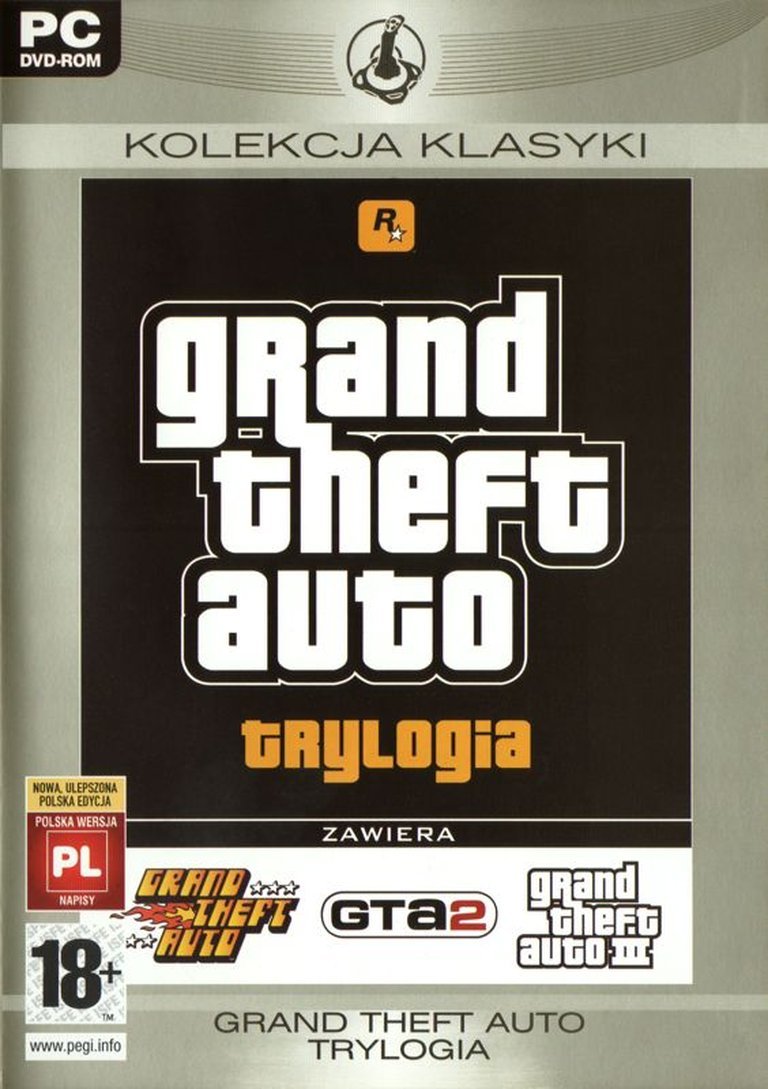
Grand Theft Auto: Trylogia is a 2007 Windows compilation by Cenega Poland featuring the early classics Grand Theft Auto (1997), Grand Theft Auto 2 (1999), its London 1969 mission pack, and the groundbreaking 3D Grand Theft Auto III (2001). Players navigate open-world environments modeled after real cities like Liberty City (New York), San Andreas (San Francisco), Vice City (Miami), Anywhere City, and 1960s London, rising through criminal ranks via missions centered on driving, shooting, theft, and underworld intrigue.
Grand Theft Auto: Trylogia Free Download
Grand Theft Auto: Trylogia Cheats & Codes
PC
Enter these as your character’s name to enable the cheat.
| Code | Effect |
|---|---|
| heart of gold | 10x Point Multiplier |
| hate machine | 10x Point Multiplier |
| itcouldbeyou | 9,999,999 points |
| satanlives | 99 lives |
| nineinarow | All Levels |
| super well | All levels and Cities |
| itsgallus | All stages |
| iamnotgarypenn | Disable Massive Cursing |
| iamgarypenn | Enable Massive Cursing |
| buckfast, then press * | Get 99 ammo for all guns |
| iamthelaw | No police |
| stevesmates | No Police presence |
| porkcharsui | Enable debug mode (pressing C shows damage, speed etc. of current car) |
| suckmyrocket | Start with all weapons and power-ups |
| 6031769 | Unlimited Lives |
| itstantrum | Unlimited Lives |
GBC
Enter password to unlock all levels.
| Code | Effect |
|---|---|
| Wendy | All Levels |
PS
Enter the following codes at the Name Entry screen.
| Code | Effect |
|---|---|
| EXCREMENT | 5x Multiplier |
| WEYHEY | 9,999,990 points |
| SATANLIVES | 99 Lives |
| TURF | All Cities (Part 1 and 2) |
| CAPRICE | All Cities (Part 1 and 2) |
| INGLORIOUS | All Cities (Part 1 and 2) |
| URGE | All Cities up to Vice City (Part 1) |
| HANGTHEDJ | All Cities, All Weapons, 99 Lives, Jail Card and 5x Multiplier |
| BSTARD | All Cities, All Weapons, 99 Lives, Jail Card, 5x Multiplier and Max Wanted level |
| MADEMAN | All Weapons |
| GROOVY | All Weapons |
| BLOWME | Enable Coordinates |
| FECK | Liberty City (Part 1 and 2) |
| EATTHIS | Max Wanted Level |
| CHUFF | No Police |
| TVTAN | San Andreas (Part 1 and 2) |
| SKYBABIES | San Andreas (Part 1) |
Grand Theft Auto: Trylogia: Review
Introduction
Imagine a time when open-world crime sprees were a radical experiment, not the industry standard—when pixelated top-down chaos in stolen cars felt like pure anarchy. Grand Theft Auto: Trylogia, released in 2007 by Cenega Poland for Windows, bundles four foundational titles from the series’ nascent 2D era: Grand Theft Auto (1997), its Mission Pack #1: London 1969 expansion (1999), Grand Theft Auto 2 (1999), and the paradigm-shifting Grand Theft Auto III (2001). This compilation isn’t the glossy Trilogy of 3D classics (III, Vice City, San Andreas) that later defined Rockstar’s empire; it’s a gritty time capsule of the franchise’s raw origins, preserving the top-down mayhem that birthed a billion-dollar phenomenon. As a game historian, I argue that Trylogia stands as an essential artifact: a bridge from arcade-style rebellion to immersive 3D storytelling, flawed yet visionary, reminding us how GTA evolved from gleeful lawlessness to cultural juggernaut. Its thesis? In an era of linear shooters, these games weaponized freedom, controversy, and satire, laying the asphalt for modern gaming’s open-world revolution.
Development History & Context
Developed primarily by DMA Design (later Rockstar North) under creators David Jones and Mike Dailly, the early GTA titles emerged amid the late-90s British game dev scene, where studios like DMA pushed procedural worlds and emergent gameplay on constrained hardware. Grand Theft Auto (1997) debuted on MS-DOS and Windows, inspired by films like Goodfellas and Pulp Fiction, but rooted in DMA’s earlier work on Lemmings and procedural generation experiments. Technological limits—no full 3D yet—forced a top-down perspective, with RenderWare engine handling sprawling cityscapes across three fictional U.S. cities: Liberty City (New York), San Andreas (San Francisco), and Vice City (Miami). The 1999 London 1969 pack shifted to a ’60s mod-era London, adding era-specific vehicles and missions, while GTA 2 refined the formula with gang respect systems and futuristic “Anywhere City.”
By 2001, GTA III marked a seismic pivot. Oversight from Rockstar Games founders Dan and Sam Houser, Leslie Benzies, and Aaron Garbut transformed DMA into Rockstar North. Using RenderWare’s 3D capabilities on PS2 (later ported to PC), it ditched top-down for third-person immersion, constrained by PS2’s 32MB RAM—leading to gradual island unlocks to mask loading. Released amid post-Columbine moral panics, it faced bans in Brazil and condemnations in Europe for “extreme violence.” Cenega Poland’s 2007 Trylogia compilation arrived late in the PS2/Xbox era, targeting Eastern European markets with DVD-ROM convenience (keyboard/mouse support), amid Rockstar’s 3D dominance (San Andreas had sold 27.5M). It reflects a niche preservation effort, bundling 2D relics with the 3D breakthrough during a gaming landscape shifting to online multiplayer (GTA Online precursors) and HD worlds. Constraints like no voice acting in 2D games (random radio chatter only) highlight an era before celebrity VO (Ray Liotta in Vice City).
Narrative & Thematic Deep Dive
GTA’s early plots are anarchic vignettes of criminal ascent, eschewing Hollywood linearity for episodic crime sprees. GTA 1 casts a nameless protagonist as a wheelman-for-hire across Liberty City, San Andreas, and Vice City, progressing via payphone missions from shadowy bosses. Themes of betrayal and rags-to-riches permeate: evade cops (six-star wanted system debuts), racketeer, and rampage. London 1969 transplants this to Swinging London, with missions evoking Kray twins’ mod gangs—smash rivals, heists amid Mini Coopers and Black Cabs—exploring cultural satire on British underworld nostalgia.
GTA 2 (1999) deepens with Claude Speed (voiced generically), navigating “Anywhere City” (retro-futuristic dystopia, hints of 1999-2013). Dual-protagonist choice (gang allegiance via respect meters) yields branching paths: ally with Zaibatsu corp, Hare Krishnas, or Scientists for kill-frenzies and vigilante modes. Themes escalate to corporate control vs. anarchy, with radio ads mocking consumerism.
GTA III (2001) revolutionizes with silent Claude’s betrayal-fueled odyssey in 3D Liberty City (Portland, Staunton, Shoreside Vale). Plot arcs mirror crime epics: robbed in a bank heist by girlfriend Catalina (ex-lover motif recurs), Claude rises via Leones (mafia intrigue with Joey, Toni Cipriani, Salvatore), Yakuza (Asuka Kasen), Cartel (SPANK drug wars), and betrayal loops (Uncle Sam missions). Subtle satire skewers American Dream corruption—cops like Ray Machowski expose internal rot—culminating in Catalina’s demise. Multi-arc structure (Leone-Forelli-Sindacco wars echo across universe) sets template for 3D saga. Trylogia‘s anthology reveals thematic evolution: 2D’s faceless chaos to 3D’s personal vendettas, probing violence, immigration, and capitalism amid controversies (Hot Coffee echoes early mods).
Gameplay Mechanics & Systems
Core loop: steal cars, obey traffic loosely, complete missions amid sandbox chaos. 2D titles emphasize top-down driving/shooting—slippery physics, 360° vehicle rotation, cop pursuits scaling by stars (1-star patrol to 6-star SWAT/tanks). Missions demand time limits, multipliers for style (no-crash bonuses), side gigs (vigilante, taxi, firefighter). GTA 2 innovates respect: kill rival gangs to join theirs, unlocking missions/vehicles; dual-city districts (Downtown, Residential, Industrial) gate progress.
GTA III elevates to 3D: analog controls for nuanced driving/shooting, mission-critical islands (Portland unlocks first), payphones/cell progression. Combat shifts to auto-aim (PS2 pad), with melee/stealth hints. Flaws persist—clunky camera, no sprint (patched later), mission restarts frustrate—but innovations like radio stations (talk/commercials satirize U.S. culture), collectibles (hidden packages), side activities (racing, paramedic) flesh loops. UI: minimalist HUD (health, armor, wanted stars), map pauses. Trylogia‘s PC ports add mouse/keyboard, but dated controls shine historically—raw, unpolished freedom birthed Saints Row clones.
| Mechanic | 2D Era (GTA1/2/London) | GTA III (3D Shift) |
|---|---|---|
| View | Top-down isometric | Third-person |
| Progression | Payphones, multipliers | Story missions, islands |
| Police AI | Pursuit scaling | Helicopters, roadblocks |
| Innovation | Gang respect | Radio immersion, 3D physics |
| Flaws | Pixel-perfect chaos | Camera jank, difficulty spikes |
World-Building, Art & Sound
Settings parody U.S./U.K. urban decay: 2D cities burst with procedural life—pedestrians scatter, traffic obeys signals loosely, destructible environments. Liberty City (NYC analog) industrial grit; San Andreas hilly; Vice City beaches; London fog-shrouded. GTA 2‘s Anywhere City futurizes with neon sects. Art: sprite-based, era-evoking (e.g., London’s Minis), pixel violence stylized.
GTA III‘s Liberty City (Portland docks, Staunton skyscrapers, Shoreside airport) immerses via scale—bridges/tunnels connect, fog masks pop-in. Visuals: PS2-era poly-counts, dynamic weather, day-night cycles enhance atmosphere. Sound: 2D radio chatter mocks media; III pioneers licensed tracks (Chuck D, Lazlow), ambient horns/sirens build tension. No VO in 2D (grunts only); III‘s mute Claude amplifies immersion. Collectively, elements forge “living cities”—peds react realistically, boosting replayability and satire.
Reception & Legacy
At launch, individual titles polarized: GTA 1 (PC 79%, PS1 68%), GTA 2 (PC 72%), London middling. GTA III exploded (PS2 97%, PC 94%), selling 14.5M, igniting “GTA clones” (Driver, True Crime). Series shipped 450M+ by 2020s, but controversies—4,000+ articles on violence (Jack Thompson lawsuits), bans, Hot Coffee—cemented notoriety. Trylogia? Sparse: MobyGames 4.5/5 (2 player ratings, no reviews), unranked critically. Polish market niche; overshadowed by 2005 Trilogy.
Legacy: Pivotal. 2D birthed wanted system, open worlds; III defined genre (post-Doom revolution). Influenced Watch Dogs, Sleeping Dogs; HD universe (IV, V) refined. As compilation, Trylogia preserves 2D “universe” (separate from 3D/HD), underscoring evolutions—top-down to three-protag (V), mods to Online. BBC icon, Telegraph export; GTA VI (2026) owes roots here.
Conclusion
Grand Theft Auto: Trylogia is no polished remaster—it’s a raw vault of gaming’s rebellious adolescence, flaws (dated controls, sparse narratives) intact. Yet its exhaustive preservation of GTA’s ascent from 2D rampage to 3D mastery cements its historical indispensability. For newcomers, play Definitive Edition first; for historians, this is sacred text. Verdict: 8.5/10—a flawed monument to freedom’s cost, eternally revving in video game history’s fast lane. Essential for series completists; a nostalgic triumph amid obscurity.