
- Release Year: 1997
- Platforms: Windows
- Publisher: Young Digital Poland
- Developer: Young Digital Poland
- Genre: Educational, Puzzle
- Perspective: Top-down
- Game Mode: Single-player
- Gameplay: Cards, Hidden object, Mini-games, Tiles
- Average Score: 81/100
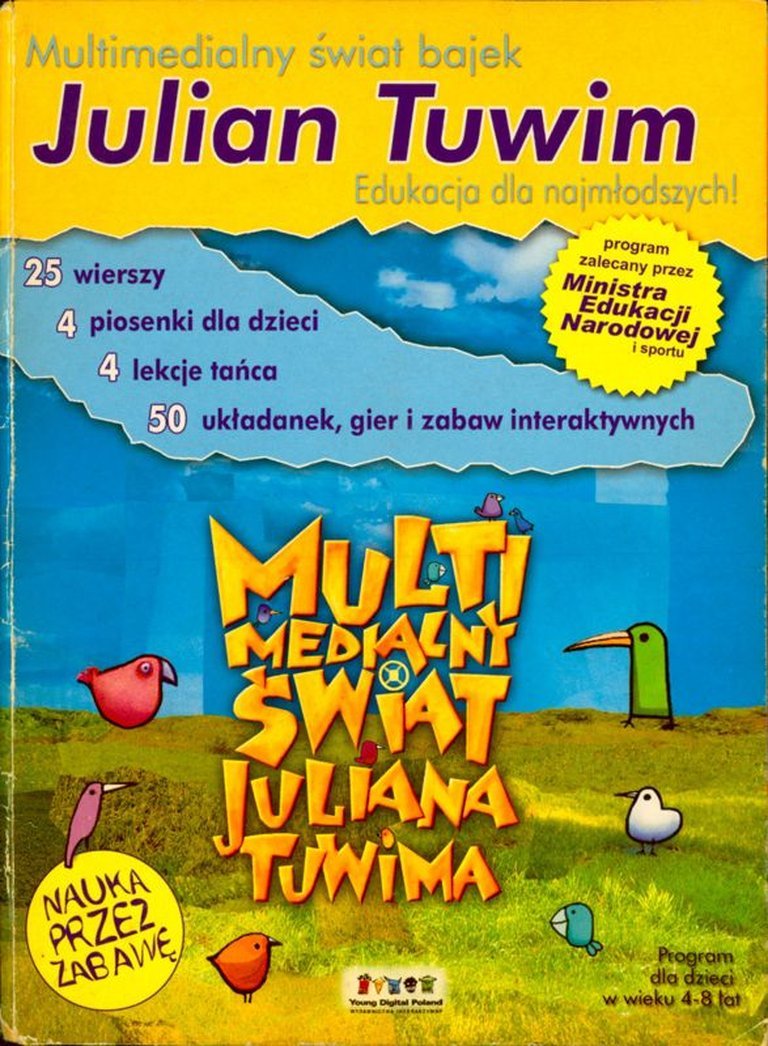
Description
Multimedialny Świat Juliana Tuwima is a 1997 educational Windows CD-ROM game by Young Digital Poland, dedicated to the children’s poems of Polish poet Julian Tuwim, featuring 25 interactive poems with full-screen illustrations, humorous animations, mini-games like jigsaw puzzles and spot-the-differences, audio recitations, songs, dance videos, and on-screen music-making instruments.
Gameplay Videos
Multimedialny Świat Juliana Tuwima: Review
Introduction
Imagine a time when CD-ROMs were the pinnacle of home entertainment, and a single disc could transform a family PC into a vibrant theater of poetry, song, and whimsy. Released in 1997, Multimedialny Świat Juliana Tuwima (The Multimedia World of Julian Tuwim) captures this era perfectly—a Polish edutainment gem that breathes digital life into the beloved children’s poems of Julian Tuwim, one of Poland’s most cherished 20th-century poets. This isn’t just a game; it’s a multimedia love letter to Polish literature, blending recitation, animation, music, and interactivity to make learning feel like play. My thesis: In an age dominated by flashy Western imports, this title stands as a pioneering work of Eastern European edutainment, masterfully leveraging early multimedia tech to immortalize Tuwim’s playful absurdities for a new generation, cementing its place as a cultural artifact worthy of rediscovery.
Development History & Context
Young Digital Poland, the studio behind Multimedialny Świat Juliana Tuwima, emerged in the mid-1990s as a trailblazer in Poland’s nascent digital publishing scene. Founded amid the post-communist economic boom, the company specialized in “Multimedialny Świat” series—educational CD-ROMs that digitized classic Polish children’s literature. This 1997 Windows release, developed and published in-house, arrived during the CD-ROM gold rush, when 4X drives (600 KB/s) and 16 MB RAM were cutting-edge specs for consumer PCs (minimum: Intel i486 DX2, Windows 95). Poland’s gaming landscape was then a mix of pirated Western hits like Doom and homegrown edutainment, as local developers grappled with limited hardware and a focus on export barriers.
The creators’ vision was ambitious: transform static poems into immersive experiences. Programming by Jarosław Kowalewski and Jarosław Pawlukowicz handled point-and-click interfaces on fixed/flip-screen visuals, while illustrations from Virus Group’s Beata Szeser and Mirosław Wiśniewski brought Tuwim’s worlds to life. Celebrities elevated it—recitation by actors Joanna Trzepiecińska and Wojciech Malajkat, songs arranged by Andrzej Pawlukiewicz and sung by stars like Majka Jeżowska, Grażyna Łobaszewska, and Mieczysław Szcześniak. Choreography by Ewa Napiórkowska featured live-action dances performed by Monika Czerwińska and others, with Robert Krzywicki crafting sound effects. Technological constraints like low-res graphics (top-down perspective, mouse-only input) were turned into strengths, prioritizing accessibility for kids on single-player setups. As the first Tuwim adaptation on CD-ROM (preceded by similar efforts like Świat Fizyki on Amiga), it reflected Poland’s push toward culturally relevant software, even earning a nod from the Minister of National Education as recommended didactic material.
Narrative & Thematic Deep Dive
At its core, Multimedialny Świat Juliana Tuwima has no traditional “plot”—it’s a anthology of 25 iconic children’s poems by Julian Tuwim (1894–1953), the master of linguistic acrobatics and absurd humor. Tuwim’s works, like Lokomotywa (The Locomotive), Ptasie radio (Bird Radio), and Rzepka (The Turnip), revel in onomatopoeia, rhythm, and everyday chaos, themes of joy, mischief, and the magic in mundanity. Here, each poem unfolds as a self-contained vignette: a full-screen illustration loads, narrated by Trzepiecińska’s warm soprano or Malajkat’s theatrical baritone, syncing words to whimsical animations (e.g., chugging trains or chattering birds).
Thematically, it’s a celebration of childhood wonder and linguistic play. Tuwim’s comedy shines through interactive elements—click a bird in Ptasie radio for squawks and flaps, embodying themes of nature’s symphony and imagination’s power. Songs adapt select poems into catchy tunes, inviting sing-alongs that reinforce rhythm and memory. Deeper layers emerge: poems like Spóźniony słowik (The Late Nightingale) touch on time and consequence with gentle humor, while hidden interactions reveal socio-cultural nods, like urban Polish life in the interwar era. Dialogue is minimal but poetic—recitations are verbatim, with on-screen text for literacy building. No characters persist across poems; instead, anthropomorphic animals and objects drive episodic narratives, fostering emergent storytelling via player agency. Flaws? The Polish-only language limits global appeal, but for its audience, it masterfully weaves education into Tuwim’s timeless wit, making poetry feel alive and conspiratorial.
Gameplay Mechanics & Systems
This is pure point-and-click edutainment, structured around core loops of exploration, recitation, and mini-games per poem. Select from a menu of 25 titles; each opens a fullscreen scene ripe for interaction. Core mechanics:
- Exploration & Hidden Objects: Click illustrations for humorous animations (e.g., bouncing objects, sound effects). Hidden surprises reward curiosity, blending puzzle-solving with comedy.
- Recitation & Learning: Play/pause narrated poems with text; intuitive UI (play buttons, volume sliders) supports repeat listens for memorization.
- Mini-Games (Universal): Every poem features jigsaw puzzles (variable difficulty: 12–48 pieces, rotatable tiles) and spot-the-differences (5–10 per scene, with hints). These loop via replayability, honing observation.
- Song & Music Systems: For adapted poems, watch live-action dance videos, sing karaoke-style, or improvise on on-screen instruments (drums, xylophone)—simple rhythm-matching builds creativity without frustration.
- Additional Modes: Coloring books (fill outlines for “rewards” like animations), logic games (pattern-matching tied to poem themes), and dexterity challenges (e.g., timing-based clicks).
UI is child-friendly: large buttons, no timers, forgiving retries. Progression is non-linear—free roam between poems, no metasave (CD-ROM era limitation). Innovations: Adaptive difficulty in puzzles; music-making as proto-rhythm game. Flaws include repetitive loops and lack of scoring, but for 1997 edutainment, it’s flawlessly paced for 4–8-year-olds, clocking 5–10 hours of repeat play.
| Mechanic | Loop Description | Strengths | Weaknesses |
|---|---|---|---|
| Puzzles | Assemble scattered tiles/images | Scalable difficulty, thematic ties | Basic visuals |
| Spot-the-Diff | Hunt 5–10 variances | Builds focus | No zoom/timer |
| Music/Dance | Click instruments/watch videos | Creative freedom | Limited variety |
| Interactions | Point-and-click animations | Humorous rewards | Finite per scene |
World-Building, Art & Sound
The “world” is a gallery of 25 vignette universes, each a lush, hand-drawn fullscreen tableau by Virus Group—vibrant watercolors of locomotives barreling through countrysides, birds in chaotic radio studios, or turnips uprooting villages. Fixed/flip-screen views emphasize detail; interactivity (e.g., draggable elements) builds immersion, creating cozy, storybook atmospheres that evoke 1930s Poland with a digital twist.
Art direction prioritizes whimsy: bold colors, exaggerated proportions amplify Tuwim’s absurdity. Sound design elevates it—Robert Krzywicki’s effects (chugs, chirps) sync perfectly; recitations by Trzepiecińska/Malajkat add emotional depth (playful vs. dramatic tones). Songs burst with star power: Pawlukiewicz’s arrangements blend folk-pop, performed live for authenticity. Live-action dances inject real-world energy, contrasting static art. Collectively, these forge a multi-sensory playground: visuals spark imagination, audio embeds poetry aurally, fostering a nostalgic, enchanting experience that feels tailor-made for rainy afternoons.
Reception & Legacy
Launch reception was niche but positive—listed on the Polish Ministry of Education’s recommended titles, it targeted schools/families in a market craving local content. Commercially, as a CD-ROM (294 MB rip available via archives), it sold steadily in Poland but faded internationally due to language barriers. Critically sparse: MobyGames shows n/a score (one player: 4.6/5), no Metacritic/GameFAQs reviews. Modern nostalgia drives preservation (Internet Archive rips, emulator sites).
Legacy endures in Polish edutainment: part of Young Digital Poland’s series (sequel Multimedialny Świat Jana Brzechwy, 1997), influencing localized multimedia like Wirtualna Szkoła. It pioneered literature-to-game adaptations, prefiguring apps like Duolingo or ABCmouse with interactive poetry. Globally, it highlights underrepresented Eastern European titles, inspiring retro digs amid 90s edutainment revivals (e.g., Living Books series parallels). No direct industry influence, but a vital preserver of Tuwim’s canon.
Conclusion
Multimedialny Świat Juliana Tuwima is a masterful relic of 1997’s multimedia optimism—a 25-poem odyssey where Tuwim’s genius meets interactive magic, flawlessly balancing education and delight through puzzles, songs, and animations. Young Digital Poland’s talent shines in its celebrity polish and kid-centric design, overcoming tech limits to deliver pure joy. In video game history, it claims a secure niche: not a blockbuster, but an essential artifact of Polish cultural gaming, deserving emulation and remasters. Verdict: 8.5/10—A timeless edutainment triumph, essential for literature lovers and retro enthusiasts. Fire up a VM, grab the ISO, and let the locomotive chug once more.