
- Release Year: 2007
- Platforms: Windows
- Publisher: Oberon Media, Inc., rondomedia Marketing & Vertriebs GmbH
- Developer: FriendsGames
- Genre: Puzzle
- Perspective: Side view
- Game Mode: Single-player
- Gameplay: Falling block puzzle, Tile matching puzzle
- Setting: Amazonia
- Average Score: 55/100
Description
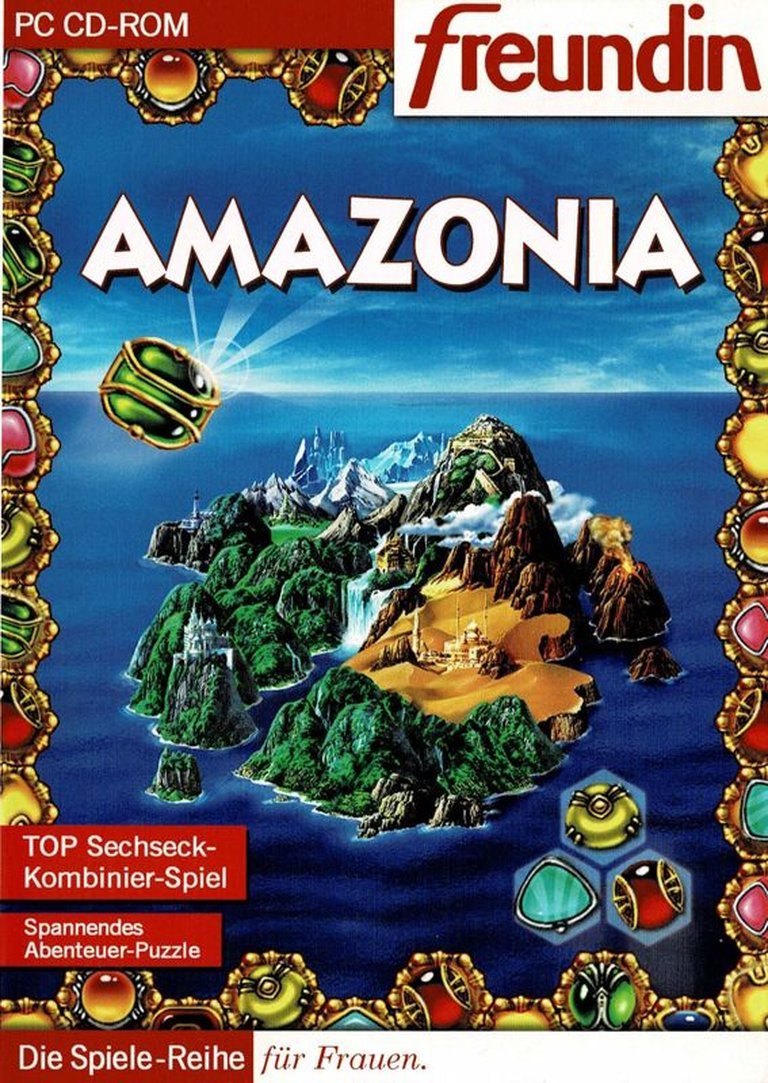
Amazonia is a match-three puzzle game set on the mystical island of Amazonia, where players swap hexagonal amulets to form rows of three or more matching colors, filling a progress meter to advance levels and ultimately release the six Spirits of the Elements to claim the treasure of the Seal of Unity. Special matches of four or more create powerful amulets that clear adjacent cells, rows, or patterns across the board, offering addictive, soothing gameplay in a colorful tropical setting.
Where to Buy Amazonia
PC
Amazonia: Review
Introduction
Imagine a digital oasis amid the frenetic pace of 2007’s gaming landscape—a year dominated by blockbuster shooters like Call of Duty 4: Modern Warfare and ambitious epics like BioShock—where a simple yet mesmerizing hexagonal puzzle grid transports you to the lush, spirit-haunted islands of Amazonia. Amazonia, developed by the boutique studio FriendsGames and released as shareware for Windows, isn’t just another match-3 clone in the post-Bejeweled era; it’s a soothing antidote to overstimulation, blending addictive tile-matching with elemental mythology. As a game historian, I view Amazonia as a understated gem of casual gaming’s golden age, proving that innovation in core mechanics and thematic serenity can create lasting appeal without relying on high budgets or hype. My thesis: Amazonia excels as a pinnacle of accessible puzzle design, its hexagonal twist and power-up escalation elevating it beyond genre peers, while its tropical ambiance and rhythmic progression cement its legacy as a “soothing” escape that punches above its weight.
Development History & Context
FriendsGames, a small Eastern European developer known for polished casual titles, crafted Amazonia in an era when PC gaming was bifurcating into AAA spectacles and the booming shareware/downloadable market. Released in 2007 amid the seventh console generation’s explosion—Nintendo Wii’s motion controls reshaping family gaming, Xbox 360’s online dominance with Halo 3, and PlayStation 3’s high-definition push—the game targeted the underserved casual audience via portals like Oberon Media and German publisher rondomedia Marketing & Vertriebs GmbH. This was the heyday of browser and downloadable puzzles, fueled by titles like Zuma and Luxor, where low barriers to entry (mouse-only input, single-player offline) democratized gaming for non-hardcore players.
The creators’ vision centered on subverting square-grid conventions with hexagons, inspired by natural patterns like honeycombs or elemental crystals, tying into the Amazonian theme. Technological constraints were minimal—Windows XP/Vista compatibility, fixed/flip-screen visuals optimized for low-end PCs—but clever systems like escalating power-ups maximized replayability without demanding cutting-edge hardware. The gaming landscape was ripe: casual games comprised a growing slice of the $17.9 billion U.S. market (per NPD), with shareware models enabling viral spread via demos. Amazonia‘s tropical motif evoked escapism, contrasting gritty shooters, and its “Die Legende der Geister” subtitle (German for “Legend of the Ghosts”) hinted at publishers’ localization efforts for Europe’s puzzle-hungry audience. Notably, the name echoes a 1985 Brazilian text adventure Amazônia by Renato Degiovani—the first commercial game from Brazil amid a piracy-riddled market reserve era—highlighting convergent cultural fascination with the Amazon, though unrelated.
Narrative & Thematic Deep Dive
At its core, Amazonia weaves a minimalist yet evocative tale: you, an unseen adventurer, must release the six Spirits of the Elements—presumably earth, fire, water, air, and two mystical kin—imprisoned across the enchanted island of Amazonia to claim the ultimate prize, the Seal of Unity. Absent overt cutscenes or voiced dialogue (true to its puzzle roots), the story unfolds via level progression, with each stage unlocking spirit lore through environmental cues and a rising meter symbolizing harmony restoration. Dialogue is sparse—point-and-click prompts like “swap amulets”—but thematic depth emerges in motifs of balance: matching colors represents elemental alignment, while special amulets evoke chaotic disruption tamed into unity.
Characters are archetypal: the player as harmonious liberator, amulets as spirit vessels (color-coded for elements), and ghosts/spirits as benevolent guides rather than foes. Underlying themes probe ecological serenity versus disruption—the Amazonian setting critiques exploitation via “treasure-seeking,” urging unity over conquest. Reviews from Softpedia (9/10) praise its “peace and serenity” chasing boredom, mirroring themes of meditative restoration. Freegame.cz (89/100) calls it “námětové” (thematically strong), with 60 minutes of “pure time” evoking ritualistic progression. No branching paths or moral choices, but the meter’s inexorable rise builds quiet tension, culminating in triumphant unity—a fable of elemental interdependence in a fragmented world. Compared to narrative-heavy 2007 peers like Mass Effect, Amazonia‘s subtlety shines, using gameplay as storytelling.
Gameplay Mechanics & Systems
Amazonia‘s core loop is a refined falling-block/tile-matching hybrid on a side-view, fixed/flip-screen hex grid: mouse-click two adjacent amulets to swap, forming lines of three-plus matching colors. Matches cascade, filling a left-side meter; max it to advance levels, with escalating speed and complexity. Simplicity belies depth—four matches spawn a bomb amulet (match with three same-color to obliterate six adjacent cells); five clears horizontal rows board-wide; six (even mixed groups) triggers an X-pattern wipe; seven combines row-and-X devastation. These power-ups chain spectacularly, rewarding foresight amid tumbling tiles, creating “eureka” moments akin to Tetris but with explosive flair.
Progression is linear yet skill-based: no explicit character stats, but combo mastery yields score multipliers, unlocking harder grids. UI is intuitive—point-and-select, clean meter HUD, pause-friendly—flawless for casual sessions. Innovations: hexagonal geometry allows six-directional matches (vs. four in squares), fostering spatial puzzles; special escalation scales risk/reward perfectly. Flaws? Repetition risks burnout post-60 minutes (per Freegame.cz), no multiplayer/variants, and shareware limits full content without purchase. Still, moderate pace (Softpedia: “enjoy every little piece”) prevents frustration, with addictive “one more level” pull. In 2007’s spectrum—from Portal‘s physics to Rock Band‘s rhythm—Amazonia‘s systems exemplify elegant minimalism.
| Mechanic | Description | Innovation/Impact |
|---|---|---|
| Basic Swap | Click two hexes to align 3+ colors | Fluid mouse controls; hex twist adds angles |
| 4-Match Bomb | Adjacent blast (6 cells) | Local clears for tight spots |
| 5-Match Row | Horizontal board-clear | Momentum builders |
| 6-Match X | Diagonal cross wipe | Visual spectacle |
| 7-Match Combo | Row + X hybrid | Ultimate power fantasy |
| Meter Progression | Fill to level up | Rhythmic goal-setting |
World-Building, Art & Sound
Amazonia island pulses with vibrant, otherworldly life: tropical paradises of swaying palms, misty ruins, and glowing spirit altars form flip-screen backdrops, evoking a cursed yet serene Eden. Atmosphere is immersive—hex amulets shimmer like jewels, cascades ripple like waterfalls—contributing to Softpedia’s “colorful” verdict. Visual direction favors bold palettes: fiery reds, oceanic blues, earthen greens, with fixed screens flipping dynamically for focus. No 3D pretense; 2D sprites suit the era’s casual aesthetic, akin to Luxor‘s marbles but hexagonally organic.
Sound design amplifies tranquility: gentle chimes for matches, swelling tropical flutes/percussion for combos, and serene ambient waves/birds create a “soothing” score (Softpedia: “could cure headaches”). No voice acting, but effects punctuate booms/X-wipes satisfyingly. Collectively, these forge escapism—puzzles feel like spirit rituals amid nature’s harmony, elevating mechanics beyond abstraction. In a year of Crysis‘ visuals and Team Fortress 2‘s bombast, Amazonia‘s restraint enhances its meditative core.
Reception & Legacy
Launched to modest fanfare as shareware, Amazonia garnered strong critical acclaim: Softpedia’s 90% (9/10) hailed its addictiveness and “great” graphics/music; Freegame.cz’s 89/100 praised graphical/musical/thematic polish and “velmi návyková” (highly addictive) 60-minute purity. MobyGames aggregates 90% critics (two reviews), players at 4.4/5 (one rating). Commercial data scarce—niche download success via Oberon—but it endures in databases like LaunchBox/GamesDB, influencing hex-puzzle successors (Hexic, modern match-3s).
Reputation evolved from “hidden gem” to casual staple, listed alongside Treasure Seekers/Legacy of the Incas. Industry influence: popularized hex grids in mobiles; shareware model prefigured free-to-play. Intriguingly, its name parallels Renato Degiovani’s 1985 Amazônia—Brazil’s first commercial hit (500k+ sales), a text adventure plane-crash survival amid jaguars/caves, ported across ZX81/Spectrum/MSX amid dictatorship-era piracy. No direct link, but both romanticize Amazonia, underscoring global allure. No Green Hell DLC ties (timeline mismatches noted in forums). Today, Amazonia symbolizes casual resilience amid 2007’s giants.
Conclusion
Amazonia masterfully distills puzzle perfection: hexagonal innovation, elemental narrative, soothing sensory bliss, and flawless loops define a casual triumph. Flaws like linearity pale against its addictive serenity and replay value. In video game history—from 1985’s pioneering Amazônia to 2007’s shareware surge—it claims a vital niche: proof small studios can craft enduring joy. Verdict: 9/10—essential for puzzle aficionados, a timeless balm in gaming’s chaotic canon. Download it; let the spirits unite you.