
- Release Year: 2002
- Platforms: Windows
- Publisher: Jaleco Entertainment, Inc.
- Developer: Jaleco Entertainment, Inc., Ketsujin Russian Studio
- Genre: Simulation
- Perspective: 1st-person, 3rd-person
- Game Mode: Online PVP, Single-player
- Gameplay: Dogfight, Strategic bombing
- Setting: World War II
- Average Score: 81/100
Description
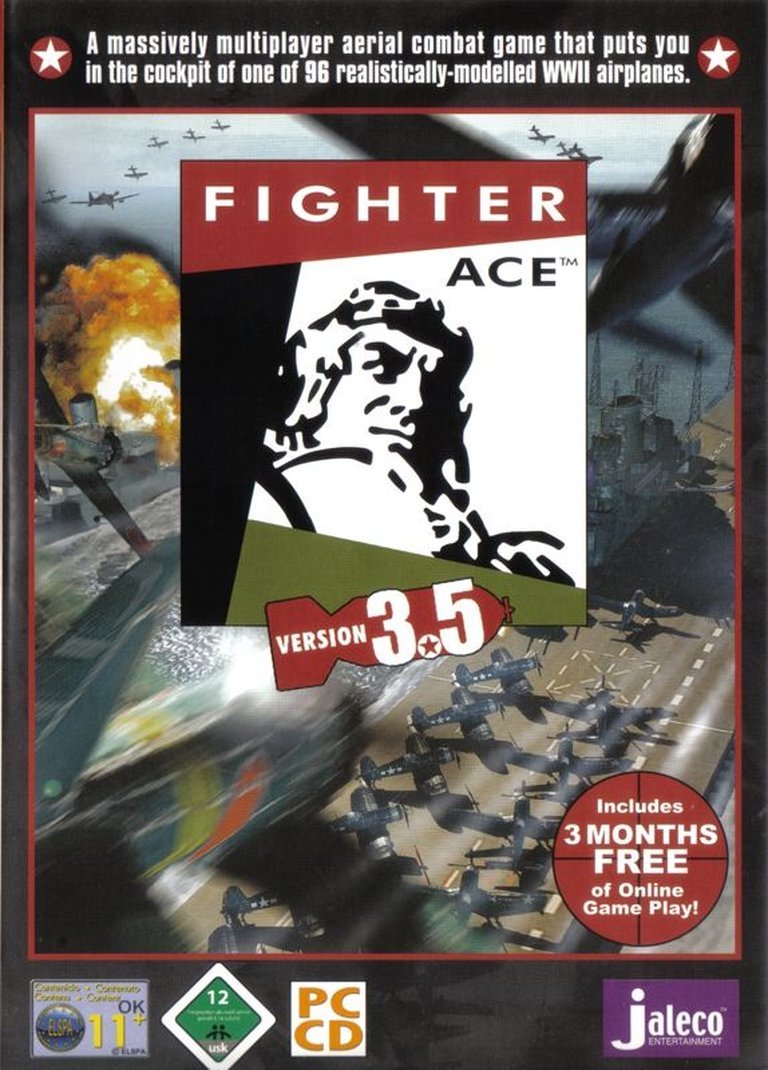
Fighter Ace 3.5 is a World War II online combat flight simulator set in the skies over Europe and the Pacific, where players pilot over 96 authentic aircraft from major nations including the United States, Great Britain, Germany, the Soviet Union, and Japan. It features multiplayer modes like fast-paced Dogfight battles, strategic Territorial Conquest missions to bomb enemy supplies and protect resources, and offline training against AI pilots, enabling massive aerial engagements with players worldwide.
Gameplay Videos
Fighter Ace 3.5 Reviews & Reception
metacritic.com (83/100): A great game for flight sim and WW2 enthusiasts, with a wide range of gameplay options backed up by outstanding in-game customer support.
ign.com : Jaleco and VR1 broaden the battlefield with this update.
myabandonware.com (88/100): I truly miss that game played it for hours on end
Fighter Ace 3.5: Review
Introduction
Imagine throttling up a Messerschmitt Bf 109 over the English Channel, tracers stitching the sky as a squadron of Spitfires dives from the sun—that’s the pulse-pounding immediacy of Fighter Ace 3.5, a 2002 Windows title that transformed solo flight sims into chaotic, global multiplayer dogfights. As the third major iteration in the Fighter Ace series—building on Fighter Ace 1.5 from 1998—this game arrived at a pivotal moment when broadband was democratizing online gaming, predating modern MMOs like World of Warplanes. Its legacy lies in pioneering massively multiplayer aerial combat in a WWII setting, blending arcade accessibility with sim authenticity to host battles with dozens (or hundreds) of real pilots. My thesis: Fighter Ace 3.5 wasn’t just a flight game; it was a vibrant online ecosystem that captured the raw exhilaration of WWII air war, leaving an indelible mark despite its eventual server shutdown, though its offline echoes endure for history buffs.
Development History & Context
Fighter Ace 3.5 emerged from a transatlantic collaboration blending American publishing savvy with Russian technical prowess, reflecting the era’s outsourcing trends in game dev. Publisher Jaleco Entertainment, Inc.—known for arcade ports and niche sims—handled North American distribution, while development split between Jaleco and Ketsujin Russian Studio (formerly tied to VR-1 Russia/BST Soft from earlier entries). Key figures included President Richard P. Wnuk, Executive Producer David McCloskey, Producer Mike D’Agnillo, and designer Doug Johnson, with a massive 69-person credit list dominated by Russian talent: programmers like Andrey Belogolov and Sergey Dubitsky, graphics engine leads Ruslan Abdikeev and Ivan Kozlov, and artists such as Anton Bogdanov.
The series originated in 1997 with Fighter Ace/Air Attack under Microsoft and VR-1, evolving through Fighter Ace 2 (self-published by VR-1) into Fighter Ace 3 by Ketsujin in 2002, with 3.5 as a rapid-update patch expanding content. Released November 25, 2002, on CD-ROM for Windows PCs, it targeted joystick-wielding enthusiasts amid technological constraints: DirectX-era graphics prioritized performance for online play (Internet/Modem, monthly subscription ~$10 after three free months), supporting 100+ players without modern broadband ubiquity. Input leaned on mouse/keyboard but shone with joysticks like Microsoft’s Sidewinder (famously gifted to top players).
The 2002 gaming landscape was crowded with WWII sims—IL-2 Sturmovik (2001) set the realism bar, Combat Flight Simulator 2 offered Pacific theater depth—but Fighter Ace 3.5 carved a niche as a subscription MMO, echoing Air Warrior‘s 1990s legacy. Visions centered on persistent worlds: Territorial Conquest mode simulated dynamic fronts, with plans for 27 historical battles (e.g., Midway with naval elements). Rigorous updates culminated in Fighter Ace 4.21 (2010 10th Anniversary online edition) before servers shut August 1, 2010, birthing the offline 4.2 Deluxe Edition. This era’s piracy risks and server costs doomed many early MMOs, but Fighter Ace‘s community-driven patches (via Mod DB) extended its life.
Narrative & Thematic Deep Dive
Unlike story-heavy sims like IL-2, Fighter Ace 3.5 eschews linear campaigns for emergent multiplayer narratives, where player actions script history in real-time. No scripted protagonists or voiced dialogue exist; instead, “plot” unfolds through allegiance to one of five nations (US, Great Britain, Germany, Soviet Union, Japan), framing you as an anonymous ace in Europe or Pacific theaters. Dogfight mode delivers episodic vignettes—lone wolf scraps or team brawls—while Territorial Conquest crafts grand strategy epics: align with a country, bomb enemy supply centers/tank columns, defend your assets, triggering AI ground offensives to capture “scenes” (airfields, factories, shipyards). Cargo/paradrop missions add sabotage layers, enabling rear-line seizures and fluid fronts.
Thematically, it romanticizes WWII aerial warfare’s duality: the lone fighter’s adrenaline rush (“Auf Wiedersehen” after a Hurricane kill, per IGN’s vivid recount) versus collective strategy, evoking Battle of Britain camaraderie. Themes of persistence triumph over skill critique grindy ranking (kills accrue ranks from Cadet to ace), mirroring wartime meritocracies, while realism sliders (arcade “soft” vs. hardcore) probe accessibility vs. authenticity. No overt anti-war messaging—pure glorification of furballs with 180-player chaos—but underlying motifs of community endure in player lore: squads like GRR or FG Demon Dogs, self-policed cheaters, and tournament rivalries hosted by Microsoft/MSN Zone. Offline mode’s AI “fodder” trains for this human theater, underscoring multiplayer as the soul. Critiques note shallow depth (no cities, theoretical AI conquests), but emergent tales—like 35-kill streaks or tank-kill leaderboards—forge personal myths.
Gameplay Mechanics & Systems
At its core, Fighter Ace 3.5 loops around takeoff-fight-land cycles, refined for online frenzy with 96+ meticulously modeled planes (Bf 109 variants, Spitfires, Tomahawks, Jacks, Bettys, C-47s). Dogfight is instant gratification: join arenas for free-for-alls or teams, blending arcade snap-rolls with sim physics (throttle cuts, engine torque). Territorial Conquest, the “real meat,” demands coordination—strategic bombing triggers tank advances, paradrops/C-47 hauls seize bases, bomber formations let leaders fly while gunners defend via auto-follow. Offline Play hones skills against AI, bridging to multiplayer.
Combat deconstructs WWII tactics: energy fighting (boom-and-zoom vs. turn-fights), damage models (wing hits, engine failure), views (1st-person cockpit, 3rd-person external, bombardier). Progression ties to kills, weighted by realism (hardcore arenas yield more points), curbing grinders; ranks signal prowess, though inconsistencies lingered. UI excels: intuitive gauges, maps, snapping crosshairs, formation commands. Innovations shine—dynamic weather/flak, ground targets (tanks, ships)—but flaws include server lag in mega-battles (mitigated by detail tweaks), absent manual, and AI quirks (static fronts pre-patch).
| Mechanic | Strengths | Weaknesses |
|---|---|---|
| Flight Model | Authentic handling (heavy bombers fight loads), 96 planes’ variety | Variant-heavy roster lacks diversity (e.g., no Me 110) |
| Multiplayer | 100+ players, lag-free dogfights, squad play | Server instability, player-dependent populations |
| Progression | Skill-weighted ranks, unlockable via play | Grind favors time over talent |
| Controls/UI | Joystick heaven, clear instruments | Mouse clunky, poor docs |
Scalable realism ensures accessibility—casuals frag, vets master loops—making sessions elastic (20 minutes to weekends).
World-Building, Art & Sound
WWII Europe/Pacific theaters form a modular sandbox: “scenes” as airfields/factories/shipyards dot maps (e.g., Channel clashes, early Germany-Britain fronts), no civilian sprawl for focus. Atmosphere thrives in scale—hulking fortresses vs. nimble fighters in dawn raids, flak blooms, ocean crashes—evoking historical furballs. Visuals, era-appropriate DirectX, prioritize speed: detailed cockpits (glinting sun, drifting clouds), poly models with shake on explosions, but low-res textures age poorly. 3rd-person aids situational awareness in melees.
Sound design falters—punchy engines/cannon cracks suffice, but lacks immersion (no radio chatter, weak ambiance), a noted deficiency. Collectively, these forge tension: low-altitude torque struggles, shipyard strafes amid tracers, massive battles stressing immersion despite performance dips. Offline feels preparatory, online elevates to living history.
Reception & Legacy
Launch reception was solid: MobyGames 72% (Adrenaline Vault 80%: “endless addictive entertainment”; Jeux Vidéo 65%: “accessible but lacks depth”), IGN 8.4 (“great for 20 minutes or weekends”), Metacritic 83 (PC Gamer 85, GameZone 81). Praised for online thrill/community, dinged for sound/UI/server woes (patches addressed). Commercially niche—subscription model yielded devoted niches, free joysticks built loyalty—but servers’ 2010 demise (post-4.21) ended online era.
Legacy endures as MMO flight pioneer: influenced War Thunder‘s persistent battles, predated World of Warplanes. Nostalgia booms on abandonware (MyAbandonware 4.38/5, Facebook groups), with players lamenting squads/furballs (“best multiplayer days”). Offline Deluxe preserves it; culturally, it democratized sims, fostering self-moderated communities amid IL-2 rivals. No direct sequels, but echoes in modern free-to-play skies.
Conclusion
Fighter Ace 3.5 masterfully fused arcade zest with sim depth, its multiplayer arenas birthing ephemeral epics that no AI could match—flawed yet fervent, a testament to early online gaming’s promise. Technological limits and shutdown temper its place, but as a community crucible and WWII air war milestone, it earns a resounding 8.5/10. Historians must seek abandonware/offline ports; for pilots, it’s a relic worth resurrecting—proof that the best dogfights were human. In video game history, it soars as the ace that got away.