
- Release Year: 1996
- Platforms: Macintosh, Windows
- Publisher: Disney Interactive, Inc.
- Developer: 7th Level, Inc.
- Genre: Puzzle
- Perspective: Side view
- Game Mode: Single-player
- Gameplay: Arcade, Tile matching puzzle
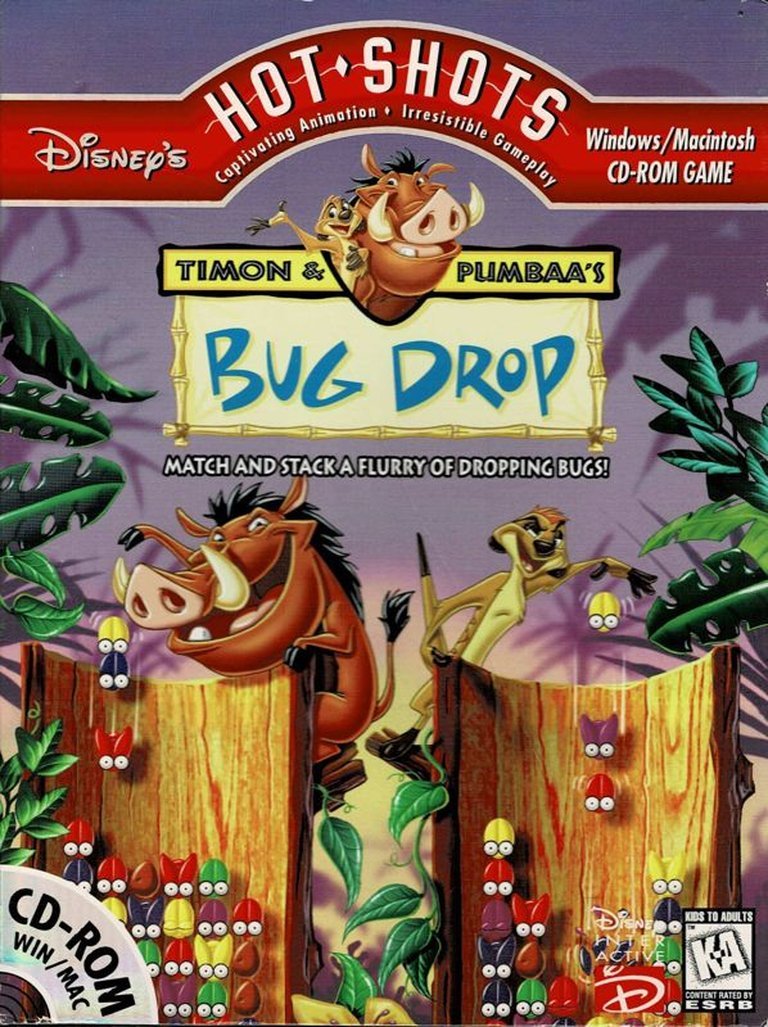
Description
Disney’s Hot Shots: Timon and Pumbaa’s Bug Drop is a 1996 tile-matching puzzle game developed by 7th Level and published by Disney Interactive for Windows and Macintosh, featuring Timon and Pumbaa from The Lion King in a side-view, fixed/flip-screen arcade setting where players drop and match bugs to clear the board in fun, kid-friendly challenges.
Disney’s Hot Shots: Timon and Pumbaa’s Bug Drop: Review
Introduction
Imagine a time when CD-ROM drives whirred to life, unleashing vibrant worlds of Disney magic on home PCs, where The Lion King‘s breakout stars—Timon the meerkat and Pumbaa the warthog—traded savanna antics for pixelated puzzle pandemonium. Released in 1996, Disney’s Hot Shots: Timon and Pumbaa’s Bug Drop is a hidden artifact from the golden age of multimedia kids’ gaming, a tile-matching puzzle that distills the duo’s irreverent humor into an addictive arcade loop. As part of Disney Interactive’s “Hot Shots” series, it rode the wave of The Lion King‘s cultural dominance, offering bite-sized fun amid the era’s edutainment explosion. This review argues that Bug Drop endures not as a technical marvel, but as a pitch-perfect embodiment of 1990s Disney synergy—charming, chaotic, and endlessly replayable—cementing its niche legacy in the pantheon of family-friendly puzzle games.
Development History & Context
Developed by 7th Level, Inc., a Dallas-based studio pioneering high-fidelity animation on CD-ROMs, Bug Drop emerged from a fertile creative partnership with Disney Interactive. 7th Level, founded in 1993, specialized in lavish multimedia titles leveraging the era’s optical media boom, such as their Monty Python series and earlier Hot Shots entries like Timon & Pumbaa’s Jungle Pinball (1995). Their vision for Bug Drop was clear: capitalize on The Lion King‘s 1994 blockbuster success—grossing over $968 million worldwide—by spinning off Timon and Pumbaa, the film’s comic relief, into standalone “quick-play” experiences. Publisher Disney Interactive, flush with tie-in revenue, greenlit a slew of such games, viewing PC CD-ROMs as an untapped frontier for transmedia storytelling.
The technological constraints of 1996 shaped the game profoundly. Windows 95 and Macintosh System 7 dominated, with 486/Pentium processors and 8-16MB RAM standard; CD-ROMs allowed “thousands of original animation cells,” a selling point amid 640×480 resolutions and 256-color palettes. Fixed/flip-screen visuals and direct-control interfaces minimized hardware demands, ensuring accessibility on budget family rigs. The gaming landscape was puzzle-saturated yet ripe for Disneyfication: Tetris clones like Columns (1990) and Dr. Mario (1990) ruled arcades, while The Lion King platformers (Virgin Interactive, 1994) proved IP extensions viable. Bug Drop slotted into this as an “arcade tile-matching puzzle,” distinct from edutainment heavyweights like The Oregon Trail but aligned with Disney’s casual portfolio (Pocahontas titles, 1995). Released alongside siblings like Hippo Hop (previous in series) and amid SNES ports of Timon & Pumbaa’s Jungle Games (1995), it targeted “Kids to Adults” (ESRB), blending strategy for parents with slapstick for children in a post-Windows 95 DirectX ecosystem.
Narrative & Thematic Deep Dive
At its core, Bug Drop‘s “plot” is a delightfully minimalist romp: Timon and Pumbaa, ever the opportunistic bug connoisseurs, must “store their bug supply” by sorting falling critters into color-matched groups of four or more before their log overflows. Framed as a competitive stockpile challenge, the story unfolds through contextual menus and in-game banter, with no sprawling campaign but endless progression via high scores. Timon, the snarky schemer, taunts players with quips like “Hakuna Matata—except when your log’s fulla matata!” while Pumbaa provides dopey counterpoint: gaseous interjections and self-deprecating asides. Dialogue, drawn from The Lion King‘s voice talent (or close impressions), peppers sessions with 90s pop culture nods—stink bugs as “sneaky” saboteurs evoke the film’s flatulence humor.
Thematically, Bug Drop amplifies The Lion King’s “Hakuna Matata” ethos: carefree indulgence amid chaos. Bugs represent gluttonous excess, grouping them a metaphor for finding order in Timon and Pumbaa’s hedonistic lifestyle. Friendship shines in head-to-head mode, where stopper stones “thwart” opponents, mirroring the duo’s bickering-yet-loyal dynamic. Subtle Lion King callbacks—jungle logs as Pride Rock proxies, chain reactions as stampede echoes—infuse depth without preachiness. For kids, it’s pure escapism; for adults, a nostalgic wink at Disney’s mastery of anthropomorphic charm. No heavy moralizing here; themes prioritize joy, replayability, and the thrill of outsmarting a warthog, making it a thematic triumph in micro-narrative design.
Character Analysis
- Timon: Agile antagonist in single-player, his wisecracking commentary drives tension, embodying survivor wit.
- Pumbaa: Bumbling foe or ally, his “stink bugs” power-ups nod to canon flatulence, adding chaotic equity.
Gameplay Mechanics & Systems
Bug Drop‘s core loop is a masterful evolution of match-3 precursors, viewed from a side-scrolling perspective where bugs cascade like Columns. Players drop colored insects (red ants, green beetles, etc.) into a log “storage logger,” aiming to align four or more of the same hue for explosive clearances. Gravity flips screens dynamically, demanding spatial strategy: misdrops trigger overflows, ending runs. Speed ramps with levels, blending arcade twitch reflexes and puzzle foresight.
Key systems elevate it:
– Chain Reactions: Multi-combos cascade clearances, scoring multipliers for “unlimited replayability.”
– Power-Ups:
| Power-Up | Effect | Strategic Role |
|---|---|---|
| Stink Bugs | Clear swathes of space | Emergency reset, Pumbaa homage |
| Stopper Stones | Block opponent drops | PvP sabotage, timing critical |
– Modes:
– Single-Player: Vs. Timon or Pumbaa AI, escalating difficulty via faster drops and smarter blocks.
– Head-to-Head: Hot-seat multiplayer, turn-based for couch co-op.
– Progression: No traditional levels; score-based endurance tests high-score chases, with “perfect for 10-minute breaks or hours.”
UI is era-appropriate: crisp direct-control mouse/keyboard, vibrant bug icons, score/log meters. Flaws include potential screen-flip disorientation and AI opacity—no visible opponent log in singles, fostering paranoia. Innovations like bug-specific physics (bouncy beetles) add nuance, making it a flawed-yet-fun gateway to modern match-3s like Candy Crush.
World-Building, Art & Sound
Set in a log-choked jungle evoking The Lion King‘s wilds, Bug Drop‘s world-building is intimate: flip-screen logs pulse with life, vines framing action as organic borders. Atmosphere thrives on escalation—from serene drips to frantic bug deluges—mirroring savanna unpredictability.
Art direction shines via 7th Level’s “thousands of original animation cells”: hand-drawn Timon/Pumbaa sprites burst with 90s flair—exaggerated expressions, squash-and-stretch physics. Fixed side-view maximizes detail, colors popping on CD-ROM textures. Sound design amplifies: bubbly drop SFX, satisfying pop clearances, chain-reaction booms. Timon/Pumbaa’s voiceovers—wisecracks mid-drop—infuse personality, with jungle ambiance (chirps, gurgles) and upbeat MIDI tracks (Lion King motifs remixed) creating immersive whimsy. Collectively, they forge a cozy, chaotic vibe, elevating a simple puzzle into a sensory Lion King tribute.
Reception & Legacy
Launch reception remains elusive—no MobyScore, no Metacritic aggregate, zero critic/player reviews on MobyGames or GameFAQs (as of 2025 entries). Commercially, it fit Disney’s prolific output: eBay listings fetch $12-30 for sealed copies (UPC 0712725000219), signaling modest collector interest amid 310k+ MobyGames titles. GameFAQs user stats peg it “Great” (8 ratings), “Easy” difficulty, ~11-hour length, but sparse.
Reputation evolved from forgotten filler to retro curiosity. Preservation via Archive.org ISOs ensures playability, while its “Hot Shots” series context—flanking Hippo Hop (1996) and Swampberry Sling (1998), alongside Jungle Games (SNES, 1995)—highlights Disney’s PC dominance pre-console shift. Influence: Pioneered Disney’s casual puzzle IP extensions, prefiguring Frozen Free Fall (2013); 7th Level’s animation tech informed later multimedia. In industry terms, it’s a microcosm of 90s CD-ROM ephemera—outshone by 3D but vital to family gaming’s democratization.
Conclusion
Disney’s Hot Shots: Timon and Pumbaa’s Bug Drop distills 1996’s multimedia zenith into a bug-choked gem: addictive mechanics, thematic levity, and Disney polish amid tech limits. From 7th Level’s ambitious cells to Timon/Pumbaa’s banter, it captures Hakuna Matata in pixels. Obscure yet resilient, it claims a rightful spot in video game history as an exemplar of accessible, IP-driven puzzling—essential for Lion King completists, retro enthusiasts, and puzzle aficionados. Verdict: 8.5/10—A charming time capsule deserving emulation revival.