
- Release Year: 2000
- Platforms: Windows
- Publisher: Fiendish Games, Ltd., Global Star Software Ltd., MitCom Neue Medien GmbH, Xtend New Media
- Developer: Fiendish Games, Ltd.
- Genre: Puzzle
- Perspective: 3rd-person (Other)
- Game Mode: Single-player
- Gameplay: Falling block puzzle
- Average Score: 66/100
Description
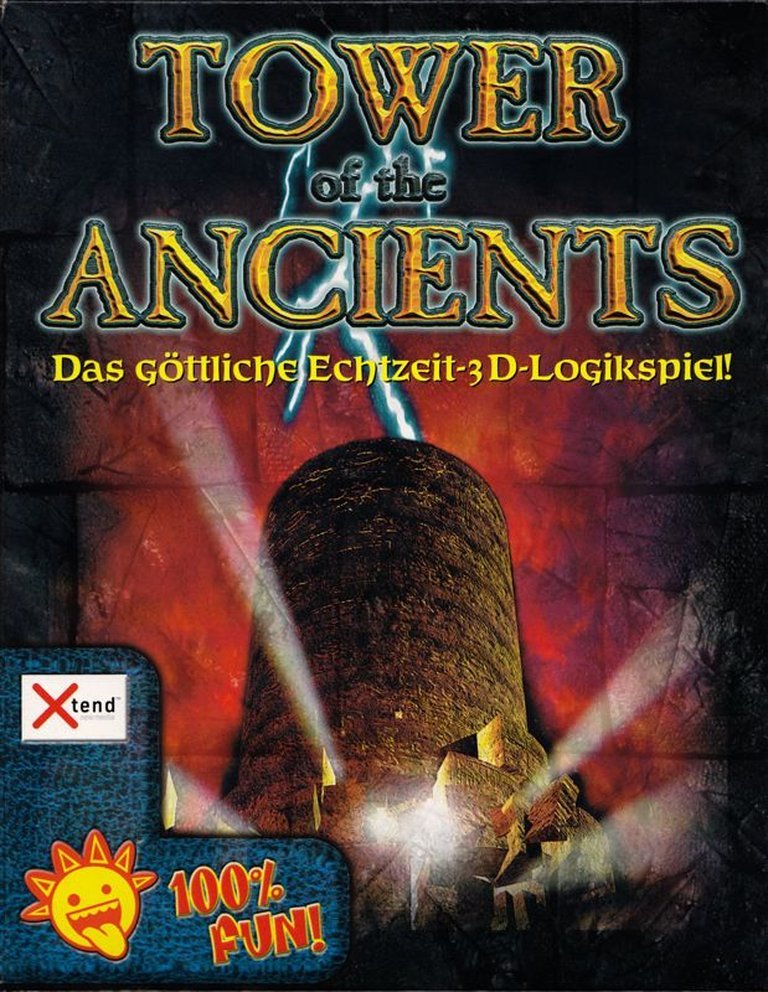
Tower of the Ancients is a falling block puzzle game where players strategically place symbol-etched stones on a circular field to construct a hollow tower, matching three identical symbols horizontally, vertically, or diagonally to make them vanish and earn points. Featuring ten progressively challenging levels with varying restrictions like limited match directions, the objective is to accumulate sufficient points without allowing the tower to reach the top of the screen.
Gameplay Videos
Tower of the Ancients Free Download
Tower of the Ancients Cracks & Fixes
Tower of the Ancients Mods
Tower of the Ancients Reviews & Reception
myabandonware.com (100/100): ranks among one of the best Tetris clones ever created
game-over.com (31/100): essentially frustration or boredom without reward
Tower of the Ancients Cheats & Codes
PC
Type “take me now satan” at the main menu to enable cheat mode. Lightning will flash to confirm correct code entry. Press one of the following keys during gameplay to activate the corresponding cheat function.
| Code | Effect |
|---|---|
| F1-F9 | Level select |
| # | Restore bricks in fallen tower |
| O | Prevent blocks from dropping |
| L | Cast lightning |
| ] | Toggle disappearing blocks |
| W | Win current level |
Tower of the Ancients: Review
Introduction
In the shadow of monolithic giants like Tetris and Columns, few puzzle games dare to weave a biblical epic into their block-stacking frenzy, but Tower of the Ancients (2000) does just that with irreverent flair. Imagine a priest thwarting the Tower of Babel’s hubris not through prayer, but by frantically rotating a divine disc of doom to match glowing symbols before God’s wrathful hand descends. Released amid the PC boom of Y2K, this Fiendish Games obscurity captures the era’s budget ingenuity: 3D pizzazz on a shoestring, a pseudo-religious motif that borders on blasphemy, and gameplay that hooks with holy fire before settling into repetitive purgatory. My thesis? Tower of the Ancients is a testament to indie ambition—a visually spectacular Tetris variant that elevates the falling-block formula through thematic audacity and technical bravado, yet stumbles into obscurity due to its lack of enduring depth, cementing its status as a cult underdog rather than a genre titan.
Development History & Context
Fiendish Games, Ltd., a diminutive UK-based studio known for cheeky titles like Natural Fawn Killers and Hot Chix ‘n’ Gear Stix, birthed Tower of the Ancients in 2000 as a digital download darling, later seeing CD-ROM releases via publishers like MitCom Neue Medien GmbH, Xtend New Media, and Global Star Software. Led by Stephen Lyons’ original concept and code—polished by James Brown’s programming, Paul Boulden’s art, Mike Ash’s sound, and Ian Livingstone’s soaring music—this seven-person team (including producer Shawnee Sequeira and marketer Alastair Cox) embodied the scrappy indie ethos of the pre-Steam era.
The late ’90s PC landscape was a puzzle paradise dominated by Tetris clones, but Tower arrived as hardware accelerated toward 3D glory. Powered by RenderWare (the engine behind early PS2 hits) and Direct3D, it demanded a Pentium 166MMX with a 3D accelerator and 32MB RAM—modest by 2000 standards, yet ambitious for a puzzle title. Fiendish’s vision was clear: subvert the Babel myth into addictive puzzling, sold online at a budget $15 price point. Technological constraints like choppy audio and no multiplayer (a glaring omission lamented by critics) reflected their lean resources, while the gaming scene buzzed with 3D spectacles (Quake III, Unreal Tournament). Distribution woes—initially web-only, later shareware via Small Rockets after Fiendish folded—doomed it to niche status, but its survival as abandonware underscores the abandonware community’s role in preserving such artifacts.
Narrative & Thematic Deep Dive
Tower of the Ancients boldly reimagines the Genesis tale of Babel, where humanity’s ziggurat ambition provoked divine confusion of tongues. Here, you embody a “benevolent priest, wise in His service,” tasked with diverting God’s gaze by… constructing the very tower He smote? The ad blurb nails the cheeky paradox: “What if the LORD had not seen the tower? What if some benevolent priest… restrained those ancient engineers?” Gameplay manifests this as sabotage-through-stacking: blocks rain like manna (or curses), bearing religious icons—crucifixes, Stars of David, ichthys fish, crescents—demanding sacrilegious alignment to “vanish” chunks, preventing the structure from piercing heaven.
The narrative unfolds implicitly across ten levels, with no voiced dialogue or cutscenes, but atmospheric cues abound: ominous Gregorian chants swell as the tower swells, culminating in God’s skeletal hand sweeping down at failure, evoking pillar-of-salt retribution. Themes probe hubris versus humility—player as mediator between mortal folly and celestial ire—infused with irreverence (God’s “malnourished Ethiopian” hand, per one critic). Progression mirrors biblical escalation: early levels echo Edenic simplicity, later ones impose “restrictions” akin to plagues (directional matching only), symbolizing divine tests. Characters are absent beyond the player-priest archetype, but the tower itself personifies chaos, its hollow core a void of unfulfilled ambition. This minimalist storytelling, while no Final Fantasy, lends thematic cohesion rare in puzzles, transforming rote matching into a mock-epic quest.
Gameplay Mechanics & Systems
At its core, Tower of the Ancients refines Columns-style matching on a cylindrical, rotatable disc—eschewing Tetris‘ linear grid for a 3D “hollow tower” that visually accrues like Babel itself. Tri-symbol blocks descend; mouse controls let you rearrange symbols mid-fall, rotate the disc (left/right), and drop precisely. Matches of 3+ identical icons (horizontal, vertical, diagonal) vaporize with chain reactions, scoring points (more for combos) and shifting the edifice downward. Game over looms when the stack breaches the screen-top, God’s hand smiting all.
Ten levels demand escalating clears (blocks/lines/points), with speed ramping to frenzy—early stages leisurely, later ones “hectic” per reviews. Innovations shine: Level 4 mandates horizontal-only, 6 vertical-only, 8 diagonal-only, forcing adaptive strategies; specials like Wild Cards (match-any) and Spite Blocks (erase all of one symbol) inject chaos. UI is intuitive—minimalist HUD tracks score, next block, level goal—but flawed: no save system strands long sessions (20+ minutes per late level), and constant speed (unlike Tetris‘ acceleration) breeds tedium as quotas balloon.
Progression loops addict initially: frantic positioning yields “Hallelujah” combos, but repetition erodes replayability—no endless mode, multiplayer, or leaderboards. Controls excel (no reference card needed), yet puzzle purity falters—easy early clears suit casual dips, but marathon demands deter “short play periods.” Verdict: mechanically solid, with directional twists elevating it above clones, but lacking depth for mastery.
World-Building, Art & Sound
The game’s pseudo-Babylonian realm pulses with atmospheric alchemy: a vast, rotating stone disc atop misty plains, ringed by ethereal pillars under stormy skies—3D environs leveraging Direct3D for rotation and depth rare in puzzles. Art by Paul Boulden impresses: glowing rune-stones shimmer, blocks textured with crisp symbols; the tower’s organic growth evokes ancient ziggurats. Effects dazzle—vanishing matches erupt in particle blasts, god-hand descends with thunderous crumble—though critics decry “crude” lighting (hyper-pixelated blobs) and dated backgrounds. RenderWare enables fluid 360° views, immersing players in a “grimy, dark” abyss (per Reddit nostalgia).
Sound elevates the divine drama: Ian Livingstone’s score blends epic choirs, chants, and organs—ominous swells building tension, triumphant “Hallelujahs” rewarding cascades. Mike Ash’s FX punctuate: laser-zaps for clears, quakes for near-overflows. Yet flaws grate—choppy music drowns in SFX clutter, repetitive lasers irk after levels. Collectively, these craft a cohesive “pseudo-religious motif,” drawing players into Babel’s hubris; visuals wow on era hardware, sound immerses, but budget limits polish.
Reception & Legacy
Launched to muted fanfare, Tower of the Ancients garnered a middling 62% critic average (MobyGames): highs like Game Captain’s 80% (“surprisingly beautiful, simple, good”) and ESC’s 70% (frantic depth, $15 value) praised visuals/theme; lows like Game Over Online’s 31% scorched repetition (“frustration or boredom without reward”). Players averaged 3.7/5, echoing addictiveness sans obsession. Commercial obscurity followed—online-only sales, Fiendish’s demise—but cult endurance persists: abandonware darling (MyAbandonware 5/5 votes), Reddit quests, fan remakes like Towers Saga (2025 Steam demo).
Influence is subtle: no direct successors, but anticipates 3D puzzles (Drakan: The Ancients’ Gates echoes thematically). As budget shareware (Small Rockets 2002), it exemplifies Y2K indies—punching via tech/theme, fading sans support. Reputation evolved from “Tetris clone” dismissals to nostalgic gem, preserved by MobyGames (added 2009) and archives.
Conclusion
Tower of the Ancients endures as a flawed masterpiece of miniature scope: audacious biblical remix, 3D spectacle in puzzle drag, and frantic matching elevated by restrictions/specials. Yet repetition, absent saves/multiplayer, and marathon levels cap its transcendence, dooming it beyond casual cultists. In video game history, it claims a quirky niche—underdog testament to indie pluck amid 2000’s 3D dawn, warranting emulation for puzzle historians. Final Verdict: 7/10—Religiously addictive for sessions, eternally obscure, but a divine diversion worth Babel’s risk.