
- Release Year: 2007
- Platforms: Windows
- Publisher: 10tacle studios AG, Viva Media, LLC
- Genre: Compilation
- Perspective: First-person
- Game Mode: LAN, Online PVP, Single-player
- Gameplay: Racing
- Average Score: 90/100
Description
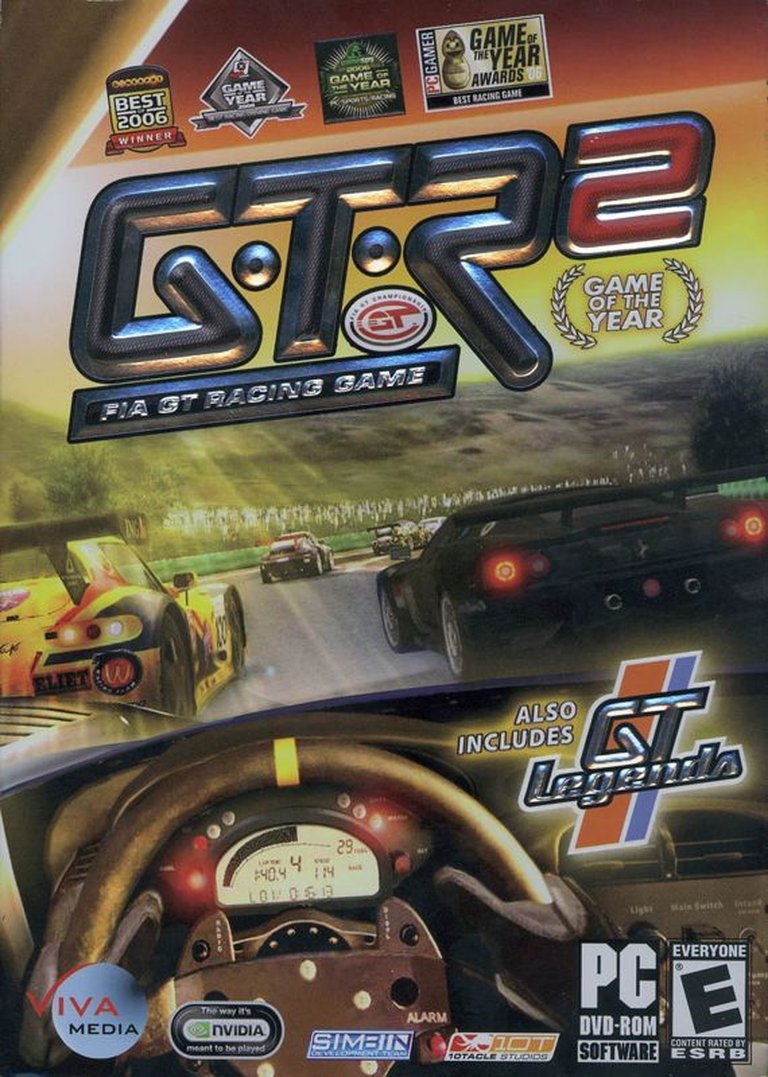
GTR 2: FIA GT Racing Game – Game of the Year is a compilation edition that packages the original GTR 2: FIA GT Racing Game (version 1.0) with GT Legends (patched to version 1.1), delivering realistic sports car racing simulations based on the FIA GT Championship series, featuring over 140 high-detailed GT and NGT class cars, 34 track layouts, various modes including championships, endurance races like the Spa 24 Hours, practice sessions, time trials, and driving school, enhanced by advanced physics, dynamic lighting, damage modeling, and multiplayer options.
GTR 2: FIA GT Racing Game – Game of the Year Cracks & Fixes
GTR 2: FIA GT Racing Game – Game of the Year Mods
GTR 2: FIA GT Racing Game – Game of the Year Reviews & Reception
store.steampowered.com (92/100): Very Positive (92% of the 260 user reviews for this game are positive).
en.wikipedia.org (90/100): The game has received widespread acclaim.
sira-simracing.com (90/100): One of the 2000’s most highly regarded PC Sim Racing titles.
metacritic.com (90/100): Universal Acclaim.
GTR 2: FIA GT Racing Game – Game of the Year: Review
Introduction
Imagine the thunderous roar of a Maserati MC12 GT1 slicing through the night at Spa-Francorchamps, tires screeching as Eau Rouge tests your mettle under dynamic rain-slicked conditions—this is the visceral thrill that GTR 2: FIA GT Racing Game – Game of the Year (2007) delivers, cementing its place as a pinnacle of mid-2000s PC racing simulations. Released as a compilation bundling the acclaimed GTR 2: FIA GT Racing Game (2006, version 1.0) with the classic-car focused GT Legends (2005, patched to 1.1), this edition was hailed by numerous outlets as the top racing title of 2006, offering unprecedented value by spanning eras from vintage touring cars to cutting-edge FIA GT machinery. As a game historian, I argue that this GOTY package not only refined the groundbreaking realism of its predecessor GTR (2004) but also defined the gold standard for accessible yet uncompromising sim racing, influencing a generation of titles while fostering a modding legacy that keeps it alive today.
Development History & Context
SimBin Studios AB—later rebranded as Sector3 Studios and now KW Studios under German automotive giant KW Automotive—emerged from the ashes of the early 2000s PC racing scene, helmed by visionary developer Harry Calas. GTR 2 was co-developed with Blimey! Games, building directly on the ISImotor (formerly gMotor) engine that powered the original GTR. Publishers 10tacle Studios AG and Viva Media, LLC handled distribution, targeting a PC-exclusive release amid a landscape dominated by console arcade racers like Need for Speed: Most Wanted (2005) and Gran Turismo 4 (2004).
The 2006 era posed unique technological constraints: DirectX 9.0c was the bleeding edge, with mid-range PCs (Pentium 4, 1GB RAM, GeForce 6-series GPUs) struggling under high-polygon car models and dynamic weather. SimBin’s vision was laser-focused on authenticity—licensing the 2003-2004 FIA GT Championship, complete with over 140 cars (from BMW M3 GTRs to Saleen S7-Rs) and 34 track variants like Hockenheim GP and Magny-Cours National. This was ambitious amid piracy woes and a shift toward consoles, where sims like Project Gotham Racing 3 offered polished but less realistic experiences. The GOTY edition, launched in 2007, responded to demand by pairing GTR 2 with GT Legends, SimBin’s ode to 1960s-1970s classics (Ford GT40s, Jaguar E-Types), patched for stability. Development emphasized moddability from day one, using editable .mas files for cars and tracks, presciently anticipating community-driven longevity in an era before Steam Workshop.
Narrative & Thematic Deep Dive
As a pure racing simulator, GTR 2 GOTY eschews cinematic plots for an emergent narrative rooted in motorsport’s unforgiving hierarchy. There’s no voiced protagonist or branching dialogue; instead, progression unfolds through career-like structures in both titles. In GTR 2, you embody an upstart driver climbing the FIA GT ladder—from open practice and driving school tutorials (led by a virtual instructor breaking down sectors at tracks like Imola) to full race weekends, championships, time trials, and grueling 24-hour endurance events at Spa. Themes of perseverance shine: mastering sensitivity-based steering, fuel strategy, and tire wear mirrors real GT racing’s blend of mechanical precision and human error.
GT Legends adds historical depth, evoking nostalgia for racing’s “golden age.” Campaigns simulate era-specific series, pitting Shelby Cobras against Alfa Romeos amid period-authentic grids. Unlockables like liveries and sponsorships craft a pseudo-story of legacy-building, where dominating Monza Junior in a Lotus Elise feels like channeling motorsport heritage. Underlying themes—rivalry, innovation vs. tradition (modern GT vs. classics)—resonate through AI opponents mimicking human-like tactics: aggressive overtakes at Dubai Autodrome or defensive lines at Oschersleben. Dialogue is sparse (HUD prompts, radio chatter), but the damage model narrates consequences vividly—a crumpled Viper GTS-R after a Brno pile-up underscores hubris. This “plotless” structure, elevated by contextual authenticity, immerses players in racing’s thematic core: glory earned lap by lap.
Gameplay Mechanics & Systems
At its heart, GTR 2 GOTY revolves around hyper-realistic core loops: qualify, race, pit, repeat—deconstructed with surgical precision. The ISImotor physics engine extends GTR‘s foundation, simulating tire grip, weight transfer, aero downforce, and damage across GT/NGT classes. Cars feel distinct—the tail-happy Lamborghini Murciélago R-GT demands throttle finesse, while the planted Maserati MC12 rewards smooth inputs. Three difficulty tiers (Novice: assists galore; Semi-Pro: balanced; Simulation: raw realism) scale accessibility, with customizable steering sensitivity, speed sensitivity, and lock angles (up to 23 degrees, tunable via Logitech Profiler for wheels like G25).
Progression is event-driven: driving school teaches braking points; championships span seasons with dynamic weather/night cycles; multiplayer (LAN/Internet) supports global grids. Innovations shine in pit strategy—mandatory stops for fuel/tires enforce chess-like planning—and modding tools, enabling Nordschleife imports or VR. Flaws persist: UI feels dated (clunky menus, no native 4K), keyboard/gamepad controls approximate but falter (wheels essential for immersion), and GTR 2‘s v1.0 lacks GT Legends‘ patches, occasionally causing stability hiccups. GT Legends complements with vintage handling quirks (understeer-heavy classics). Multiplayer thrives via fan servers, but Steam’s version omits some licensed Ferraris/Porsches due to expirations—mods restore them. Overall, loops reward mastery, with AI’s tactical depth (e.g., mirroring your lines) preventing repetition.
World-Building, Art & Sound
The “world” is a meticulously recreated FIA GT universe: 34 layouts across Europe, UAE, and China (Zhuhai’s twists, Estoril’s elevation changes), laser-scanned for accuracy. GTR 2 excels in atmosphere—dynamic lighting casts long shadows at Monza 2004, rain sprays visors at Spa 2003, crowds cheer from grandstands. Visuals, powered by DX9 effects, feature high-poly cars with sponsor-accurate decals, reflective paints, and cockpit details (gauges flicker realistically). GT Legends evokes sepia-toned nostalgia: sun-baked Laguna Seca, period scenery sans modern barriers.
Art direction prioritizes simulation over flash—trackside objects (barriers, curbs) deform under abuse, damage ripples panels. Draw distances impress for 2006, holding up modded in 4K. Sound design, by composer Stephen Baysted, elevates: inline-6 Porsches whine authentically, V12 Ferraris howl; engine bays pulse with mechanical clatter, tires whisper on asphalt before squealing. Radio chatter (“Box, box!”) and crowd ambiance build tension during 24-hour stints. Weather audio—pattering rain, wind howl—amplifies immersion, contributing to a holistic sensory cockpit that outshines console peers.
Reception & Legacy
Upon 2006 launch, GTR 2 exploded: Metacritic 90/100 (IGN 9.2/10, GameSpot 9/10, Operation Sports 100/100), earning IGN’s Best PC Racing Game, GameSpot’s Best Driving Game (and “Best Game Nobody Played”), PC Gamer’s Best Racing, and Computer Games Magazine’s Best Simulation. The 2007 GOTY edition amplified value, though MobyGames notes sparse user reviews (3.0/5 average from few votes). Commercially, it topped charts despite PC piracy, bundling boosting sales.
Reputation endures: Steam’s 92% positive (260+ reviews), active forums discuss Moza wheels and patches. Influence ripples—pioneered modding (Overtake.gg hosts hundreds of cars/tracks, Nordschleife, open-wheelers), inspiring iRacing, RaceRoom (SimBin successor), and rFactor 2. Licensing lapses (Steam’s car cuts) spurred community fixes; cancelled GTR 3 echoes in Project Motor Racing. In sim history, it bridged arcade-to-sim shift, proving PC’s sim supremacy pre-console invasions.
Conclusion
GTR 2: FIA GT Racing Game – Game of the Year masterfully fuses GTR 2‘s modern GT intensity with GT Legends‘ classics, delivering exhaustive content, physics perfection, and modding freedom that eclipses contemporaries. Minor UI/modernization gripes pale against its realism, variety (140+ cars, 34 tracks), and replayability. As a historian, I verdict it essential—a landmark securing SimBin’s throne in video game history, eternally revving for sim racers chasing authentic adrenaline. Score: 9.5/10