
- Release Year: 2000
- Platforms: Windows
- Publisher: Electronic Arts, Inc.
- Developer: Electronic Arts, Inc.
- Genre: Compilation
- Perspective: First-person
- Game Mode: Online PVP, Single-player
- Gameplay: Exploration, Hunting, Simulation
- Setting: Realistic, Wildlife
- Average Score: 65/100
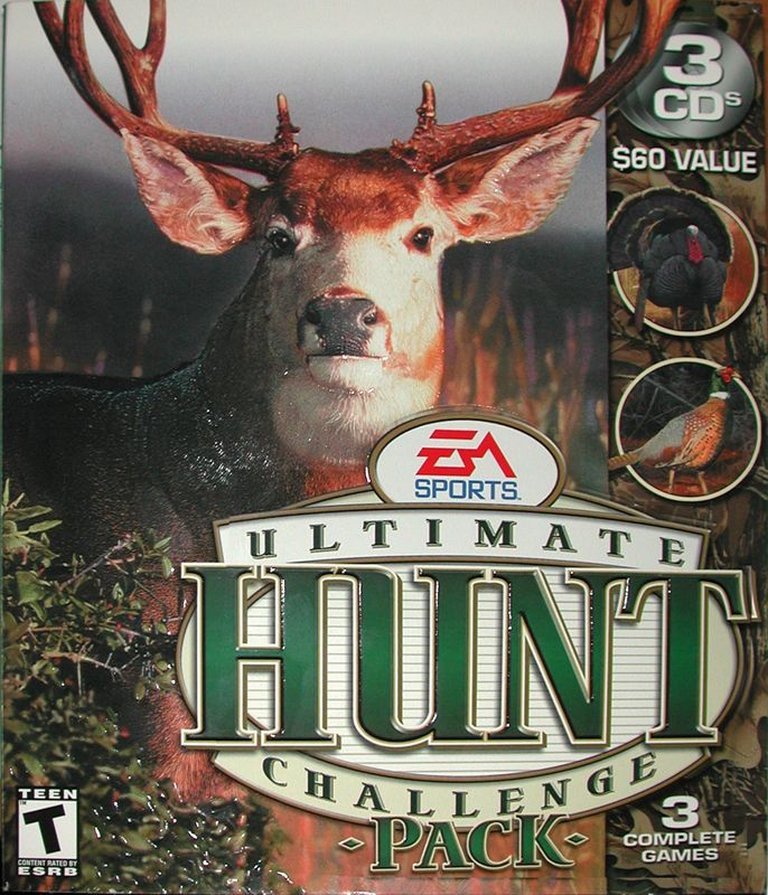
Description
Ultimate Hunt Challenge Pack is a 2000 Windows compilation from Electronic Arts featuring three hunting simulation games—Deer Hunt Challenge, Pheasant Hunt Challenge, and Turkey Hunt Challenge—offering realistic gameplay across expansive territories on multiple CDs, with support for solo offline play and up to four players online via Internet, challenging hunters to track and bag game in detailed environments.
Ultimate Hunt Challenge Pack: Review
Introduction
In the bustling year of 2000, when the PlayStation 2 launched amid fanfare for genre-defining titles like The Sims, Deus Ex, and Tony Hawk’s Pro Skater 2, a quieter contender emerged from Electronic Arts’ sports division: Ultimate Hunt Challenge Pack. This three-disc behemoth bundled Deer Hunt Challenge Special Edition (a refined 1999 release with 15 new levels), the all-new Pheasant Hunt Challenge, and Turkey Hunt Challenge, targeting North America’s most prized game animals—deer, pheasants, and wild turkeys. As a compilation, it promised over 100 challenge-based scenarios, multiplayer internet tournaments, and unprecedented realism in animal AI and sprawling 3D environments. My thesis: While not a revolutionary landmark, Ultimate Hunt Challenge Pack stands as a pinnacle of early 2000s PC hunting simulations, delivering exceptional value through its strategic depth, immersive worlds, and authentic hunting mechanics that captured the patience and cunning required in the wild, cementing EA Sports’ foothold in a niche genre ripe for Cabela’s-style dominance.
Development History & Context
Developed primarily by the Inland Design Team under EA Sports’ banner, Ultimate Hunt Challenge Pack was helmed by executive producers Michael Cihak and D. Scott Williamson, with associate producer Rob Nicholls overseeing integration. The credits boast 118 contributors, including programmers like Brian Bilicki and Joe Chang, world artists such as Mike Cronin and Andy Dorizas, and interface designer Daniel Bernard. Michael Cihak also handled music and sound, composing original tracks alongside Matt Scott. This was EA’s second major foray into hunting sims, building on Deer Hunt Challenge‘s 1999 foundation amid a PC gaming landscape constrained by DirectX 7, Pentium processors (minimum 166MHz recommended Pentium II 300MHz), 16-64MB RAM, and 4X CD-ROM drives—hardware that prioritized functionality over flashy visuals.
Released on March 15, 2000, for Windows 95/98, the pack arrived during a transitional era. Consoles dominated headlines with PS2’s Japan launch, but PC sims thrived in sports and simulation niches. Hunting games were burgeoning, with competitors like Cabela’s Big Game Hunter (1998) emphasizing spectacle over strategy. EA’s vision, per promotional materials, was to create “the most realistic graphics and animal AI, the richest, largest 3D worlds, and the best gameplay of ANY hunting game.” Technological limits—2MB video RAM supporting 800×600 or 1024×768 resolutions—forced optimization for vast terrains rather than photorealism, using analog joystick support alongside keyboard/mouse. As a commercial CD-ROM title (ESRB Teen for simulated hunting violence), it retailed inexpensively, leveraging shovelware economics to bundle three full games plus target/skeet modes and online multiplayer for up to four players. In a year of Y2K recovery and broadband infancy, its internet tournaments were forward-thinking, though hampered by dial-up latency.
Narrative & Thematic Deep Dive
Hunting simulations like Ultimate Hunt Challenge Pack eschew traditional narratives for experiential storytelling, where “plot” unfolds through progression from Greenhorn novice to Master Hunter across 100+ ranked scenarios. There’s no overwrought dialogue or character arcs—absent are the voiced hunters or lore-heavy backstories of modern titles like theHunter: Call of the Wild. Instead, the “narrative” is procedural: each hunt builds tension via environmental cues, animal behaviors, and player choices, evoking the solitary rhythm of real-world pursuits.
Thematically, it romanticizes North American wilderness as a proving ground for skill and strategy. Deer hunts in refined Eastern thickets or Western open expanses demand stands, blinds, decoys, and scents; turkey chases involve scouting, ambushing, or calling; pheasant flushes pair with sporting dogs for dynamic retrievals. Underlying motifs include patience versus impulse—animals’ “unsurpassed” AI reacts wildly realistically, fleeing noise or unnatural movement, rewarding “smart” hunting over trigger-happy sprays. Man versus nature permeates, with weather, habitats, and locations (e.g., “prime honey holes” in the West) dictating success. Multiplayer tournaments add bragging rights, turning solo sims into competitive lore. Critiques note deer hunts feel “too easy,” undermining tension, but pheasant and turkey modes deliver “real hunting” challenge. No deep philosophy here—just raw, thematic immersion in conservation-era hunting ethics, where trophies symbolize mastery amid ethical Teen-rated restraint.
Gameplay Mechanics & Systems
At its core, Ultimate Hunt Challenge Pack loops through scout-prepare-execute-score, deconstructing hunting into layered systems. Challenge modes span dozens of scenarios per game, escalating from novice fields to expert gauntlets. Players select weapons (rifles, shotguns, bows), gear (decoys, calls, scents, dogs), locations, weather, and time—customization fostering replayability.
Combat is deliberate: ballistic trajectories, windage, and heart-shot precision demand steady aiming via mouse/keyboard or joystick. AI shines—deer spook at footsteps, turkeys gobble responsively, pheasants burst coveys unpredictably—forcing strategies like still-hunting or elevated blinds. Progression unlocks ranks via trophy scores, blending arcade pace with sim authenticity. Innovations include integrated target/skeet shooting for skill drills and internet multiplayer (LAN/internet, 1-4 players), rare for 2000 sims, enabling global hunts.
UI is functional yet dated: clean interfaces by Daniel Bernard allow quick loadouts, but clunky menus and no in-game capture (per abandonware notes) frustrate modern eyes. Flaws? Deer AI skews permissive, per Gamezilla, and vast worlds (170MB+ install) load slowly on era hardware. Strengths: dogs auto-flush/retrieve pheasants seamlessly; multiplayer tournaments add stakes. Overall, loops innovate by gamifying realism—fast-paced decisions amid preparation—outpacing rivals in depth.
World-Building, Art & Sound
The pack’s three 3D worlds—unrivaled in “size and detail” for 2000—immerse via regional authenticity: Eastern U.S. thickets choke visibility, demanding stealth; Western expanses offer long-range vistas. Artists like Steve Gehrke and Sean McMenemy craft dynamic terrains with foliage, rivers, and weather (rain scatters scent, fog obscures), contributing to atmosphere where every rustle heightens paranoia.
Visuals prioritize scale over polish: textured models (deer antlers gleam realistically) run smoothly on period GPUs, but lack anti-aliasing shows edges. No screenshots in sources underscore abandonware status, yet promo hype promises “detailed enough to be realistic.”
Sound elevates: Michael Cihak’s compositions blend folksy twang with ambient wilderness—wind-swept plains, turkey gobbles, dog barks, shotgun cracks. Calls are interactive, AI-responsive; footsteps crunch leaves, building immersion. These elements synergize for “complete outdoors experience,” where audio cues (distant flushes) cue ambushes, outshining silent competitors.
Reception & Legacy
Critically middling at 61% (MobyGames aggregate of three reviews), launch reception praised value—”three games for the price of one,” “awesome value considering… huge amounts of hunting territory” (Gamezilla, 79%)—and realism (“among the best… fairly realistic, moderately challenging,” Electric Games, 60%). Detractors flagged boredom for non-hunters (“allen anderen wird schnell langweilig,” PC Player Germany, 43%) and deer ease. No player reviews emerged; Metacritic lacks scores, reflecting niche appeal. Commercially untracked amid 2000 blockbusters (Pokémon dominated sales), it sold steadily as budget shovelware.
Legacy endures in abandonware archives (MyAbandonware, Archive.org ISOs), influencing hunting sims like Cabela’s Ultimate Deer Hunt (2001) with AI/strategy benchmarks. EA’s pack popularized multiplayer hunts and challenge tiers, paving for Cabela’s Big Game Hunter 4 (2000 rival). In genre history, it marks EA’s sim pivot, prefiguring Tiger Woods depth, though overshadowed by flashier 3D shooters. Today, it evokes Y2K PC nostalgia—dial-up duels in pixelated wilds.
Conclusion
Ultimate Hunt Challenge Pack masterfully compiles strategic hunts into a value-packed sim, excelling in AI-driven realism, vast worlds, and multiplayer innovation despite dated tech and uneven difficulty. Its 61% average belies a definitive 2000 artifact: for hunters (or father-in-laws thereof), a joy; for casuals, a patient grind. In video game history, it claims a sturdy niche as EA’s hunting vanguard—recommended for retro sim enthusiasts seeking authentic wilds over bombast. Verdict: 7.5/10—a trophy-worthy bundle that, tweaks aside, bagged the era’s best interactive pursuit.