
- Release Year: 2003
- Platforms: Macintosh, Windows
- Publisher: HEUREKA-Klett Softwareverlag GmbH
- Developer: HEUREKA-Klett Softwareverlag GmbH
- Genre: Adventure, Educational
- Perspective: 1st-person
- Game Mode: Single-player
- Gameplay: Puzzle elements
Description
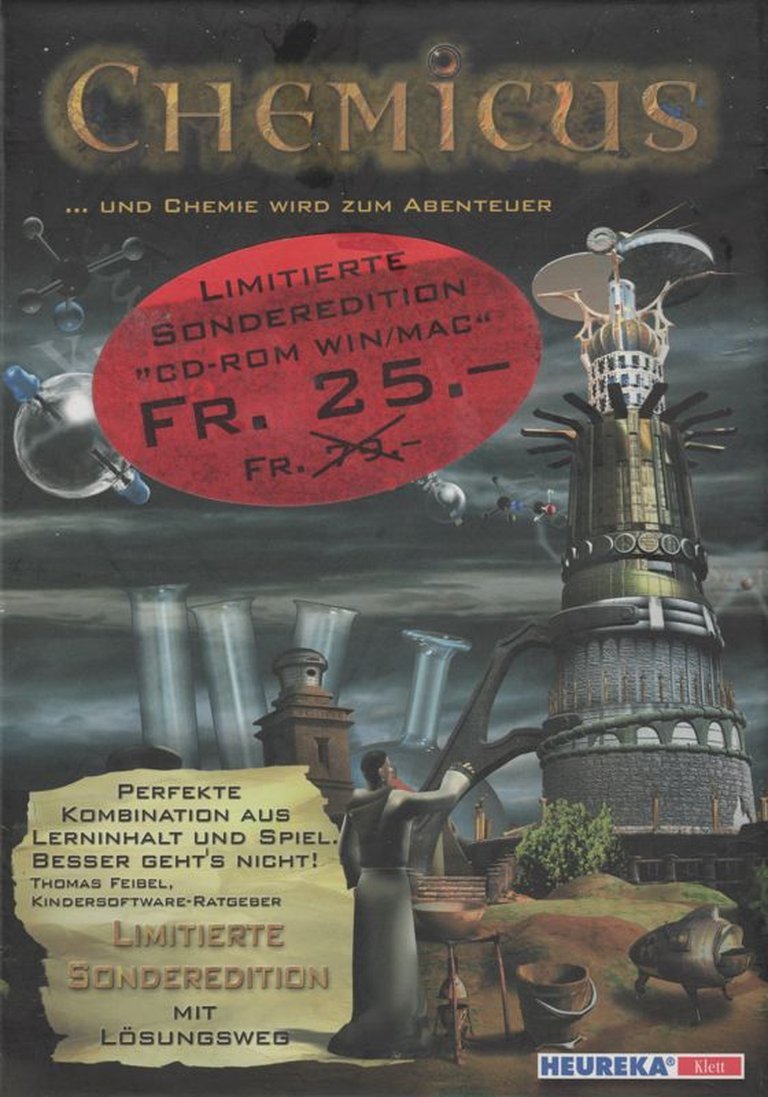
Chemicus: Limitierte Sonderedition is a special limited edition of the educational adventure game Chemicus: Journey to the Other Side, released in 2003 for Windows and Macintosh, where players explore a hidden laboratory in a first-person perspective, solving intricate chemistry-based puzzles as part of an interactive science journey created by HEUREKA-Klett Softwareverlag GmbH; this edition uniquely includes the full game and a printed solution manual to aid in mastering its challenging educational content.
Chemicus: Limitierte Sonderedition Reviews & Reception
adventuregamers.com : This game is, in fact, much more than a chemistry book with a GUI.
uhs-hints.com : Chemicus is a stunning example of a game that, in all respects, scores high in both categories.
Chemicus: Limitierte Sonderedition: Review
Introduction
Imagine stumbling upon a hidden laboratory where a brilliant chemist has unlocked a portal to a parallel world governed by the immutable laws of atomic structure and chemical reactions—a realm where the periodic table isn’t just a chart, but a subway map to salvation. Chemicus: Limitierte Sonderedition, released in 2003 by HEUREKA-Klett Softwareverlag GmbH, elevates this premise from edutainment gimmick to a landmark in educational adventure gaming. As a limited special edition of the 2001/2002 title Chemicus: Journey to the Other Side, it bundles the core game with a printed walkthrough solution, catering to players daunted by its cerebral demands. This review unearths its legacy as a bridge between Myst-era puzzle adventures and science pedagogy, arguing that while its narrative thread frays under scrutiny, its masterful fusion of real-world chemistry with immersive exploration cements it as an underappreciated gem in early 2000s gaming history.
Development History & Context
Developed and published by Germany’s HEUREKA-Klett Softwareverlag GmbH, with production credits to bvm Gesellschaft für Konzeption und Gestaltung digitaler Medien mbH and audio by ATMO Audio Produktion, Chemicus: Limitierte Sonderedition emerged from a studio specializing in “edutainment”—games that prioritize learning without sacrificing playability. Heureka-Klett’s vision, rooted in making STEM accessible, built on predecessors like Physicus (physics-focused) and Bioscopia (biology), forming the “Chemicus series” alongside sequels such as Chemicus II: Die versunkene Stadt (2002). The base game, Journey to the Other Side, launched in 2001 for Windows and Macintosh, with Tivola handling U.S. distribution in 2002 under the “Quest for Knowledge” banner.
The early 2000s gaming landscape was dominated by post-Myst (1993) point-and-click adventures like Riven (1997), Syberia (2002), and Myst III: Exile (2001), which emphasized pre-rendered worlds, non-linear puzzles, and atmospheric isolation. Technological constraints—Pentium II 233 MHz CPUs, 64 MB RAM, 8x CD-ROM drives, and 50 MB HD space—necessitated slideshow transitions over real-time 3D, aligning perfectly with Heureka-Klett’s static, detailed scenes. CD-ROM distribution (two discs) introduced swapping frustrations amid rising DVD adoption, but full installs mitigated this. As edutainment boomed in Europe (especially Germany, with its emphasis on science curricula), Chemicus targeted ages 10-102 (realistically mid-teens+), blending adventure tropes with authentic chemistry to counter perceptions of “dry” educational software. The Limitierte Sonderedition (limited special edition), exclusive to Austria, Germany, and Switzerland, added a printed solution—reflecting developer awareness of its puzzle intensity—positioning it as a collector’s item in a market shifting toward broadband and MMOs.
Narrative & Thematic Deep Dive
At its core, Chemicus unfolds a sparse yet serviceable sci-fi tale: Your friend Richard, a chemistry savant, experiments in a secret lab, uncovers an ancient amulet revealing a gateway to Chemicus—a shrouded city safeguarding primordial scientific knowledge. Accused of stealing a “transmission molecule” vital to their energy source, Richard is imprisoned. Armed with clues and a communicator, you portal-hop to prove his innocence, restore balance, and unravel the world’s chemical mysteries.
Characters are ethereal presences: Richard appears in glitchy, computerized renderings via videophone, urging haste with melodramatic pleas (“Hurry up!”). Inhabitants of Chemicus—shadowy figures glimpsed fleetingly—evoke pursuit without dialogue or depth, emphasizing solitude. No branching narratives or moral choices; dialogue is minimal, often awkwardly translated from German (e.g., “Score” for save/load), prioritizing puzzle exposition over drama.
Thematically, Chemicus mythologizes chemistry as a universal force: Regions embody elements (ironworks for Fe, silicon sands, halogen pools), navigated via a periodic table transporter. Themes of discovery, analysis, and synthesis mirror real science—redox reactions symbolize conflict resolution, fractional distillation purification quests. Yet, the plot serves as connective tissue, not driver; reviewers like Frank Nicodem (UHS) noted its “weak” development, while Andrew Plotkin (Zarf) dismissed it as “very little,” subordinating story to “the mythology of chemistry.” This edutainment ethos elevates knowledge as heroism, but sacrifices immersion—no character arcs, no intrigue beyond Richard’s histrionics—making it feel like a framework for labs rather than a living tale.
Gameplay Mechanics & Systems
Chemicus epitomizes first-person puzzle adventures: Point-and-click navigation through Myst-like static scenes (no panning), inventory accessed via bottom-right button, and a hidden analyzer magnifying chemical compositions. Core loop: Explore element-themed regions, collect knowledge chips unlocking the “Chemicus Brain Center” encyclopedia, gather reagents, synthesize solutions, and apply them contextually. Navigation demands periodic table mastery—keys as element tiles unlock subway stops (e.g., noble gases hidden near halogens).
No combat or timers (save one repeatable puzzle); progression is item-driven, non-linear post-tutorial (freely roam 10+ areas), gated by prerequisites (e.g., can’t access needs without keys). Puzzles—30+ hours’ worth—immerse in chemistry: Acid-base indicators, electrolysis, alloying metals (multi-step melting), electrochemistry, organic synthesis. Innovations shine: Realistic interactions (e.g., solubility, electronegativity), analyzer tool, disposal mechanics (nod to lab safety). Inventory balloons (up to 35 items), encouraging analysis over brute force—wrong mixes regenerate harmlessly, no dead-ends or death.
Flaws persist: Hotspots inconsistently activate (e.g., controls grayed until primed), pixel-perfect clicks (early drawers), trial-and-error despite logic (test all powders/liquids), location-specific reactions (heat same mix wrong spot? Nope). UI quirks: Coded saves (date/time only, no thumbnails), cumbersome scrolling, pop-up labels (helpful for “fine white powder” vs. immersion-breaking). Disc swaps escalate late-game; full install advised. Intuitive for chemists, esoteric for novices—encyclopedia aids, but navigation demands prior knowledge. Walkthrough inclusion (printed/PDF) underscores accessibility, yet Plotkin decried “mechanical menu-mashing,” Lora (Ataniel) frustration from aimless goals.
World-Building, Art & Sound
Chemicus’ world—a surreal, uninhabited metropolis of chemical metaphors—pulses with abstract wonder: Iron forges belch steam, silicon gardens shimmer, glasshouses refract light, pools evoke halogens’ reactivity. Atmosphere blends Myst‘s isolation with lab sterility—evocative yet impersonal, prioritizing puzzle integration over lore. No coherent history; regions interlink thematically (e.g., periodic adjacency), fostering “elegant abstraction” (Plotkin).
Visuals dazzle: Pre-rendered scenes rival Exile or Syberia in detail—breathtaking textures, lighting, 3D animations (experiments burst vividly). Syd (GameBoomers) lauded “beautiful slideshow graphics”; Nicodem compared favorably to top adventures. Sound excels: Realistic effects (panning water, realistic reactions), ambient music fitting without intrusion. Rare character FMVs disappoint (blocky renders vs. live-action peers like Dracula Resurrection), but scarcity minimizes impact. Collectively, they forge a hypnotic, educational sandbox—immersive for science fans, museum-like for others.
Reception & Legacy
Launch reception skewed positive in niche circles: MobyGames lists no scores/reviews for the edition (n/a MobyScore), but base Chemicus earned acclaim—UHS (Nicodem, 2003: high praise for balance), Adventure Gamers (Tom_K, 2003: “Decent” 3/5, qualified success), GameBoomers (Syd: “marvelous”), Zarf (Plotkin: “pretty good” despite edutainment fears), Ataniel (Lora: “Okay” for kids). Commercial viability: Modest, as CD-ROM edutainment amid Half-Life 2 hype; German focus limited U.S. traction, yet series endured (Chemicus II 2002/2004).
Reputation evolved: Cult status among adventure historians for edutainment innovation—teaching esters, redox via play, pre-Kerbal Space Program‘s pedagogy. Influenced genre subtly: Pioneered science-mythos worlds (e.g., The Talos Principle‘s puzzles), validated edutainment post-Myst (inspiring The Room series’ logic). Preserved in databases (MobyGames ID 79028, OGDB), it symbolizes early 2000s German dev ingenuity, though eclipsed by flashier sequels. No remasters, but emulation sustains playability.
Conclusion
Chemicus: Limitierte Sonderedition masterfully alchemizes adventure gaming’s puzzle heritage with rigorous chemistry, delivering 20-30+ hours of brain-teasing discovery amid stunning visuals and sound. Its innovations—integrated encyclopedia, realistic mechanics—outweigh UI gripes and narrative thinness, proving edutainment’s potential without diluting fun. Flaws like hotspot woes and disc swaps reflect era constraints, yet its legacy endures: A definitive mid-tier classic that educated a generation on science’s wonders. Verdict: Essential for puzzle aficionados and STEM enthusiasts—8.5/10, securing its place as a hidden periodic treasure in video game history.