
- Release Year: 2005
- Platforms: Windows
- Developer: Jospin Le Woltaire
- Genre: Adventure
- Perspective: Side view
- Game Mode: Single-player
- Gameplay: Graphic adventure, Puzzle elements
- Setting: Scottish highlands
- Average Score: 61/100
Description
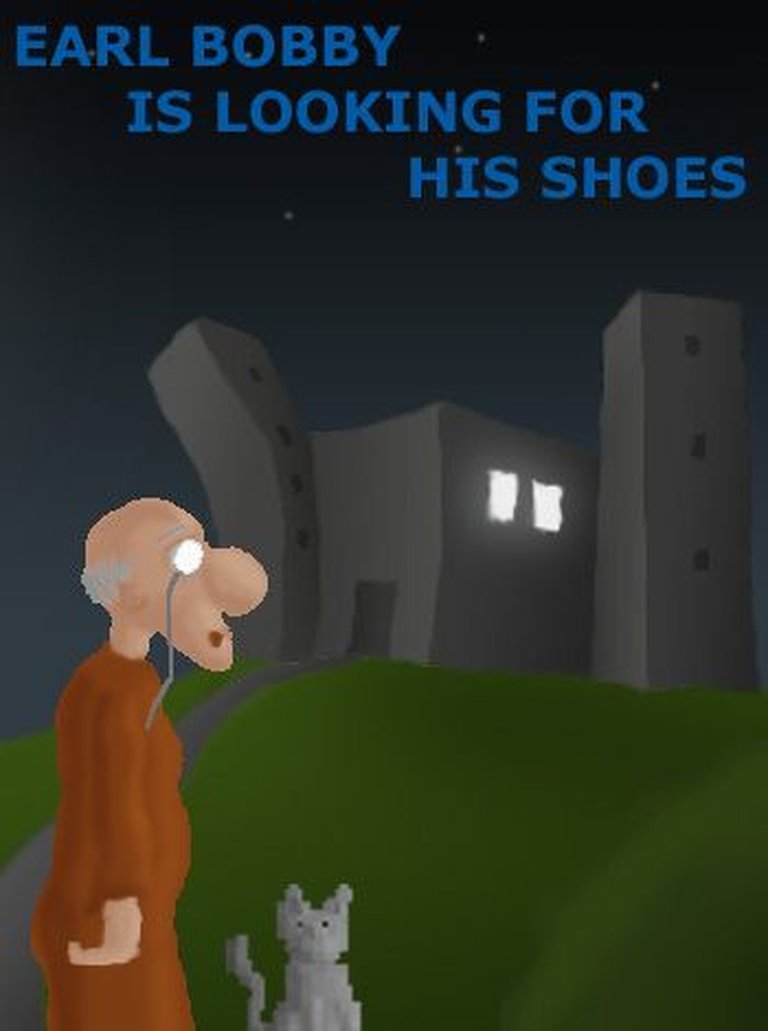
Earl Bobby is looking for his Shoes is a short point-and-click adventure game set in an old Scottish castle in the Highlands, where players help the forgetful Earl Bobby, plagued by dementia, locate his missing shoes at midnight before an important conference. Amid quirky puzzles and interactions with humorous characters like Arnold the Armor and Antonio the cat, the game introduces the eccentric earl and his penchant for losing objects in the first installment of the Earl Bobby trilogy.
Earl Bobby is looking for his Shoes Free Download
Earl Bobby is looking for his Shoes Reviews & Reception
adventuregamestudio.co.uk : Short, crazy, rough around the edges, visually stylish, humorous and, while it lasts, a lot of fun.
Earl Bobby is Looking for his Shoes: Review
Introduction
Imagine stumbling through a dimly lit Scottish castle at the stroke of midnight, not as a ghost hunter or treasure seeker, but as the frantic aide to an absent-minded earl on the verge of a meltdown over his missing footwear. Earl Bobby is Looking for his Shoes (2005) thrusts players into this absurd scenario with unapologetic glee, a freeware gem from the golden age of indie point-and-click adventures. As the inaugural chapter of the Earl Bobby trilogy, this micro-adventure endures as a testament to minimalist brilliance amid the sprawling epics of its era. My thesis: In an industry obsessed with scale, Earl Bobby proves that brevity, slapstick humor, and clever puzzle design can deliver profound laughs and philosophical nudges, cementing its status as a cult classic for adventure game aficionados.
Development History & Context
Developed single-handedly by Jospin Le Woltaire—credited for both visual artwork and scripting—Earl Bobby is Looking for his Shoes emerged from the vibrant freeware scene powered by the Adventure Game Studio (AGS) engine. Released on January 29, 2005, for Windows, it ran on humble specs: 320×240 resolution in 16-bit color, compatible with Pentium II processors, 16MB RAM, and even Windows 95. Le Woltaire, operating under the moniker “Le Woltaire,” poured his vision into this project, with minimal support from Javier Kohen and Peder Johnsen on proofreading and testing. Notably, the soundtrack repurposes public-domain works by Ludwig van Beethoven, a cheeky nod to classical music that aligns with the game’s groups on MobyGames (“Games with classical music”).
The mid-2000s marked a renaissance for indie adventures, as AGS democratized development for hobbyists. Tools like AGS allowed creators to bypass AAA budgets, fostering a wave of short, experimental titles amid the dominance of action-heavy blockbusters like Half-Life 2 and Grand Theft Auto: San Andreas. Le Woltaire announced the “talky” version on AGS forums in late January 2005, hinting at voice acting additions that elevated it from silent prototype to polished freeware. One AGS commenter speculated it was crafted in just three days, underscoring its scrappy origins—yet this constraint birthed innovative puzzles in a single-room setting. Inspired by the Austrian comedic archetype Count Bobby (popularized in 1960s Viennese films), Le Woltaire transplanted the character’s bumbling nobility to the Scottish Highlands, blending cultural homage with AGS’s puzzle-centric ethos. Hosted on sites like the official Earl Bobby Realm and later archived on Internet Archive and itch.io, it exemplifies preservation efforts for ephemeral freeware.
Narrative & Thematic Deep Dive
At its core, Earl Bobby unfolds in a single, cluttered room of a decrepit Scottish castle, where midnight panic sets the tone. Earl Bobby, an elderly aristocrat plagued by dementia-like forgetfulness, awakens to prepare for a crucial conference—only to discover his beloved shoes have vanished. “It seems to be his fate somehow,” the description wryly notes, as players assume the role of his unseen helper, navigating his ravings and eccentric household.
The plot is a masterclass in economy: no sprawling quests, just a frantic shoe hunt yielding “many crazy puzzles” and introductions to anthropomorphic allies like Arnold the Armor (a chatty suit of armor) and Antonio the cat (a sly feline accomplice). Dialogue crackles with absurdity—Bobby’s Scottish brogue-laced outbursts, fully voiced, paint him as a lovable fool whose object-loss symbolizes deeper existential drift. Themes flirt with the “sense of life,” per the synopsis: Bobby’s dementia isn’t tragic but comedic fodder, mirroring Count Bobby’s slapstick heritage. Puzzles escalate from logical (rifling drawers) to surreal (interacting with living furniture), culminating in a “surprise” ending that twists expectations, blending pathos with punchlines.
Subtly, it probes aging and futility—Bobby’s castle as a microcosm of a shrinking world—yet humor dominates, with voice lines praised as “worthwhile alone.” Character arcs are implied: Bobby evolves from hysteria to triumph, his companions revealing castle lore through banter. No overwrought lore dumps; instead, themes emerge organically, making this 30-minute jaunt feel like a witty vignette on mortality, far punchier than contemporaries like The Longest Journey.
Gameplay Mechanics & Systems
Pure point-and-click orthodoxy powers Earl Bobby, with side-view 2D scrolling in a confined space. Players wield a point-and-select interface to examine, pick up, and combine items, building an inventory from a “spartan room” that punches above its weight—every candlestick, book, or cobweb serves multiple purposes, as AGS reviewer MrEdwardNigma lauded for logical placements and versatility.
Core loop: Observe hotspots, solve “freaky” puzzles escalating in lunacy. Early tasks involve basic fetches; mid-game, interact with Arnold (perhaps shaking him for clues) or coaxing Antonio (catnip chicanery?). Save/load via F5 keeps frustration low, vital for a puzzle-heavy title. Voice acting cues reactions dynamically, enhancing feedback. UI is AGS-standard: clean inventory bar, contextual cursors—no bloat, though Ascovel noted “missing responses” as a rough edge.
Innovation shines in environmental interplay—one room yields depth via animations (Bobby’s nervous pacing, object physics). Balance is “well-balanced,” per Acme, avoiding pixel-hunting via intuitive hints from characters. Flaws? Brevity limits replayability, and 2005-era resolution feels dated, but puzzles reward lateral thinking over trial-and-error. No progression trees or combat—just pure, comedic deduction, completable in under 30 minutes, ideal for “Mittagspause” (lunch break) playthroughs.
World-Building, Art & Sound
Confined to one room in a Highlands castle, the world-building thrives on detail: flickering candlelight casts moody shadows, dusty tomes and rusted armor evoke genteel decay. Visuals are stylized 2D—basic yet “stylish,” per reviews—with fluid animations bringing static scenery alive (e.g., Arnold rattling, Antonio pouncing). 320×240 suits the intimate scale, prioritizing clarity over spectacle; Le Woltaire’s artwork captures Scottish kitsch without caricature overload.
Atmosphere builds via sound: Beethoven’s classical motifs lend ironic grandeur to farce, clashing hilariously with Bobby’s yelps. Voice acting—full English dub—is the star, delivering “skvěle namluveny” (excellently voiced) lines with theatrical flair, as Freegame.cz raved. Subtle effects (creaking floors, meows) amplify immersion, making the room feel alive. Collectively, these forge a cozy, chaotic vibe: a “short, crazy” bubble where slapstick elevates mundanity, far more evocative than generic AGS peers.
Reception & Legacy
Launch reception was niche but glowing: MobyGames aggregates 88% critic score (100% Adventurespiele: “spaßige kleine Unterhaltung”; 77% Freegame.cz: “povědený po všech stránkách” save length gripes), with players at 4.2/5. AGS forums buzzed—38 votes, comments hailing humor, voice work, and ending (“cute little game”). Collected by few but downloaded 16,738 times on AGS, it spawned the trilogy (Balls in 2007, Loo in 2010), influencing Le Woltaire’s oeuvre (A Second Face).
Commercially nil as freeware, its legacy lies in indie preservation: archived on Internet Archive, rehosted on itch.io (5/5 rating), and forums. It embodies AGS’s short-game ethos, prefiguring bite-sized hits like The Cat Lady shorts or modern itch.io comedies. No industry-shaking impact—unlike ToeJam & Earl kin—but it endures in adventure circles, inspiring “crazy puzzles” in freeware. Reputation evolved from “opportunity missed” (too short) to cherished relic, symbolizing 2000s DIY spirit.
Conclusion
Earl Bobby is Looking for his Shoes distills adventure gaming to its essence: laughs, logic, and a lingering smile. Le Woltaire’s solo triumph—flawed yet flawless in brevity—outshines bloated contemporaries, its puzzles and voices etching unforgettable absurdity. Amid video game history’s titans, it claims a quirky throne: essential for AGS fans, a delightful detour for all. Verdict: 9/10—a timeless trinket proving small shoes leave big footprints. Play it now; your lunch break awaits enlightenment.