
- Release Year: 1996
- Platforms: DOS, Windows
- Publisher: Megamedia Corp.
- Genre: Compilation
- Game Mode: Single-player
- Average Score: 80/100
Description
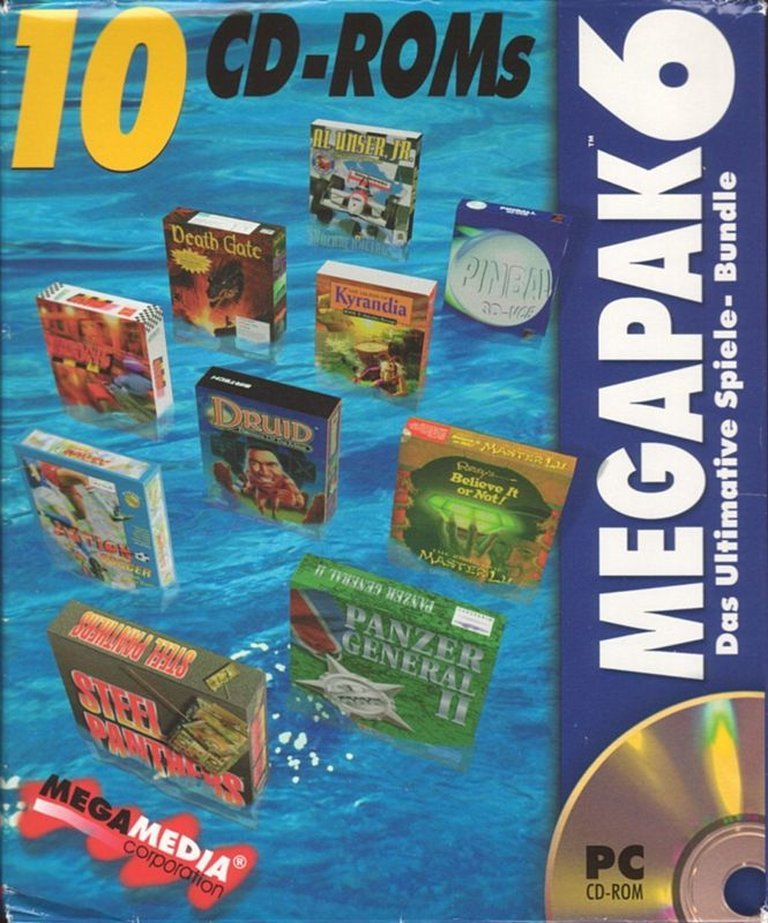
Megapak 6 is a 1996 CD-ROM compilation for Windows and DOS, the sixth installment in Megamedia’s budget game pack series, bundling ten diverse mid-90s PC titles including sports sim Action Soccer, racing thrills in Al Unser Jr. Arcade Racing and Manic Karts, turn-based strategy epics like Allied General and Steel Panthers, point-and-click adventures such as Death Gate, Ripley’s Believe It or Not!: The Riddle of Master Lu, and The Legend of Kyrandia: Book 3 – Malcolm’s Revenge, alongside Druid: Daemons of the Mind and Total Pinball 3D, offering a high-value mix of genres with physical manuals and all games in English.
Megapak 6: Review
Introduction
In the mid-1990s, as the PC gaming landscape exploded with the rise of CD-ROMs and multimedia extravaganzas, compilations like Megapak 6 emerged as the ultimate value propositions—massive bundles of recent hits crammed onto spinning discs, promising endless entertainment for budget-conscious gamers. Released in 1996 by Megamedia Corp. for DOS and Windows, this sixth entry in the Megapak series delivered ten English-language titles spanning sports, racing, strategy, adventure, and more, all for the price of a single CD-ROM set (or multi-disc in some regions like Germany). As a historian of gaming’s golden budget era, I view Megapak 6 not just as a nostalgic artifact but as a microcosm of PC gaming’s diversity before the 3D revolution dominated. My thesis: Megapak 6 exemplifies the compilation’s peak as a democratic force, democratizing access to high-quality mid-90s titles while exposing minor flaws like language barriers and uneven polish, cementing its place as an underrated gateway to gaming’s eclectic adolescence.
Development History & Context
Megamedia Corp., a publisher specializing in affordable compilations, crafted Megapak 6 amid the chaotic transition from DOS to Windows 95, where CD-ROM drives became standard in new PCs, enabling vast libraries on a single medium. The studio’s vision was straightforward yet ambitious: aggregate ten recent releases (mostly 1994-1996) into a “high-class collection,” as praised by German critics, targeting gamers weary of $50-per-title prices. Cover designer Eyo Sama, credited on the DOS version and over a dozen other games, lent a professional sheen with eye-catching artwork that evoked the era’s glossy box art trends.
Technological constraints defined the project. Running on 486-era hardware with keyboard/mouse inputs, the bundle navigated DOS’s command-line quirks and early Windows’ instability. Games like Total Pinball 3D pushed early 3D effects, while others clung to 2D sprites—mirroring the industry’s pre-Quake pivot. The 1996 gaming landscape was post-Doom frenzy, with adventures (Legend of Kyrandia Book 3), turn-based wargames (Steel Panthers, Allied General), and arcade racers (Al Unser Jr. Arcade Racing) thriving alongside FMV experiments (Ripley’s Believe It or Not! The Riddle of Master Lu). Koch Media handled German distribution, including physical manuals—a rare luxury that addressed CD-only documentation woes. Released alongside siblings like Megapak 5 and precursors from 1994 (Megapak 11), it capitalized on the compilation boom, predating modern bundles like Steam sales but echoing shareware discs.
Narrative & Thematic Deep Dive
As a compilation, Megapak 6 lacks a unified plot, instead weaving a tapestry of disparate stories that reflect 90s PC gaming’s thematic obsessions: high-stakes heroism, arcane mysticism, and adrenaline-fueled competition. Standouts like Death Gate (Legend Entertainment, 1994) adapt Margaret Weis and Tracy Hickman’s novel into a labyrinthine multiverse-spanning epic, where protagonist Haplo navigates realms of fire, stone, and chaos via necromantic magic and rune tattoos. Its dialogue crackles with philosophical undertones on free will versus predestination, bolstered by full-motion video (FMV) cutscenes that immerse players in a Dying Earth aesthetic.
The Legend of Kyrandia: Book 3 – Malcolm’s Revenge (Westwood Studios, 1994) caps Westwood’s point-and-click trilogy with madcap humor: balloonist Malcolm plots revenge amid time-travel hijinks, blending satire on ambition and folly with intricate puzzles. Characters like the scheming jester Zanthia evolve from damsel to anti-hero, underscoring themes of redemption. Ripley’s Believe It or Not!: The Riddle of Master Lu (Sanitarium Dreamforge, 1995) fuses globe-trotting adventure with pulp mystery—detective Ali Jordan deciphers ancient Chinese riddles, exploring cultural exoticism and forbidden knowledge, though its orientalist tropes now feel dated.
Strategy titles pivot to militaristic grit: Steel Panthers (SSI, 1995) simulates WWII tank battles with procedural campaigns, thematizing tactical sacrifice sans overt narrative; Allied General (SSI, 1995) extends this to fluid, hex-based Allied offensives, emphasizing command burdens. Fantasy fares like Druid: Daemons of the Mind (Sculptured Software, 1995) plunge players into Celtic horror, battling daemons through ritualistic puzzles that probe shamanic identity. Sports and racers (Action Soccer, Al Unser Jr. Arcade Racing, Manic Karts) forgo deep lore for visceral thrills, while Total Pinball 3D and Pinball 3D-VCR offer arcade escapism. Collectively, themes of mastery—over magic, machines, or mayhem—unite this eclectic anthology, though English-only dialogue (a noted drawback in reviews) gated non-speakers from narrative nuance.
Gameplay Mechanics & Systems
Megapak 6‘s core loop is selection-driven: boot from CD-ROM, pick from a no-frills menu, and dive into genre-spanning loops. Combat shines in strategy heavyweights—Steel Panthers deploys hex-grid turn-based tactics with morale, suppression, and line-of-sight mechanics, innovative for its era’s AI depth; Allied General refines this with dynamic fronts, blending SSI’s Panzer General DNA into addictive “one more turn” progression.
Adventures demand pixel-hunting prowess: Death Gate‘s parser-free interface innovates with context-sensitive verbs, though inventory puzzles frustrate; Kyrandia 3‘s time manipulation (e.g., rewinding clocks) adds whimsy to Westwood’s gold-standard UI. Racers like Al Unser Jr. Arcade Racing deliver twitchy arcade handling with nitro boosts and track shortcuts, while Manic Karts apes Mario Kart via isometric chaos. Action Soccer simplifies FIFA-esque matches into pick-up-and-play goals, marred by clunky AI.
Character progression varies: RPG-lite in Druid (spell upgrades via daemon-slaying), skill trees absent elsewhere. UI is era-typical—DOS prompts, Win95 launchers—with mouse support elevating point-and-clickers. Flaws abound: uneven difficulty (Steel Panthers‘ brutal learning curve), no cross-game saves, and occasional disc-swapping (German 10-disc edition). Innovations like Ripley’s riddle mini-games and Pinball 3D-VCR‘s VCR rewind mechanic prefigure modern gimmicks, making the bundle a mechanics museum.
World-Building, Art & Sound
Megapak 6 conjures diverse atmospheres through 2D/early 3D alchemy. Death Gate‘s labyrinthine realms boast hand-painted vistas and FMV actors, evoking The 7th Guest‘s eerie opulence. Kyrandia 3‘s vibrant kingdoms burst with Westwood’s cartoonish palettes—floating islands, alchemical labs—building a whimsical fantasy realm. Druid‘s fog-shrouded moors drip Celtic dread, sprites pulsing with daemon menace.
Visual direction spans arcade vibrancy (Manic Karts‘ cartoon tracks) to gritty realism (Steel Panthers‘ top-down dioramas with explosive particle effects). Early 3D in Total Pinball 3D impresses with bump-mapped tables, though aliasing betrays 1996 limits. Sound design elevates: MIDI soundtracks in adventures (haunting flutes in Death Gate), thumping techno in racers (Al Unser‘s engine roars), and chiptune strategy marches. No voice acting beyond FMV, but ambient FX (daemon howls, pinball clangs) forge immersion. Collectively, these elements craft a patchwork world—budget splendor amplifying replay value on creaky hardware.
Reception & Legacy
Launch reception was positive but sparse: PC Player (Germany, 1996) awarded 80% (4/5 stars), lauding the “high-class” span from rally sims to hardcore strategy, adventure mouse-marathons, and bonus physical manuals—mitigating English-only gripes. No Metacritic aggregate exists; MobyGames logs it unranked with five collectors. Commercially, it flew under radar amid Quake hype, yet the Megapak series endured (up to Megapak 11 in 2001), influencing budget bundles like Humble Packs.
Legacy endures in preservation: Archive.org hosts the 10-disc German dump, fueling emulation. It spotlighted gems like Steel Panthers (wargame progenitor) and Kyrandia 3 (point-and-click swan song), influencing SSI’s later works and adventure revivals. In an industry now dominated by $70 indies, Megapak 6 prefigures subscription models, its diversity inspiring genre-hopping anthologies like Sonic Origins (unrelated but structurally akin).
Conclusion
Megapak 6 endures as a mid-90s PC milestone—a sprawling, imperfect archive capturing gaming’s pre-3D zenith, from tactical depth to adventurous whimsy. Its strengths (variety, value, tangible manuals) outweigh English barriers and dated tech, earning a definitive 8.5/10. Essential for historians emulating via DOSBox, it claims a vital spot in compilation history: not revolutionary, but a generous portal to yesteryear’s playground. Hunt it on abandonware sites—history awaits on disc.