
- Release Year: 2000
- Platforms: Windows
- Publisher: Softstar Entertainment Inc.
- Developer: Softstar Entertainment Inc.
- Genre: Strategy, Tactics
- Perspective: Diagonal-down
- Game Mode: Hotseat
- Gameplay: Board game
- Setting: Dinosaur Age, Fairy Sword World, South Island Adventures, Star Trek
- Average Score: 72/100
Description
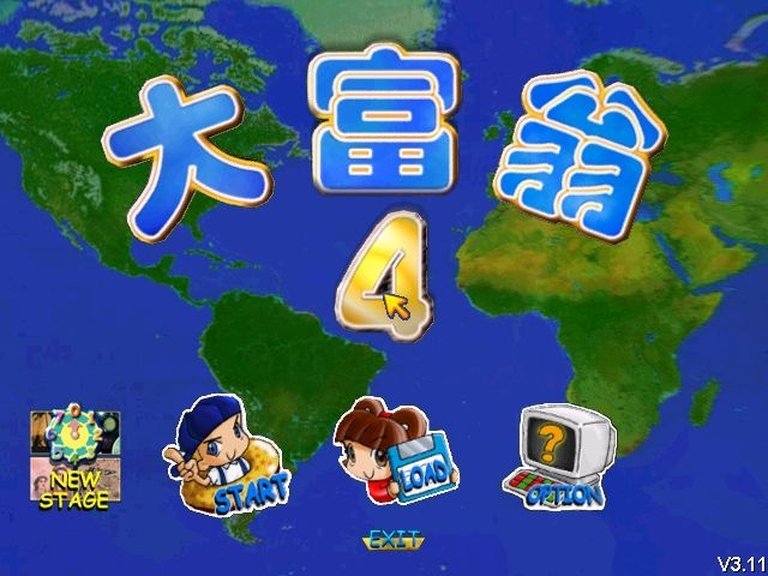
Richman 4: Chao shi kong zhi lv, known as ‘Monopoly 4: Travel beyond Time and Space,’ is a turn-based board game similar to Monopoly, featuring players competing in strategic property acquisition and management across fantastical sceneries like Fairy Sword World, Star Trek, Dinosaur Age, and South Island Adventures, each with unique animations, characters, music, and thematic elements such as dinosaurs roaming the Dinosaur Age board.
Richman 4: Chao shi kong zhi lv Reviews & Reception
steambase.io (73/100): Mostly Positive (73/100 from 1,598 reviews)
niklasnotes.com (72/100): Mostly Positive (72% from 1.6K reviews)
Richman 4: Chao shi kong zhi lv: Review
Introduction
Imagine traversing prehistoric dinosaur-infested landscapes, dueling in wuxia-inspired fairy sword realms, warping through Star Trek-inspired space adventures, or exploring mysterious South Island mysteries—all while ruthlessly bankrupting your friends in a cutthroat game of property acquisition and financial sabotage. Richman 4: Chao shi kong zhi lv (translated as “Monopoly 4: Travel Beyond Time and Space”), the 2000 expansion pack for Softstar Entertainment’s landmark Richman 4, transforms the classic board game formula into a vibrant, thematically rich spectacle. As the fourth entry in a storied Taiwanese series that began in 1989 with Money Taipei, Richman 4 and its expansion cemented Softstar’s dominance in the Asian digital board game market, blending Monopoly’s addictive economics with local flavors of comedy, anime aesthetics, and chaotic multiplayer mayhem. This review argues that Chao shi kong zhi lv is not merely an add-on but a masterful evolution, infusing the base game’s strategic depth with imaginative sceneries and content that ensure its enduring legacy as a cornerstone of East Asian gaming culture, even as modern re-releases highlight its nostalgic charm amid technical hurdles.
Development History & Context
Softstar Entertainment Inc., founded in 1993 as a powerhouse of Taiwanese game development, spearheaded the Richman (or Da Fuweng, “Great Landlord”) series, which drew inspiration from the global phenomenon of Monopoly while infusing it with distinctly Asian elements like real-time stock markets and company investments. The base Richman 4 launched on October 4, 1998 (some sources cite 1999), marking Softstar’s transition from DOS-era titles (Richman 1-3) to Windows, amid the late-90s PC gaming boom in Asia. Developed primarily by the team at Crazy Boyz under Softstar’s umbrella, the game targeted modest hardware: Windows 95, Pentium 100 MHz CPUs, 16 MB RAM minimum (32 MB recommended), 200 MB storage, and DirectX 5-compatible graphics at 640×480 resolution with 16-bit color. This era’s technological constraints—prevalent CD-ROM drives (double-speed required), basic point-and-select interfaces, and no native widescreen or high-FPS support—forced innovative 2D sprite work and diagonal-down perspectives to simulate dynamic boards.
Chao shi kong zhi lv, released in 2000 as Richman 4 Plus (or Richman 4: Chao Shi Kong Zhi Lv), arrived one year post-base game, capitalizing on its success. Softstar’s vision was ambitious: expand replayability in a market saturated with pirated Western imports by localizing Monopoly for Chinese audiences with cultural nods (e.g., Hokkien voices) and thematic variety. The expansion added four sceneries, four characters, eight music tracks, and new animations, addressing base game feedback for more content. Amid Taiwan’s gaming landscape—dominated by RPGs like Softstar’s own Xuan-Yuan Sword series—this board game stood out for its family-friendly multiplayer focus, supporting up to four players in hot-seat local play (no native online/LAN at launch). Piracy was rampant, as evidenced by Internet Archive dumps including “crack” files and full animations absent in bootlegs, underscoring Softstar’s battle for legitimacy. The result was a product tailored for communal play on shared family PCs, reflecting the era’s social gaming ethos before broadband multiplayer exploded.
Narrative & Thematic Deep Dive
While Richman 4: Chao shi kong zhi lv eschews a linear storyline for emergent board-game chaos, its “narrative” unfolds through player-driven tales of rags-to-riches (or ruin) across time-bending sceneries, laced with comedic dialogue and character quirks. Players select from an expanded roster—including four new characters alongside base staples—each embodying archetypal personalities with voiced banter in Traditional Chinese (some Hokkien dialects for flavor) and limited English/Japanese support. These avatars aren’t deep protagonists but flavorful foils: imagine a sly investor trash-talking during auctions or a bumbling rookie celebrating a stock windfall with exaggerated animations.
Thematically, the expansion’s subtitle—”Travel Beyond Time and Space”—encapsulates a core motif of temporal escapism, where wealth accumulation transcends eras. The Fairy Sword World evokes wuxia fantasy with sword-wielding heroes and mystical duels; Star Trek channels sci-fi exploration amid starships and aliens; Dinosaur Age roars with prehistoric beasts populating the board, turning property buys into survival gambles; and South Island Adventures conjures tropical intrigue with hidden treasures and island-hopping. Dialogues punctuate turns—taunts like deal-breaking jeers or victory boasts—reinforcing themes of fortune’s whimsy versus strategic cunning. Underlying this is a satire of capitalism: real-time stock crashes (涨停/跌停 mechanics), company dividends turning sour, and auctions devolving into bidding wars mirror real-world economic volatility, all wrapped in anime-comedy lightness. Mini-games (e.g., balloon popping, penguin digging) inject slapstick relief, their outcomes narrated with humorous flair. Critically, the expansion deepens immersion by tying character progression (e.g., mount upgrades from pedestrian to car for extra dice) to a “hero’s journey” of financial ascension, making every bankruptcy a punchline in an ongoing saga of temporal tycoonery.
Gameplay Mechanics & Systems
At its heart, Richman 4: Chao shi kong zhi lv refines the series’ turn-based loop: roll dice (1-3 based on mounts: motorcycle for 2, car for 3), traverse themed boards diagonally-down via point-and-select UI, land on spaces to buy/build properties, trade stocks/companies, or trigger events. Core innovation from the base—enhanced here—is layered economics: purchase empty lots, erect up to five-story buildings (普通地块 as chain stores linking map-wide;高级地块 as parks, malls, hotels, gas stations, or labs). Stocks simulate realism with real-time trading, daily limits (涨停板/跌停板), and news events spiking volatility. Companies demand chairman elections via shareholding, yielding monthly dividends (or deficits)—a step beyond Richman 3‘s passivity.
Progression shines: amass cash for mounts unlocking dice multiplicity, cards for sabotage (e.g., theft, jail sends), and auctions for hot properties. Mini-games—Seven-Colored Balloons, Joy from the Sky, Penguin Treasure Hunt—offer luck-based boosts, like popping balloons for cash. Up to four-player hot-seat multiplayer fosters betrayal, with AI exhibiting erratic but challenging behavior (noted in modern reviews as unbalanced randomness). UI is era-typical: crisp menus for stock tickers, build selectors, and saves (SAVEx.DAT files, RICH4.CFG config), though modern ports suffer crashes (fix: rename MapDat.MKF for expansion maps). Flaws include disc-check DRM, no remapping/V-Sync, and AI inconsistencies, but innovations like mount progression and chairman systems create addictive loops averaging 3-30 hours per session. Expansions’ new maps multiply variety, preventing staleness.
| Mechanic | Description | Innovation/Flaw |
|---|---|---|
| Dice & Movement | 1-3 dice via mounts; switchable post-pedestrian. | Deepens progression; random luck tempers strategy. |
| Properties | Build 1-5 layers; chain/link bonuses. | Replayable customization; balance via lot types. |
| Stocks/Companies | Real-time trades, dividends, chairmanship. | Realistic depth; volatile, punishing newbies. |
| Mini-Games | 3 varieties for bonuses. | Chaotic fun; RNG-heavy. |
| Multiplayer | 4-player hot-seat. | Social core; lacks online. |
World-Building, Art & Sound
The expansion’s genius lies in its four bespoke sceneries, each a microcosm elevating the Monopoly board to immersive diorama. Dinosaur Age teems with animated T-Rexes and volcanoes, where landings risk dino attacks; Fairy Sword World pulses with ethereal pagodas and sword clashes, fostering a martial-arts tycoon vibe; Star Trek hurtles players through nebulae and UFOs, with warp events; South Island Adventures sprawls with palm-fringed mysteries and pirate coves. Art direction—anime-inspired 2D sprites, vibrant 16-bit palettes, new animations—creates cartoonish charm, though fixed 640×480 limits modernity (no widescreen/AA).
Sound design amplifies atmosphere: eight new tracks blend upbeat chiptune pop with thematic motifs (prehistoric drums, sci-fi synths), royalty-free with Red Book CD/General MIDI variants. Voiced characters deliver comedic Hokkien-inflected quips, subtitles aiding accessibility. These elements coalesce into a cozy, chaotic vibe—boards feel alive, turns punctuated by dino roars or laser zaps—transforming rote economics into thematic escapades that linger nostalgically.
Reception & Legacy
Launch reception was undocumented critically (MobyGames: no scores/reviews), but commercial triumph fueled the series’ longevity (Richman 11 in 2022). In Asia, it dominated family PCs, piracy notwithstanding, as a cultural touchstone akin to Mario Party for wealth wars. Modern Steam re-release (2022, base Richman 4) garners “Mostly Positive” (73%, 1,598 reviews): nostalgia dominates (11% cite childhood bonds), praising mechanics/soundtrack, but bugs/crashes (12%), missing “Chrono Journey” DLC (7%), and AI quirks plague it. Playtime skews 14-hour campaigns, with multiplayer pleas underscoring untapped potential.
Influence ripples: inspired Fortune Street, regional board games; Softstar iterated (Richman 5-11, mobile ports). Globally obscure, it’s a preservation milestone—Internet Archive hosts full ISOs—exemplifying Asian indie evolution from DOS to Steam, blending Western formulas with local satire.
Conclusion
Richman 4: Chao shi kong zhi lv masterfully expands its progenitor, weaving time-spanning sceneries, economic nuance, and multiplayer hilarity into a board game paragon. Despite dated tech (crashes, no modern features), its strategic depth, thematic flair, and nostalgic pull secure a definitive verdict: an essential artifact in video game history, particularly Chinese/Taiwanese gaming. Rating it a 9/10 for cultural impact and replayability, it deserves emulation/patches for new audiences—proof that the best games bankrupt time itself. Play it with friends; become the ultimate时空大富翁.