
- Release Year: 2004
- Platforms: Macintosh, Windows
- Publisher: gingerbeardman
- Developer: gingerbeardman
- Genre: Action
- Perspective: 2D scrolling
- Game Mode: Single-player
- Gameplay: Arcade, Grappling hook
- Average Score: 63/100
Description
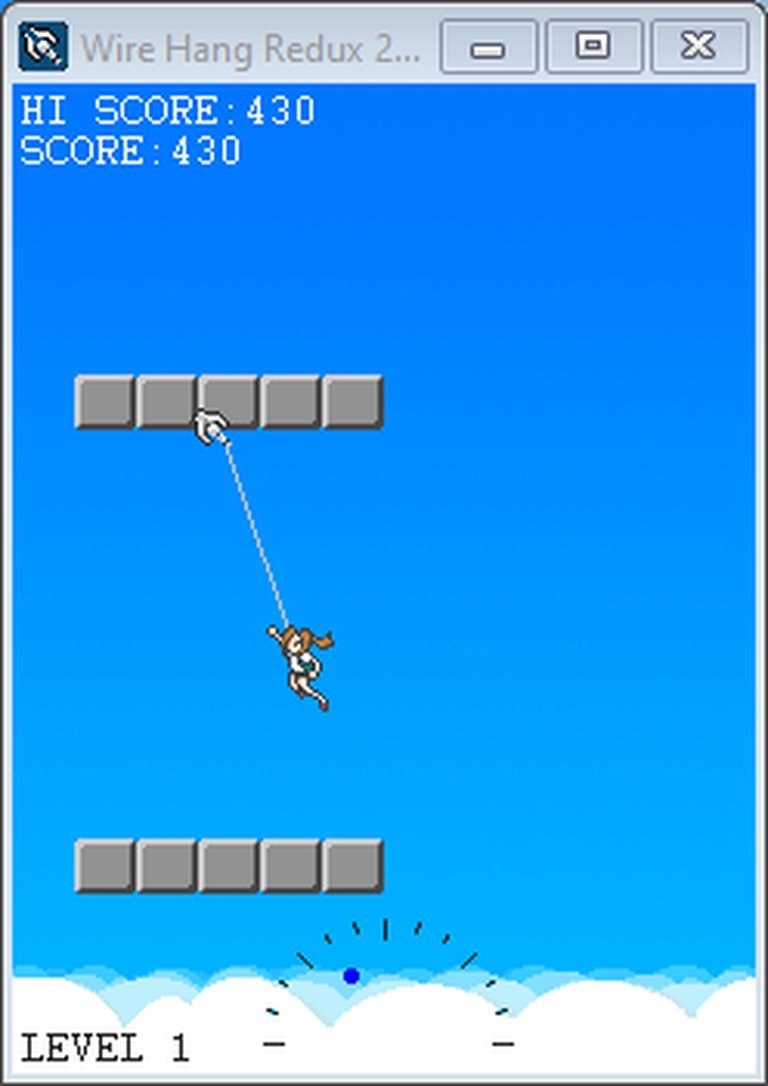
Wire Hang Redux is a simple yet addictive coffee-break arcade action game where players control an anime-style heroine using a mouse-aimed grappling hook to climb endlessly high into the sky, aiming to beat personal high scores in a 2D scrolling environment; falling past the bottom of the screen results in game over.
Wire Hang Redux Free Download
Wire Hang Redux Reviews & Reception
homeoftheunderdogs.net (76/100): Two thumbs up, way up!
Wire Hang Redux Cheats & Codes
Windows
Press TAB (Boss Key).
| Code | Effect |
|---|---|
| TAB | Makes the game window look like a Notepad text file. |
Wire Hang Redux: Review
Introduction
Imagine a single mouse click propelling an anime heroine skyward on an electromagnetic wire, her fate hanging—quite literally—by a thread as platforms dwindle and physics taunt your precision. In an era dominated by sprawling blockbusters, Wire Hang Redux emerges as a minimalist masterpiece, a “coffee-break” arcade gem that captures the pure, unadulterated thrill of high-score chasing. Released in 2004 as a fanmade remake of Masaki Kobayashi’s 1998 Java original Wire Hang, this solo-developed title by Matt Sephton (aka gingerbeardman) transcends its humble origins to embody the addictive essence of classic arcade design. My thesis: Wire Hang Redux is not merely a faithful recreation but a refined evolution that exemplifies how constraint breeds brilliance, cementing its place as an underdog icon of indie gaming history.
Development History & Context
Wire Hang Redux was born from necessity and passion in the freeware explosion of the early 2000s, a time when broadband was nascent, Java applets ruled browser gaming, and tools like BlitzBasic empowered bedroom developers to punch above their weight. Matt Sephton, operating under the gingerbeardman moniker, crafted this from-scratch remake using BlitzPlus for Windows and BlitzMax for Mac, engines renowned for their rapid prototyping and 2D prowess—ideal for a solo dev on an underpowered laptop that struggled with the original Java version.
The original concept hailed from 1998, credited to Masaki Kobayashi (D2AC), who later joined the Gran Turismo team, infusing the project with authentic Japanese arcade DNA reminiscent of taut, timing-based titles like Umihara Kawase. Sephton secured Kobayashi’s blessing, transforming a browser-bound curiosity into a native desktop experience. Released on June 20, 2004, for Windows (with Mac following in December), it arrived amid a gaming landscape shifting from PC dominance to console wars, yet freeware portals like Tucows, Download.com, VersionTracker, and even Apple.com’s download section provided fertile ground.
Development logs reveal an iterative sprint: initial release in June 2004, followed by rapid updates through 2005 and beyond (up to 2011). Key milestones included optimized collision detection, parallax scrolling, sound effects, a boss key (TAB disguises the window as Notepad—perfect for office skulkers), screenshot support (S key), and Mac OS X compatibility. Platforms shrank in width at higher altitudes for escalating difficulty, while features like hideable mouse cursor (M key) and spacebar firing polished usability. Technological constraints? Blitz’s scripting kept it lightweight (383KB archived size), ensuring broad accessibility on Windows XP-era rigs, even as Java’s performance woes motivated the Redux.
This context underscores Wire Hang Redux‘s role in the “fanmade remakes” wave (e.g., Home of the Underdogs collection), bridging Java-era browser games with native indiedom, predating itch.io’s rise and foreshadowing mobile endless climbers.
Narrative & Thematic Deep Dive
Wire Hang Redux eschews verbose storytelling for silent, score-driven ascent, a narrative vacuum that amplifies its themes through pure mechanics. You control Rinrei-chan, a kawaii anime heroine in manga-inspired attire—flowing skirt, determined expression—embarking on an endless vertical odyssey. No cutscenes, no lore dumps; the “plot” unfolds in real-time: climb infinitely or plummet to oblivion. Platforms generate procedurally, evoking a surreal skyscraper facade in an eternal blue sky, punctuated by birds, planes, and a whispered “secret at the top” (hints suggest ultra-high scores unlock easter eggs).
Core Themes:
– Perseverance and Fragility: Rinrei-chan’s wire sways like a spider’s thread, symbolizing human tenacity amid chaos. One mistimed shot, and gravity reclaims her—mirroring life’s precarious balances.
– Minimalism as Philosophy: Absent dialogue or backstory, the game philosophizes via failure loops. Recovery zones (one per platform) offer mercy, but exploits were patched, enforcing disciplined progression.
– Addiction and Transcendence: High-score chasing evokes Sisyphus, yet mastery yields euphoria. Japanese roots (Kobayashi’s influence) infuse kawaii ascent with existential zen—climb for self-imposed summits.
Character depth lies in Rinrei-chan’s animations: idle sway, hook-throw tension, falling despair. No branching paths or NPCs; themes emerge analytically from repetition, rewarding psychological endurance over plot twists. In a post-Celeste world, its subtlety prefigures “just one more try” narratives in precision platformers.
Gameplay Mechanics & Systems
At its core, Wire Hang Redux distills climbing into a hypnotic loop: aim, fire, swing, repeat. Mouse controls radar-like aiming (direct control interface), with left-click/spacebar firing the extending “electromagnetic wire” that latches onto overhead platforms. Success hinges on physics simulation—a rubber-band tautness model where longer stretches yield momentum boosts, propelling Rinrei-chan higher.
Key Systems Deconstructed:
– Core Loop:
1. Fall toward screen bottom (game over threshold).
2. Aim wire (platforms vary in shape/position; procedural generation ensures unpredictability).
3. Fire and reel in—perfect arc timing maximizes swing velocity.
4. Release, repeat. Radar mini-map aids foresight.
– Progression & Difficulty Ramp:
| Altitude | Platform Changes | Challenges |
|---|---|---|
| Low | Wide, frequent | Basic timing |
| Mid | Varied shapes | Precision aiming, rebound walls for tricks |
| High | Shrinking width | Pixel-perfect shots, faster descent |
– Birds/planes introduce dynamic obstacles; parallax adds vertigo.
– Innovations:
– Recovery Zone: Post-latch buffer for repositioning (limited to one per platform post-patch).
– Rebound Mechanic: Bounce wire off walls for creative swings (pro tip: aim high).
– Controls Polish: Spacebar alt-fire, M (hide mouse), S (sound toggle/screenshot), TAB (boss key).
– UI/Progression: Clean 2D scrolling window with score/radar display. No XP trees—just global high-score persistence. Flaws? Mouse-only focus limits accessibility (no native controller, though analogue pad teased); no multiplayer.
Strengths: Intuitive (seconds to learn, lifetime to master), physics feel “solid” per reviews. Flaws: Repetitive sans modes (planned “Extra” with power-ups unshipped). Verdict: Masterclass in arcade purity, akin to Kick-Ups or UrthWurm.
World-Building, Art & Sound
The “world” is an abstract vertical infinity: endless cyan skies, geometric platforms evoking urban ledges or alien scaffolds. Anime/manga art style shines—pixelated Rinrei-chan boasts fluid sprites (idle bob, wire strain, fall flail), upgraded iteratively with faux perspective and parallax clouds/buildings for depth illusion.
Visuals:
– Style: Kawaii pixel art (retro tags on itch.io), bigger window than original.
– Atmosphere: Soaring vertigo builds tension; shrinking platforms instill dread.
– Dynamic Elements: Birds flap by, planes streak—subtle hazards enhancing peril.
Sound Design: Sparse but effective post-updates—wire thwips, latch clangs, fall whooshes. Toggleable (S key), it punctuates silence, amplifying isolation. No OST; ambient sky evokes meditative focus.
Collectively, these forge immersion: visuals propel aspiration, sound underscores risk, creating a cohesive “coffee-break trance.”
Reception & Legacy
Launch reception was rapturous for freeware: Home of the Underdogs awarded 7.61/10 (“Top Dog,” 8.5/10 staff), praising addictiveness; sites like Acid-Play, Game Hippo (8/10), Caiman (4/5) echoed. Magazines globalized it—Super PLAY (Sweden, #3 freeware 2004), SCREENFUN/PC Home (Germany/UK cover discs), Svět počítačů (Czech). Apple.com Top 10; Japanese buzz via Windows Forest. Over 1 million downloads via Tucows et al.; MobyGames notes 1 collector, no formal scores (user reviews absent).
Legacy endures: Archived on Internet Archive, re-released on itch.io (2016 builds, $3 paid option), 64-bit Mac ports (2022). Influences? Pioneered grappling-hook precision in indies (Umihara Kawase kin), boss-key trope for stealth gaming, BlitzBasic showcase. In endless-runner era (Doodle Jump echoes), it validates minimalist arcade revival, preserving Java-era gems.
Conclusion
Wire Hang Redux is a triumph of subtraction—stripping gaming to aim, physics, and score—delivering endless replayability in 383KB. Matt Septon’s Redux elevates Kobayashi’s vision with polish, proving solo indies could rival studios. Flaws (repetition, accessibility) pale against its hooks: taut swings, kawaii charm, historical pluck. Final Verdict: 9/10. Essential artifact of 2000s freeware golden age, a must-play for arcade historians and high-score obsessives. Download it today—your next million clicks await.