
- Release Year: 1985
- Platforms: Arcade, Windows, Xbox 360
- Publisher: Konami Industry Co. Ltd., Microsoft Corporation
- Developer: Konami Industry Co. Ltd.
- Genre: Action
- Perspective: Side view
- Game Mode: Hotseat, Single-player
- Gameplay: Fighting
- Setting: Futuristic, Sci-fi
Description
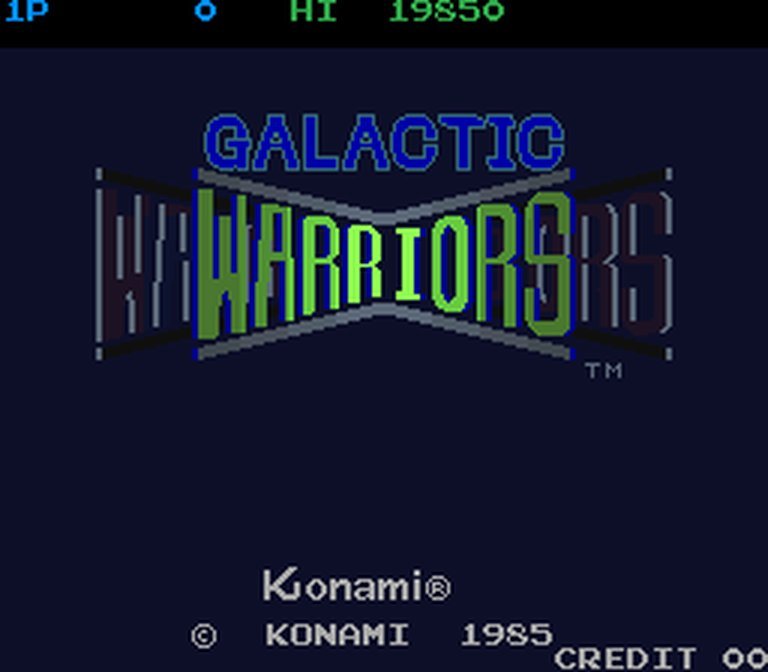
Galactic Warriors is a 1985 arcade fighting game developed by Konami, where players select one of three unique mecha robots—Samson with a laser sword, Gaea firing projectiles, or Poseidon with extendable arms—and battle a series of opponents across sci-fi locations like Mars, icy landscapes, Saturn, space stations, and finally Earth against a mirror version of their chosen fighter, featuring side-view combat with kicks, blocks, weapons, gravity effects, and a lives-based system in a futuristic solar system setting.
Gameplay Videos
Galactic Warriors: Review
Introduction
In the neon-lit arcades of 1985, where pixels clashed amid the clamor of coin drops, Galactic Warriors emerged as a bold mechanical symphony of combat—a game that dared to arm robots with laser swords, extendable limbs, and projectile-firing bosoms, all while laying the foundational code for the modern fighting genre. Developed and published by Konami mere months after their breakthrough hit Yie Ar Kung-Fu, this obscure arcade title stands as the first fighting game to offer multiple playable characters with distinct move sets and the pioneering mecha-based brawler that whispered innovations later screamed by giants like Street Fighter II. Despite its rarity—boasting zero known surviving cabinets in major preservation censuses and no contemporary reviews—Galactic Warriors endures as a visionary artifact, proving that even in the shadow of platformers and shooters, Konami was forging the future of versus fighting. My thesis: This is not just a forgotten arcade curio but a mechanical marvel whose mechanics and character variety prefigured the genre’s golden age, deserving resurrection and reverence in gaming history.
Development History & Context
Konami Industry Co. Ltd., already a titan of mid-80s arcades with hits like Gradius, Green Beret, and the martial arts pioneer Yie Ar Kung-Fu, unleashed Galactic Warriors on November 15, 1985 (Japan), powered by their custom Bubble System hardware—a modular cart-based architecture blending a Motorola 68000 CPU at 9.216 MHz for blistering 2D action, a Zilog Z80 for sound processing, dual General Instrument AY-8910 PSGs, a K005289 custom chip, and a Sanyo VLM5030 speech synthesizer for amplified mono audio. This setup enabled fluid animations and environmental effects rare for the era, contrasting the rigid sprites of contemporaries.
The creators’ vision, shrouded in the era’s scant documentation, appears rooted in experimentation: following Yie Ar Kung-Fu‘s one-on-one pugilism, director(s) (uncredited in surviving records) pivoted to sci-fi mecha warfare, introducing selectable protagonists amid a solar system-spanning gauntlet. Technological constraints—vertical raster monitors, 8-way joysticks, and three buttons—shaped a side-view, fixed/flip-screen fighter optimized for upright cabinets, supporting 1-2 players alternating turns. The 1985 gaming landscape was dominated by run-and-guns (Bubble Bobble), platformers (Super Mario Bros. on NES), and early beat-’em-ups, but versus fighters were nascent; Data East’s Karate Champ (1984) set the template, yet lacked variety. Galactic Warriors filled this void, predating Street Fighter (1987) by blending platformer lives systems with timed duels, all while Konami juggled a prolific pipeline (Hyper Olympic ’84, Jail Break). Later ports to Xbox 360 and Windows via Microsoft’s Game Room (2010) and Arcade Archives (November 13, 2025) signal ongoing archival efforts, underscoring its cult preservation status amid Konami’s arcade legacy.
Narrative & Thematic Deep Dive
Galactic Warriors eschews verbose cutscenes for a plot distilled to arcade essence: pilot one of three interstellar mechs—Samson (agile swordsman), Gaea (ranged artillery), or Poseidon (grappling brute)—to vanquish rogue robots terrorizing the solar system, culminating in a mirror match against your doppelgänger on Earth. No dialogue burdens the experience; instead, stages unfold as planetary showdowns, each boss embodying cosmic threats: Urunes (Mars’ quadrupedal gunner), Giger (icy whip-master), Boreas (Saturn-shrouded chain-wielder), Asura (winged laser visionary), and Orion (space station colossus). Victory loops back with enhanced armaments, implying endless galactic escalation.
Thematically, it’s a paean to 80s sci-fi mecha mania—echoing Mobile Suit Gundam and Macross—where anthropomorphic robots symbolize humanity’s hubris in mechanized conflict. Playables evoke mythic archetypes: Samson (biblical strength via laser sword), Gaea (earth-mother with maternal projectiles, controversially breast-fired), Poseidon (sea-god reach via extendable arms). Bosses draw from mythology and horror—Boreas (north wind), Asura (Hindu demon), Giger (H.R. biomechanical homage)—clashing in a zero-gravity ballet of destruction. Underlying motifs probe identity (mirror finale) and adaptation (weapon switches), with lives-based attrition underscoring mortality amid futuristic immortality. Sparse but evocative, the narrative prioritizes visceral progression over lore, a blueprint for fighters where story serves spectacle.
Gameplay Mechanics & Systems
At its core, Galactic Warriors deconstructs fighting into a taut loop of selection, survival, and escalation across six gravity-altered stages, controlled via 8-way joystick and buttons for attack, guard, and weapon toggle. Select your mech pre-game: Samson excels in close-quarters sword combos and aerial juggles; Gaea dominates zoning with homing projectiles (yes, from chest-mounted cannons); Poseidon thrives on pokes via telescoping punches/kicks. Each boasts unique techniques—kicks, blocks, armed/unarmed strikes of varying power—plus innovations like air-blocking, multi-hit air combos, and projectiles, all predating genre standards.
Combat shines in its depth: a depleting health bar (blue-to-pink gradient signals peril) tracks damage, with blocking incurring chip harm. Timers cap rounds at 90 seconds; time-out favors the least-damaged (pink-bar loser auto-fails). Lives system (no continues) borrows from platformers—deplete three, game over to attract mode—enforcing mastery over attrition. UI is minimalist: life bars, timers, scores on fixed/flip-screens, with flip for versus fluidity. Flaws emerge in AI predictability (boss patterns rote) and balance (Gaea’s range trumps melee), but innovations abound—gravity tweaks (low-G moons enable floaty jumps), extra weapons post-loop, 2P versus. Solo gauntlet demands adaptation; multiplayer amplifies chaos. It’s a mechanical crucible, flawed yet prophetic.
Core Loop Breakdown
- Character Select & Progression: Three distinct movesets; bosses unlock loop 2 with buffs.
- Combat Arsenal: Punches/kicks (weak/strong), weapons (toggle), jumps/air attacks, guards/blocks.
- Win Conditions: Deplete health, survive timer, preserve lives across stages.
- Innovations: Modern bar UI (vs. notched meters), chip damage, aerial strings—echoed in Street Fighter.
World-Building, Art & Sound
The game’s universe pulses with retro-futuristic grit: solar system odyssey from Mars’ red dunes (Urunes duel) to icy tundras (Giger), Saturn’s rings (Boreas), aerial voids (Asura), orbital stations (Orion), and terrestrial finale. Stages layer parallax backgrounds—planets looming, stars scrolling—with gravity mods altering jump arcs, fostering atmospheric immersion despite 256×224 resolution sprites. Visual direction favors chunky, expressive mechs: Samson’s sleek saber clashes, Gaea’s curvaceous form, Poseidon’s hulking limbs—colorful palettes on vertical CRTs pop amid flip-screen transitions.
Sound design elevates the arcade hum: AY-8910 chiptunes deliver punchy BGM (featured in Konami GAME MUSIC VOL.2 and KONAMI GM HITS FACTORY I, sampled in media), syncing bassy stabs to sword clashes and synth swells to victories. VLM5030 voices sparse grunts; mono amp booms impacts. These elements coalesce into a tense, otherworldly vibe—gravity shifts disorient, sound cues telegraph attacks—immersing players in mecha Armageddon, where every pixel and beep reinforces sci-fi stakes.
Reception & Legacy
Launch reception is ghostly: No MobyGames scores (n/a), zero critic/player reviews, VAPS census lists it “very rare” (no owned units), collected by mere 5 players. Commercial whispers suggest niche success—Konami’s arcade dominance ensured distribution, but 1985’s shooter saturation overshadowed it. Reputation evolved via emulation (MAME ROMs since inception) and retrospectives: Hardcore Gaming 101 hails it “pre-Street Fighter II,” crediting mechanics to Wikipedia canon. Influence permeates: Character variety inspires Mortal Kombat; health bars, chip damage, timers standardize post-1987; mecha trope endures (Virtual On). Ports (Game Room 2010, Arcade Archives 2025) revive it, cementing cult status among historians. It shaped Konami’s fighters (Yie Ar Kung-Fu II, Martial Champion) and the genre’s DNA.
Conclusion
Galactic Warriors is a pixelated prophet—Konami’s 1985 arcade gem that birthed selectable fighters, mecha mayhem, and mechanics now genre bedrock, all amid solar skirmishes of mythic bots. Its sparse narrative fuels timeless themes, robust systems reward mastery despite arcade austerity, and atmospheric craft immerses utterly. Obscured by rarity and silence, its legacy roars through descendants, from Street Fighter to modern emulations. Verdict: An essential historical pillar, 9/10—play the 2025 port, preserve the pioneer. In video game history, it claims vanguard status: the first true versus fighter evolution.