
- Release Year: 2017
- Platforms: Linux, Macintosh, Windows
- Publisher: Chubby Pixel
- Developer: Chubby Pixel
- Genre: Adventure
- Perspective: 1st-person
- Game Mode: Single-player
- Setting: Fantasy
- Average Score: 69/100
- VR Support: Yes
Description
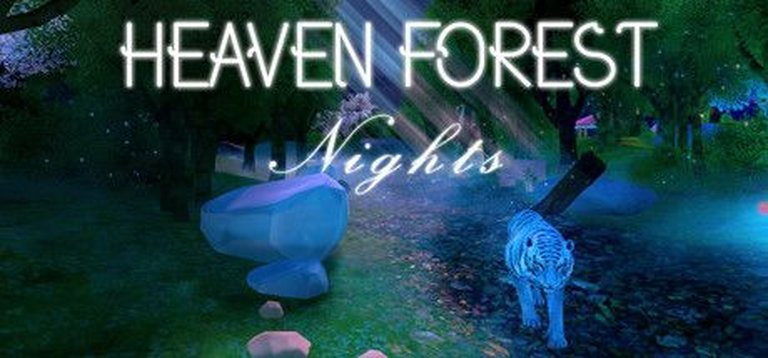
Heaven Forest: Nights is the second chapter in the Heaven Forest series, a first-person meditative adventure set in a fantasy world where players contemplate the profound meaning of death as the counterpart to life’s purpose explored in the first game. Through exploration, players collect scrolls of wisdom that unfold human nature and philosophical insights on mortality, existence, and what lies beyond, with optional VR support for Vive and Oculus headsets.
Gameplay Videos
Where to Buy Heaven Forest: Nights
PC
Heaven Forest: Nights Guides & Walkthroughs
Heaven Forest: Nights Reviews & Reception
metacritic.com (70/100): Subjects like life and death can be decidedly hard to tackle, and it is clear what Heaven Forest Nights is attempting to achieve in that it wants its players to think for themselves.
opencritic.com (70/100): Subjects like life and death can be decidedly hard to tackle, and it is clear what Heaven Forest Nights is attempting to achieve in that it wants its players to think for themselves.
Heaven Forest: Nights: Review
Introduction
Imagine wandering through a ethereal forest under a starlit sky, where every rustling leaf whispers questions about mortality, and ancient scrolls unravel the fragile tapestry of human existence. Heaven Forest: Nights, released in 2017 as the second installment in Chubby Pixel’s contemplative Heaven Forest series, dares to confront the ultimate taboo: death. Building on its predecessor’s exploration of life’s purpose, this VR-optional walking simulator invites players into a meditative reverie on existence’s impermanence. As a game historian, I’ve traced its quiet footprint amid the indie explosion of the mid-2010s, a era when VR promised transcendence but often delivered gimmicks. My thesis: Heaven Forest: Nights is a bold, if fleeting, philosophical artifact—profound in intent, mesmerizing in aesthetics, yet undermined by its skeletal execution, cementing its status as a cult curiosity rather than a landmark.
Development History & Context
Chubby Pixel, a modest Italian indie studio helmed by visionary developer Fabio Ferrara, emerged in the vibrant post-Minecraft indie scene of the early 2010s. Known for low-poly, introspective titles like Suicide Guy and the original Heaven Forest (2016), the studio leveraged Unity’s accessible engine to punch above its weight. Nights launched on March 14, 2017, across Windows, macOS, and Linux via Steam, coinciding with VR’s nascent boom—HTC Vive and Oculus Rift were fresh on shelves, and the game smartly marketed optional VR support without mandating it.
The 2017 landscape was a petri dish for experimentation: walking simulators like Dear Esther (2012) and Firewatch (2016) had popularized narrative-driven exploration, while VR titles such as The Vanishing of Ethan Carter pushed immersive philosophy. Ferrara’s vision, drawn from the first game’s life-affirming musings, pivoted to death’s enigma amid personal and cultural reckonings—global anxieties over mortality post-2016 elections and pandemics loomed in hindsight. Technological constraints were minimal; low specs (Intel Dual-Core 2.4 GHz, GTX 570) democratized access, but Unity’s quirks led to reported Linux bugs and multiplayer inconsistencies (listed as “Internet” options despite its solo zen vibe). Budget-conscious at $0.99, it was a passion project, free from AAA bloat, embodying indiedom’s ethos: big ideas, small scope.
Narrative & Thematic Deep Dive
At its core, Heaven Forest: Nights is a philosophical poem disguised as a game, inverting the series’ arc from life’s meaning to death’s void. The plotless narrative unfolds in a nocturnal fantasy forest, where the player—embodied in first-person—confronts existential dread: “We are born and we grow up… sooner or later we will die. So, in the end, have everyday efforts any meaning at all?” No protagonists or dialogue exist; instead, collectible “scrolls of wisdom” serve as fragmented soliloquies, probing dualities like life’s purpose versus death’s finality, physical transcendence, and wisdom born from mortality’s shadow.
Plot Structure and Characters
Lacking traditional arcs, the “story” is emergent: exploration yields scrolls that “unfold human nature,” culminating in quiet epiphany. Absent characters amplify isolation—ethereal creatures (hinted in Steam forums) lurk as spectral observers, evoking Heidegger’s Being and Time or Camus’ absurdism. Night’s palette symbolizes oblivion, contrasting the first game’s daylight vitality.
Dialogue and Themes
Scrolls deliver terse, poetic aphorisms: death as “immanent” wisdom’s genesis, efforts’ futility amid entropy. Themes layer deeply—nihilism (“do life and death have meaning? For good or bad?”) clashes with transcendence (“something beyond the physical?”), echoing Eastern philosophy (Zen impermanence) and Western existentialism (Kierkegaard’s leap of faith). Collecting all scrolls rewards holistic “unfolding,” critiquing superficial living. Yet, ambiguity borders pretension; without voice acting or branching paths, themes risk solipsism, demanding player investment the brevity undermines.
This meditative pacing fosters introspection, but sparse text (no quantified count) leaves interpretation to the void—brilliant for philosophers, barren for casuals.
Gameplay Mechanics & Systems
Heaven Forest: Nights epitomizes the walking simulator: direct control (keyboard/mouse/VR) propels free-roaming in a compact forest. Core loop? Wander, observe, collect scrolls amid zen pacing—no combat, puzzles, or progression beyond discovery.
Core Loops and Exploration
Traversal is meditative bliss: float through low-poly glades, scale subtle inclines, uncover hidden nooks. Multiplayer tags (Internet, MMO, PvP) confuse—likely artifacts from Unity templates or mislistings, as forums gripe about solo isolation. VR enhances embodiment (seated/standing, Vive/Oculus), but desktop mode suffices, with keyboard/mouse for precision.
Combat, Progression, and UI
No combat; “action” tags mislead. Progression ties to 24 Steam achievements (e.g., “Useless Achievement,” per forums), rewarding scroll hunts and exploration. UI is minimalist—HUD-free immersion, pause queried in discussions (absent main menu). Flaws abound: short length (3-5 hours, per analytics), repetitious loops foster boredom, technical hitches (Linux unplayability, GTX 550 Ti queries).
Innovations and Shortcomings
Innovative VR-optional design predates accessibility norms; scrolls as “profound thinking” aids innovate micro-narratives. Yet, flaws dominate: reskin accusations (night variant of Heaven Forest), glitchy multiplayer ghosts, no replayability sans trading cards. Achievements gatekeep completionism, but loops lack depth—engaging for zen seekers, infuriating for gamers craving agency.
World-Building, Art & Sound
The titular “Heaven Forest” at night is a masterclass in atmospheric minimalism: fantasy realm of luminous flora, floating orbs, and shadowy thickets, rendered in Unity’s signature low-poly charm. Visual direction—starry voids, bioluminescent paths—evokes Proteus or Abzû, VR amplifying scale for awe.
Atmosphere and Immersion
Nightfall infuses dread-laced serenity; dynamic lighting (torches? fireflies?) shifts moods from tranquil to ominous. Scale feels infinite yet intimate, fostering solitude.
Art Style and Sound Design
Art: Stylized polygons prioritize mood over fidelity—praised in reviews for “beautiful graphics.” Sound: Ambient whispers, ethereal synths (soundtrack lauded ~2-6%), subtle footsteps amplify zen. No voiceover preserves purity, but silence risks tedium. Collectively, they elevate themes—visuals embody death’s beauty, audio its hush—crafting transcendent highs amid mechanical lows.
Reception & Legacy
Launch reception was muted: Steam’s 76% positive (89 reviews, now ~68% Mixed from 349) splits on beauty vs. brevity—”relaxing” vs. “boring reskin.” MobyGames: No score, 24 collectors. Metacritic/OpenCritic: TBD, lone 70/100 from GameSpew praises autonomy. Forums vent frustrations (short, no pause, tech woes), Backloggd averages 1.5/5.
Commercially, $0.99 pricing yielded niche sales (bundle fodder in Chubby Pixel packs). Legacy? Marginal influence on VR walkers (Proteus kin), predating Tetris Effect‘s zen VR. Critiqued as asset flip, it endures in philosophical indies’ shadow—cited academically? Unlikely, per Moby’s 1,000+ citations stat. Evolving rep: Cult VR relic, emblem of 2017’s experimental excess.
Conclusion
Heaven Forest: Nights aspires to digital koan, its forest a canvas for mortality’s brushstrokes—stunningly atmospheric, thematically audacious, yet crippled by scant content and executional sins. In video game history, it occupies a liminal space: not revolutionary like What Remains of Edith Finch, nor disposable shovelware, but a poignant indie footnote. Recommended for VR philosophers craving brevity (7/10), skipped by action seekers. Amid gaming’s bombast, it reminds: sometimes, walking into the dark yields wisdom’s faint glow. Final verdict: Essential curiosity for meditative sim completists, forever etched in Unity’s humble hall of wonders.