
- Release Year: 2008
- Platforms: Windows
- Publisher: HIT Entertainment Ltd., Mindscape Germany GmbH
- Genre: Educational
- Perspective: Fixed / flip-screen
- Game Mode: Single-player
- Gameplay: logic, Math, Point and select
- Setting: Fantasy
Description
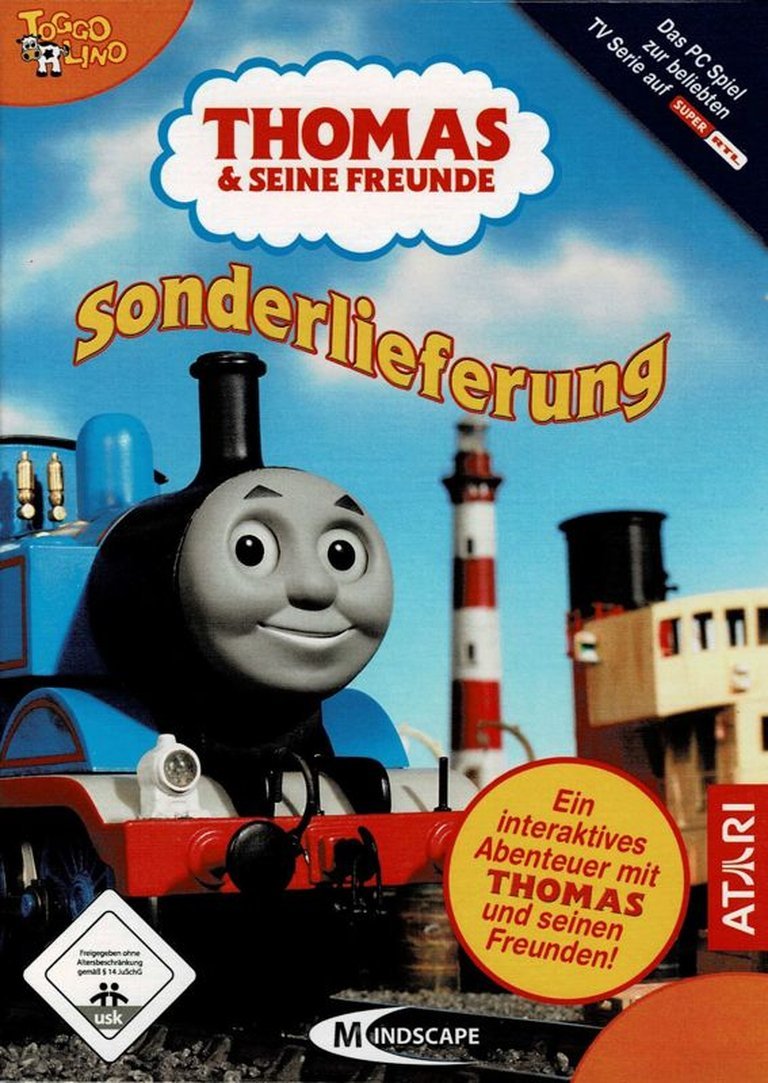
Thomas & Friends: Special Delivery is an educational PC game set in the fantasy world of Sodor, where new animals arrive at Brendam Docks for delivery to the zoo by James, who gets lost en route. Players assist Thomas, Harold, and other engines through point-and-click puzzles promoting logical thinking, shape and color recognition, and pre-school math skills to locate James and ensure the special delivery arrives on time.
Gameplay Videos
Thomas & Friends: Special Delivery Free Download
Thomas & Friends: Special Delivery Reviews & Reception
kwannies.com : My 5-year-old son is a die-hard fan of Thomas the Train. So when he saw the Thomas & Friends Special Delivery box, he was all excited.
Thomas & Friends: Special Delivery: Review
Introduction
Imagine a world where the chugging rhythm of steam engines isn’t just nostalgic escapism but a gateway to learning shapes, colors, and logic for the tiniest engineers. Thomas & Friends: Special Delivery (2007), a humble PC CD-ROM edutainment title, embodies this perfect synergy of beloved children’s television and early digital education. Rooted in the enduring Thomas the Tank Engine franchise—spawned from Rev. W. Awdry’s 1945 book series and popularized by HIT Entertainment’s animated series—this game tasks players with rescuing the vain red engine James from a navigational mishap while delivering exotic animals to the zoo. As a game historian, I see it as a snapshot of mid-2000s edutainment: unpretentious, accessible, and laser-focused on preschoolers aged 3-5. My thesis? While technologically constrained and narratively simplistic, Special Delivery excels as a gentle introduction to computing and cognition, preserving the whimsical charm of Sodor in an era before touchscreens dominated kids’ gaming, cementing its place as an underappreciated artifact in the Thomas digital legacy.
Development History & Context
Developed by the UK-based Focus Multimedia Ltd. and initially published by Mindscape (UK) Limited in early 2007 for the British market, Thomas & Friends: Special Delivery emerged from a lineage of Thomas licensees stretching back to 1993’s Thomas the Tank Engine & Friends: Thomas’s Big Race. Focus Multimedia, known for budget-friendly educational software, crafted this point-and-click adventure amid the post-millennial boom in edutainment titles targeting Windows XP/Vista machines—requiring modest specs like 256MB RAM and a DirectX 9-compatible graphics card. The game’s UK version featured narration by David Holt, a voice actor tied to the Thomas TV series, while the US release (mid-2007 by Brighter Minds Media, with a 2008 re-release) swapped in Robin Smith, marking his final Thomas narration gig.
Technological constraints defined the era: fixed/flip-screen visuals on CD-ROM meant no open-world fluidity, relying instead on pre-rendered animations and simple mouse interactions—no keyboards needed for little hands. The gaming landscape was bifurcated; while consoles chased high-fidelity blockbusters like Halo 3 (2007), PC edutainment thrived on licensed IPs like Thomas, Barbie, and Sesame Street, capitalizing on parental demand for “guilt-free screen time.” HIT Entertainment, holding Thomas rights, licensed aggressively, spawning relatives like Trouble on the Tracks (2000) and A Day at the Races (2007, PS2). A German variant (Thomas & Seine Freunde: Sonderlieferung, via Mindscape Germany GmbH) underscores its modest international footprint. Vision-wise, creators aimed for “edutainment”—blending story with six skill-building activities to foster logic, counting, and shape recognition—reflecting early 2000s pedagogy emphasizing play-based learning amid rising PC ownership in households (over 70% in US by 2007). Patches and updates were nil, true to its disposable CD-ROM nature, but its preservation on sites like Archive.org and MyAbandonware speaks to grassroots archiving efforts.
Narrative & Thematic Deep Dive
At its core, Special Delivery‘s plot is a taut, episodic rescue mission: New animals arrive at Brendam Docks via a ship (complete with the uncut S.S. Arabic whistle sound, a delightful TV series Easter egg). James, the splendid red engine prone to vanity-fueled blunders, is tasked with hauling them to the zoo but predictably veers off-course. Sir Topham Hatt dispatches Thomas and Harold the Helicopter on a search, enlisting the player to solve puzzles and lay tracks across Sodor. Chapters unfold narratively: from Tidmouth Sheds briefings to Viaduct crossings, culminating in zoo delivery for opening day. Non-speaking cameos—Henry, Gordon, Percy, Mavis, Bertie—pepper scenes, evoking the ensemble spirit of the Island of Sodor, with inside-cover nods to Molly, Salty, and Bulstrode hinting at broader lore.
Thematically, it’s a masterclass in preschool morality tales: responsibility (James learns humility), teamwork (Thomas and friends unite), and perseverance (overcoming obstacles like clouds or misrouted paths). Dialogue, delivered via warm narration (Holt’s crisp British timbre in UK; Smith’s folksy US delivery), is sparse but purposeful—gentle prompts like “Listen again and try!” reinforce growth mindset without scolding. Underlying motifs draw from Awdry’s railway realism: trains as metaphors for routine and consequence, animals symbolizing wonder and care. Goofs abound, adding meta-charm—James’ white wheels, Thomas’ mismatched Rainbow Sun whistle, Mavis steaming like a steamie—mirroring the TV series’ production quirks. No deep lore dives, but Knapford’s mention ties to canon, making it a faithful extension. For tots, it’s empowerment: players aren’t passive viewers but Sodor saviors, blending fantasy with real-world skills like direction-following.
Gameplay Mechanics & Systems
Special Delivery distills edutainment to a flawless point-and-click loop: Narrator advances story → Activity challenge → Success unlocks next chapter. No combat or progression trees—just six interlocking minigames emphasizing math/logic, pre-school basics:
- Shape/Color Matching: Sort puzzle pieces for animal cages, honing recognition.
- Counting/Time-Keeping: Tally Troublesome Trucks or time routes.
- Memory/Observation: Spot differences or clear clouds over forests (a noted sticking point for some kids).
- Deduction/Logic: Lay tracks to guide engines, deducing paths.
- Puzzles: Vertical vision games with directional choices.
- Following Directions: Click sequences amid animations.
Two difficulty levels scale complexity—easy for 3-year-olds (gentle hints, fewer pieces), hard for 5+ (tighter timers, more options)—with auto-save ensuring bite-sized sessions. UI is toddler-proof: oversized buttons, no text reliance (narration-led), intuitive mouse drags/clicks building fine motor skills. Flaws? Repetition in flip-screen transitions feels dated; wrong choices trigger cartoon boings (Sound Ideas library staples) but rarely frustrate. Innovative touches include printable personalized certificates—early gamification rewarding completion—and progress persistence, rare for 2007 CD-ROMs. Loops are tight (full playthrough ~1 hour), fostering replay via levels/certificates, but lack multiplayer or unlocks limits longevity. Overall, mechanics prioritize accessibility over depth, succeeding as a “first computer game” primer.
World-Building, Art & Sound
Sodor pulses with lived-in charm despite 2D constraints: Brendam Docks bustle with Cranky’s cranes and ship horns (muffled Mack truck air blasts); Tidmouth Sheds evoke communal warmth; the Viaduct looms dramatically. Fixed screens flip seamlessly, building atmosphere via parallax-scrolling rails and foggy horizons—evocative of model-train origins. Art direction stays true to HIgh-definition TV aesthetics: Bright primaries, expressive face animations (save cover’s shrunken Thomas eyes), but goofs like yellow boiler stripes on Thomas/Percy or backward-spinning James wheels betray rushed animation. Animals add whimsy, their cages central to puzzles.
Sound design elevates: Custom Thomas/James whistles (some pitched wrong), Harold’s Hollywoodedge helicopter whir, dockside marine blasts create immersive railside ambiance. Narration anchors—Robin Smith’s US mispronunciation of “Brendam” as “Brendan” is a endearing goof. No orchestral score noted, but chugs, toots, and boings (e.g., CARTOON ACCENT – BONG) punctuate joyfully. Collectively, these forge a cozy, non-intimidating bubble—visuals teach via familiarity, audio reinforces via rhythm—making Sodor feel like a tangible playground.
Reception & Legacy
Launch reception was whisper-quiet: No Metacritic/MobyGames critic scores (tbd/n/a), zero IGN reviews beyond listings, reflecting edutainment’s niche status. Parent blogs shone brightest—From Val’s Kitchen (2008) hailed it for developmentally delayed kids (“I did it!” triumphs), rating it E for 3-5s at $19.99; Kwannies/Momviews echoed excitement for Thomas fans. Forums scarce, but abandonware sites (MyAbandonware 4.78/5 from 69 votes) show retro appeal. Commercially modest—CD-ROM sales in pre-digital distribution era—no charts, but re-releases suggest steady parental uptake.
Legacy endures quietly: Final Robin Smith-narrated Thomas game; MobyGames entry (added 2025) highlights preservation needs. Influences Thomas mobile wave (Express Delivery 2015, Adventures! 2018), pioneering track-laying/logic for later apps. In industry terms, it exemplifies edutainment’s pre-app pivot—bridging TV-to-PC before iPad dominance—foreshadowing Endless Alphabet-style learning. Obscure today (Archive.org rips fuel nostalgia), it reminds us: Amid AAA giants, kid games like this quietly shaped generations’ first clicks.
Conclusion
Thomas & Friends: Special Delivery is no revolutionary epic but a pitch-perfect preschool primer: Narratively cozy, mechanically sound, aurally enchanting, despite era-bound jank. It distills Sodor’s magic into cognitive sparks—logic, shapes, teamwork—empowering tots sans frustration. In video game history, it occupies a vital footnote: A bridge in Thomas‘ 30+ digital outings, underscoring edutainment’s role in democratizing play. Verdict: Essential for parents/archivists (8/10)—play it via emulator for that pure, chuffing nostalgia. Dust off the CD; Sodor awaits.