
- Release Year: 2014
- Platforms: Macintosh, Windows
- Publisher: 4PM Game Ltd.
- Developer: 4PM Game Ltd.
- Genre: Adventure
- Perspective: 1st-person
- Game Mode: Single-player
- Gameplay: Decision making, Interactive story, Multiple endings, Object interaction
- Setting: Contemporary
- Average Score: 33/100
Description
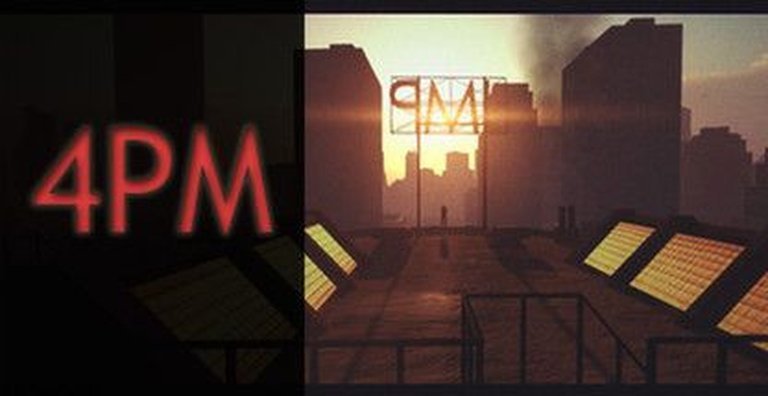
4PM is a short first-person interactive story following Caroline, a young woman immersed in a life of alcohol dependency, as she wakes from a hangover after a dance party, takes a cab to work, escapes her office, encounters a mysterious man, and reaches a suicidal climax on a rooftop, with player choices leading to multiple endings in this experiential adventure planned as the first episode of a larger narrative intersecting characters’ lives.
Where to Buy 4PM
PC
4PM Reviews & Reception
metacritic.com (41/100): Generally Unfavorable
steamcommunity.com : left in a state of confusion, frustration, disappointment, and joy […] overjoyed that it was over. However, it does have its moments, but not enough to give my recommendation
avclub.com (30/100): I can’t say that you should spend any time thinking about 4PM
gamegrin.com (30/100): showed promise, but is ultimately a dull experience filled with forgettable characters
gamewatcher.com : falls well short of delivering affecting drama
4PM: Review
Introduction
Imagine staggering through a haze of regret, the remnants of last night’s excess blurring the line between memory and nightmare—welcome to 4PM, a bold, if flawed, interactive vignette that thrusts players into the fractured psyche of Caroline Wells, a young woman teetering on the edge of self-destruction. Released in 2014 as a Steam Greenlight success, this micro-experience from a solo filmmaker-turned-developer captured the indie scene’s fascination with “walking simulators” amid the rise of narrative-driven titles like Gone Home and Dear Esther. Yet, its legacy is one of unfulfilled promise: a cinematic experiment that probes alcoholism, guilt, and catharsis but stumbles under technical limitations and brevity. My thesis? 4PM stands as a poignant artifact of early 2010s indie ambition—a high-concept proof-of-concept that prioritizes emotional provocation over polish, influencing the episodic, experiential wave while underscoring the perils of solo development in an era hungry for intimate stories.
Development History & Context
4PM emerged from the National Film and Television School in the UK, helmed by Serbian cinematographer Bojan Brbora as his student project, later published by his own 4PM Game Ltd. Brbora, known for short films, envisioned it as the pilot for an episodic series: each installment following a different character through “one day in a year,” their paths intersecting in a larger tapestry of interconnected lives. This modular structure promised unique gameplay per episode, blending linear cinema with interactivity.
Built on Unity, the game leveraged accessible tools amid 2014’s indie boom, where Steam Greenlight democratized distribution for narrative experiments. Technological constraints were evident—Brbora handled design and development solo, with a 41-person credit list dominated by voice talent (Samantha Dakin as Caroline, Tim Ahern as James), sound designers (Neo Peterson), and composers (Terence Dunn, Arran Price). Executive producer Vincent Scheurer and producer Michelangelo Fano provided support, but the modest budget showed in unpolished visuals and animations.
The gaming landscape was ripe: post-Amnesia horror and The Walking Dead‘s choice-driven drama normalized short-form stories. 4PM rode this wave, pricing at $2.99-$4.99 as a “high production value cinematic experience” sans inventories or health bars. Yet, as a 20-60 minute title tackling heavy themes like alcoholism and suicide, it entered a market demanding substance over style, competing with polished peers like The Stanley Parable. Brbora’s film background prioritized provocation, but gaming’s interactivity proved a double-edged sword.
Narrative & Thematic Deep Dive
At its core, 4PM chronicles Caroline Wells’ descent from mundane hangover to existential precipice, unpacking why a “young, pretty girl” drowns in alcohol. The plot unfolds chronologically from 10 AM to 4 PM: Caroline awakens in her cluttered London flat amid police sirens and empty bottles, flashbacks to a raucous club night interrupting her cab ride to JMP corporation. Voicemails from a berating boss (Will’m Bentinck) and pleading mother (Stephanie Blakey) reveal a crumbling life—absent father (hinted via photo), corporate drudgery, isolation.
Pivotal is the office escape: a stealthy evasion of the boss to reach the roof, where Caroline encounters James Jackson (Tim Ahern), a mysterious man from the club offering his business card. Their confrontation unveils revelations—James accuses Caroline of ruining his marriage through an affair, tying her alcoholism to guilt over her father’s death (implied car crash she witnessed). Choices emerge: examine James’ wallet (money vs. family photos), persuade him from suicide, or mirror his despair. Multiple endings diverge—save James and call mom, mutual downfall, or Caroline’s solo catharsis—emphasizing agency in tragedy.
Thematically, 4PM dissects addiction as escape from trauma: Caroline’s blurred vision and unsteady gait simulate intoxication, flashbacks (dance floor vomit quest, bar chats) layering shame. Guilt permeates—James embodies consequences, her mother forgiveness. Writer Stefan Kaday crafts dark humor amid pathos, but pacing falters: exposition dumps via phone messages and roof monologues feel rote, characters archetypal (jerk boss, cab driver Bobbie Chappel). Dialogue shines in emotional peaks (“James is upset with wife/Caroline”), but rushed delivery undermines depth. Planned episodes promised richer intersections, but this prototype feels truncated, prioritizing shock over nuance.
Gameplay Mechanics & Systems
4PM rejects traditional loops for experiential vignettes, each scene’s mechanics mirroring Caroline’s haze: WASD movement with clunky, drunken sway (nauseating for some, immersive for others); mouse-look reveals interactables (bottles, photos, phone). Core loop? Navigate vignettes, trigger flashbacks via objects, make binary choices post-office.
Key systems:
– Exploration & Interaction: Limited hotspots—examine sink bottles, mirror for self-loathing, business card for James’ intro. No inventory; clicks advance narrative.
– Flashback Sequences: Time-sensitive QTEs, e.g., club bathroom dash (timer to vomit), blending reflex with story.
– Stealth Section: Office evasion—hide in colleague rooms, avoid boss patrols. Failure restarts segment, frustratingly linear.
– Choice & Endings: Roof decisions (dialogue wheels: money/family, save/condemn) yield 2-4 paths, replayable in ~30 minutes.
– UI/Progression: Minimalist—no HUD, chapter loads as “quick cuts.” Keyboard/mouse only, 1-player offline.
Innovations? Scene-specific mechanics (Breakout mini-game at desk) tie to theme, but flaws abound: sluggish input lag, narrow FOV (~45°), pop-in textures. No progression beyond endings; it’s anti-gameplay, prioritizing “putting you in her shoes.” Stealth/QTEs feel obligatory, diluting purity—critics decry them as “half-hearted minigames.”
| Mechanic | Strengths | Weaknesses |
|---|---|---|
| Movement | Simulates intoxication | Nauseating, clunky |
| Choices | Multiple endings | Binary, low impact |
| Interactables | Narrative depth | Limited, scripted |
| Stealth/QTE | Tense moments | Repetitive, unfair resets |
World-Building, Art & Sound
London’s gray sprawl frames Caroline’s isolation: cluttered flat (crash-view window, AA letter), throbbing club, sterile JMP office (desks, boss lair), ominous roof. World-building is intimate—objects evoke backstory (father photo, wallet)—but static, no open exploration.
Visuals: Unity’s fugue filter (blur, vignette) evokes hangover, vibrant club contrasting drab office. Yet, dated models (poor faces, liquid shadows), animations (tilted gait), glitches (texture pop-in, shrinking cutscenes). Cinematic framing shines in roof tension, but low-poly feels 2008 Source mod.
Sound: Orchestrated score (Dunn/Price) swells dramatically; professional VO elevates—Dakin’s slurred despair, Ahern’s anguish. Ambient city sirens, vomit SFX immerse, but mix issues (distant dialogue, dropouts) jar. No subtitles errors noted, but pacing mismatches VO.
Elements synergize for unease: visuals/audio simulate disorientation, heightening themes. Atmospheric peak? Roof wind howls mirroring turmoil.
Reception & Legacy
Launch reception was polarized: MobyGames 43% critics (Guardian 80%: “provocative without sensationalism”; Destructoid 70%: “mature story”; Escapist 10%: “David Cage lunatic”). Metacritic 41/100, Steam “Mostly Negative” (235 reviews). Players (2.4/5) lambasted length (“30 mins robbery”), tech woes, value; positives lauded themes for those with “ties to addiction.”
Commercially modest—19 Moby collections, $2.99 Steam sales via bundles. Reputation evolved: early “Gone Home-like experiment”; later, “me-too walking sim” (HonestGamers: “Dear Esther rip-off”). No patches noted; episodic sequels unrealized.
Influence? Paved indie path for short dramas (Actual Sunlight), emphasizing VO in narratives. Credits linked to VR titles (Pixel Ripped 1989), hinting Brbora’s pivot. In history, 4PM exemplifies 2014’s “experiential” bubble—ambitious but cautionary, boosting discourse on “game or not?” debates.
Conclusion
4PM ambitiously weds filmic storytelling to interactivity, delivering raw glimpses of alcoholism’s toll through Caroline’s spiral, but its brevity, technical hiccups, and uneven execution relegate it to curiosity status. Bojan Brbora’s vision—cathartic, choice-driven episodes—shone in emotional crescendos and thematic daring, yet clunky mechanics and superficial depth undermined impact. In video game history, it occupies a footnote: a valiant student prototype amid walking sim proliferation, reminding us that provocation demands polish. Verdict: Worth a bundle dive for narrative enthusiasts (5/10), but skip full price—play Gone Home for mastery of the form. A flawed gem, preserved as indie daring’s double-edged blade.