
- Release Year: 2000
- Platforms: Windows
- Publisher: Take-Two Interactive Software, Inc., TalonSoft, Inc.
- Developer: Silicon Dreams Studio Ltd.
- Genre: Strategy, Tactics
- Perspective: Top-down
- Game Mode: LAN, Single-player
- Gameplay: Business simulation, Managerial
- Setting: Futuristic, Sci-fi
- Average Score: 61/100
Description
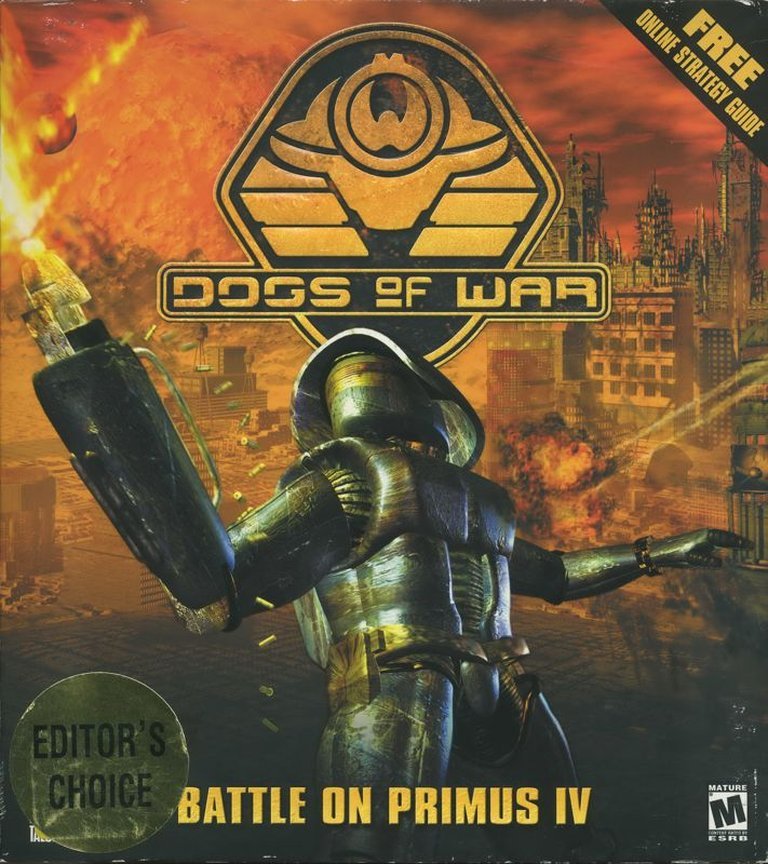
Dogs of War is a real-time tactical strategy game set in a sci-fi universe where three factions—the Imperial Order, the rebel Warmonkeys, and the alien Mantai—battle for supremacy across massive 3D battlefields spanning up to ten square kilometers. Players command up to 200 units from over 40 types, including infantry, mechanized forces, and alien creatures, switching seamlessly from overseeing large-scale armies in strategic views to controlling individual snipers in third-person mode, across 20 single-player missions and multiplayer battles.
Gameplay Videos
Where to Buy Dogs of War
PC
Dogs of War Free Download
Dogs of War Cracks & Fixes
Dogs of War Patches & Updates
Dogs of War Guides & Walkthroughs
Dogs of War Reviews & Reception
ign.com : the game isn’t without its merits and deserves plenty more time before the final judgment can be made.
neoseeker.com : looks nice but plays like a dog.
eurogamer.net : a paltry slop of uninspired point-and-clicking, and clumsy stumbling into enemies and dying.
Dogs of War Cheats & Codes
PC
During gameplay, enter TIMBO then press F5.
| Code | Effect |
|---|---|
| TIMBO | Enables cheat mode; press F5 to disable collision detection / turn off sprite detection |
Dogs of War: Review
Introduction
In the late 1990s, as real-time strategy (RTS) games like StarCraft and Command & Conquer dominated with their base-building frenzy, Dogs of War burst onto the scene in 2000 promising a radical evolution: a pure tactics game stripped of resource grinding, set in sprawling 3D battlefields where players could seamlessly shift from god-like oversight of massive armies to the gritty, third-person cockpit of a single sniper. Developed by the UK-based Silicon Dreams Studio and published by TalonSoft, this sci-fi epic pitted human factions against alien hordes on the resource-rich planet Primus IV. Amid a crowded genre experimenting with 3D—titles like Ground Control and Dark Reign 2 were contemporaries—Dogs of War stood out for its hybrid ambition. Yet, its legacy is one of unfulfilled potential: a visually arresting tactical innovator hamstrung by technical frustrations, earning it a middling 61% on Metacritic and a place as a cult curiosity rather than a classic. This review argues that while Dogs of War pioneered “action tactics” with flair, its execution falters under AI woes and rigid design, cementing it as a bold footnote in RTS evolution.
Development History & Context
Silicon Dreams Studio Ltd., a small British outfit founded in the mid-1990s, entered the fray with Dogs of War after cutting their teeth on military sims and tactical titles. Led by team leader and lead programmer Chris Satchell, alongside talents like AI specialist Philip Harris, graphics wizard Matthew Ritchie, and lead designer Paul Saunders, the studio boasted 138 credits including artists Jason Butterley and animators Keith Fallon. Originally titled Warmonkeys—a nod to one of the factions—it was rebranded by publisher TalonSoft (known for turn-based wargames like Battleground) just before launch, and released as Starship Soldiers in Germany due to title conflicts. TalonSoft, under Take-Two Interactive, handled the PC release on April 14, 2000 (EU), May 6 (UK), and July 31 (NA), with a cancelled Dreamcast port hinting at broader ambitions.
The era’s tech constraints shaped its identity: full 3D environments demanded hardware acceleration, supporting isometric top-down and third-person views on battlefields up to 10 square kilometers with 200 units. This was post-StarCraft (1998), pre-Warcraft III (2002), when RTS was pivoting to 3D purity—no fog-of-war blackouts, but line-of-sight realism. Influenced by Myth: The Fallen Lords (1997) for squad tactics sans bases, it echoed Battlezone II (1999) in direct control but scaled up for vehicular mayhem. Celebrity flair came via Craig Charles (Red Dwarf) voicing story and characters, and Fatboy Slim’s intro FMV track, adding polish amid 2000’s gaming landscape of experimental RTS like Ground Control (which reviewers compared favorably for superior execution). Budget constraints showed: no in-mission saves, multiplayer via LAN/Internet (up to 8 players), and patches promised for AI woes, reflecting TalonSoft’s wargame roots clashing with arcade action.
Narrative & Thematic Deep Dive
Dogs of War‘s plot unfolds around 2200 on Primus IV, Earth’s first off-world colony, a tale of colonial betrayal and resource imperialism drawn from sci-fi tropes like Starship Troopers. Colonists, hailed as heroes for mining depleted Earth’s needs, face reptilian Mantai attacks—Raptors, Corvoids, Rhinoids, Psychoraptors, Firebugs, and suicide Crash Bugs—but receive zero Imperial aid. Rebuilding, they unearth SL-18, a miracle alloy revolutionizing armor and weapons. Earth, now desperate, taxes and outposts Primus IV, sparking rebellion under Professor Ashton Fletcher. Colonists seize comms, trade SL-18 freely, hire blunt-force Warmonkeys mercenaries (with “Shared Battlefield Awareness” tech), igniting war against the finesse-oriented Imperial Order. Mantai lurk as third-party wildcards.
Campaigns split into Imperial/Warmonkeys arcs (25 missions total, Mantai unlocked post-completion), narrated via Craig Charles’ gravelly voiceovers and engine-cutscenes. Themes probe exploitation: Earth’s neglect breeds secession, mirroring real-world colonialism, while SL-18 symbolizes blood minerals (e.g., coltan in Africa). Factions embody styles—Imperials: surgical strikes; Warmonkeys: armored rushes; Mantai: swarm horror—yet the narrative lacks depth. Dialogue is sparse, missions linear puzzles over character-driven arcs; no branching paths or moral choices. Reviewers like Eurogamer called it “gritty atmospheric plot line” potential unrealized, with voice acting feeling amateurish. Ultimately, it’s serviceable B-movie fare, prioritizing tactical set-pieces over emotional investment, a flaw amplifying gameplay rigidity.
Gameplay Mechanics & Systems
At its core, Dogs of War is “real-time tactics” (RTT): no bases, resources, or production—deploy pre-set squads (40+ units: infantry, mechs, aliens) on vast maps, leveraging terrain via line-of-sight. Core loop: strategic top-down commands (group moves, attacks) fluidly toggle to third-person “direct control” (arrow keys steer vehicles/infantry, sniper scopes for precision). Units gain XP for ranks unlocking abilities, with squad customization pre-mission (rarely unit-buying). UI mixes panels for stats/briefings, but clunky: no minimap clicks, confusing hotkeys.
Innovations shine—zoom from army oversight to rifle POV, massive unit caps foster chaos—but flaws abound. Pathfinding is “pathetic” (Joystick.fr): units clip buildings, loop endlessly, ignore commands. AI? “Oduran” (Hacker), suicidal (snipers charging tanks), or omnipotent (360° vision, lethal fire). Direct control lacks strafing, tiny views frustrate stealth. Missions are “highly linear puzzles” (GameSpy), scripted one-path solutions demanding strategy guides; no mid-mission saves spikes difficulty. Multiplayer (8-player maps) adds replayability, but single-player’s 20-25 scenarios escalate to “knackig” (PC Player) frustration. Compared to Ground Control, it’s tactical but unpolished—eye-candy explosions thrill, yet “clunky controls” (Adrenaline Vault) topple potential.
| Strengths | Weaknesses |
|---|---|
| Seamless strategic/direct control hybrid | Poor pathfinding/AI |
| Large-scale battles (200 units) | Linear, puzzle-like missions |
| Unit progression/XP system | No in-mission saves |
| Line-of-sight realism | Confusing UI/no minimap jumps |
World-Building, Art & Sound
Primus IV pulses with sci-fi grit: deserts, ice fields, canyons, urban sprawls—scaled authentically (infantry dwarfed by skyscrapers). 3D visuals dazzle: knallige explosions, smoke trails, weather effects (Power Unlimited’s “eyecandy”). Textures/textures impress (detailed bridges), though drab palettes (rotbraun monotony, PC Games) and map-edge “layered cake” jar. Cameras: strategic long-range to immersive third-person/FMV-like intros.
Sound elevates: Fatboy Slim’s funky intro FMV sets tone, John Hancock/Stephen Maloney’s tunes/SFX boom (explosions, gunfire). Craig Charles’ voice adds character quirk, though “pointless” (Eurogamer). Atmosphere builds tension—Mantai swarms terrify close-up—but dark, trostlos (GameStar) visuals undermine immersion. Collectively, they craft a cinematic battlefield, where pyrotechnics mask repetition, enhancing “high-level action” (Svenska PC Gamer).
Reception & Legacy
Launch reception was mixed (Metacritic 61/100, MobyScore 6.2): highs like Power Unlimited’s 92% (“moddervette tactical action”) and PC Joker 77% praised depth/multiplayer; lows like CGW’s 20% (“sloppy design cautionary tale”) lambasted AI/pathfinding. GameSpot (54%) deemed it “unfinished,” Eurogamer (50%) “frustrating.” Sales? Modest—$18-25 used today, collected by few. Patches addressed some crashes/AI, but core issues persisted.
Influence? Pioneered RTT hybrids (Battlezone-meets-RTS), inspiring unit possession in later titles (Savage: The Battle for Newerth, 2004), but overshadowed by Ground Control‘s polish. Reputation evolved to “great potential unrealized” (GiN), a wargame footnote amid 3D RTS boom (Homeworld, Total Annihilation). Today, it’s preserved obscurity—abandonware downloads thrive, evoking nostalgia for 2000’s bold experiments, yet no remaster/sequels. Silicon Dreams faded post-Codename: Panzers (2004).
Conclusion
Dogs of War endures as a daring 2000 artifact: its 3D tactical purity, direct-control gimmick, and visceral battles heralded RTT’s future, bolstered by stellar visuals/sound. Yet, crippling AI, pathfinding, linearity, and absent features relegate it to mediocrity—a “decidedly average” (AVault) what-if eclipsed by peers. In gaming history, it claims a niche as innovator manqué, worthy of emulation for tacticians craving base-free sci-fi skirmishes. Verdict: 6.5/10—play for history’s sake, but brace for frustration. A stepping stone, not summit, in RTS ascension.