
- Release Year: 2011
- Platforms: Windows
- Publisher: bitComposer Games GmbH, Immanitas Entertainment GmbH
- Developer: Spectral Games
- Genre: Action
- Perspective: 3rd-person
- Game Mode: LAN, Online PVP, Single-player
- Gameplay: Shooter
- Setting: Africa, North America
- Average Score: 37/100
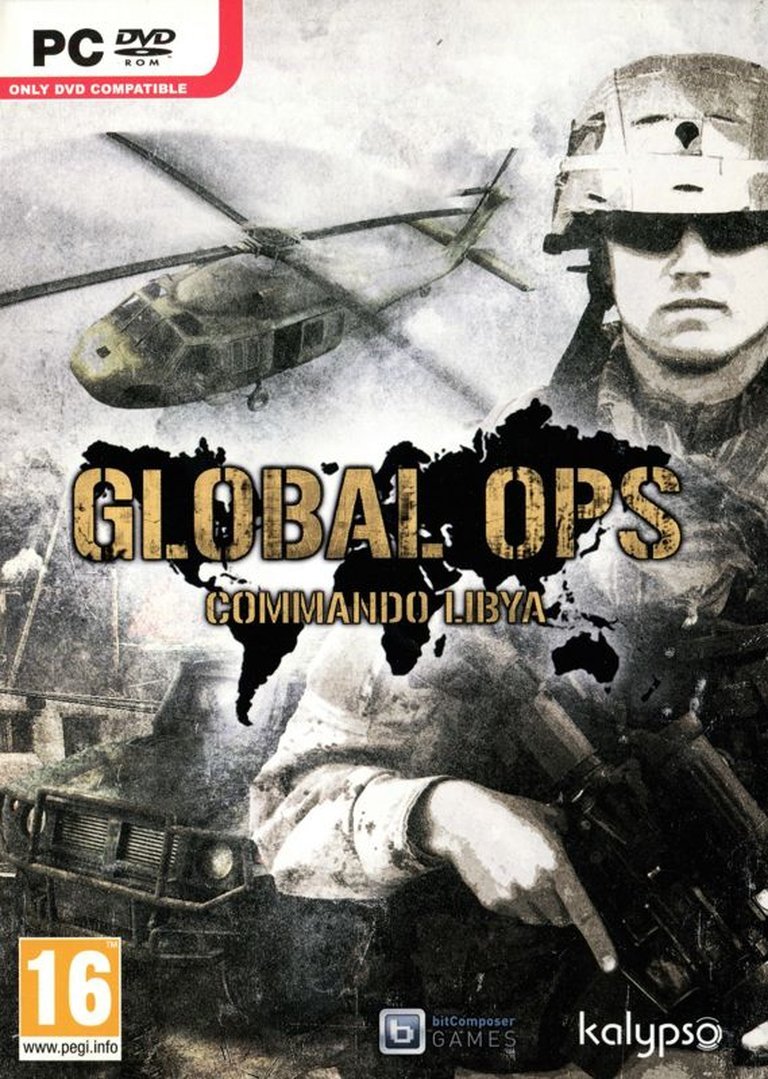
Description
In Global Ops: Commando Libya, a third-person shooter set in Greenland, Northern Africa, and Libya, the CIA sends elite agent West—accompanied by AI-controlled partner Pope—to retrieve an atomic bomb from the Libyan regime, which plans a terrorist attack against the USA. Players battle through nine linear levels using a cover system for regenerating health, dual-wielding weapons, and vehicle sequences to eliminate enemies and thwart the plot.
Gameplay Videos
Where to Buy Global Ops: Commando Libya
PC
Global Ops: Commando Libya Cracks & Fixes
Global Ops: Commando Libya Patches & Updates
Global Ops: Commando Libya Guides & Walkthroughs
Global Ops: Commando Libya Reviews & Reception
metacritic.com (37/100): An utterly rubbish game.
gamewatcher.com : one of the worst shooters in the history of the world.
Global Ops: Commando Libya Cheats & Codes
PC
Goto Username/My Documents/My Games/GlobalOps_CommandoLibya/Go_Game/Config and open Go_Input with Notepad. Add to or edit [Engine.Console] so it reads as: [Engine.Console] ConsoleKey=Tilde TypeKey=Tilde MaxScrollbackSize=1024 bEnableUI=True Then save. In the game press the Tilde Key (~). Enter any of the following cheat codes.
| Code | Effect |
|---|---|
| god | God Mode |
| loaded | Unlimited Clips |
| ghost | No Clipping Mode |
| walk | Disable No Clip |
| slomo # | Change Game Speed |
| playersonly | Freeze AI |
| open GT_intro | Load Chapter 1 map |
| open GT_zima | Load Chapter 2 map |
| open GT_statek | Load Chapter 3 map |
| open gt_gruzja | Load Chapter 4 map |
| open GT_village | Load Chapter 5 map |
| open GT_jaskinie | Load Chapter 6 map |
| open GT_miasto | Load Chapter 7 map |
| open GT_poscig | Load Chapter 8 map |
| open GT_baza | Load Chapter 9 map |
| open GT_lotnisko | Load Chapter 10 map |
Global Ops: Commando Libya: Review
Introduction
Imagine a world where a real-life Cold War aviation disaster collides with 2011’s Libyan Civil War, repackaged as a budget third-person shooter that shamelessly apes Gears of War while stumbling over its own feet. Released in October 2011 exclusively for PC, Global Ops: Commando Libya—developed by Polish newcomer Spectral Games and published by bitComposer Games and Immanitas Entertainment—arrives like a relic from a bygone era of ambitious but undercooked Eastern European titles. At a mid-price launch of around €28 (now a Steam bargain at under $1), it promised high-stakes global espionage to thwart a nuclear terror plot. Yet, what unfolds is a chaotic blend of technical misfires, unintentional hilarity, and genre mimicry gone awry. As a game historian, I see Global Ops not as a masterpiece, but as a cautionary artifact of the post-Gears cover-shooter boom—a thesis that underscores its place as a “so bad it’s good” cult curiosity, emblematic of budget gaming’s highs and lows in an era dominated by AAA blockbusters like Battlefield 3 and Modern Warfare 3.
Development History & Context
Spectral Games, a small Polish studio founded by veterans from titles like Medal of Honor: Allied Assault, Men of Valor: Vietnam, and NecroVision, marked their debut with Global Ops. Led by figures like Project Lead Radomir Kucharski, Design Lead Bartosz Kościański, and Art Director Tomasz Libisz, the team of around 33 credited individuals (including testers and producers from bitComposer) operated on a shoestring budget amid the 2011 gaming landscape. Powered by Unreal Engine 3—a choice that highlighted both ambition and limitation—this was no AAA production; it targeted the mid-price “budget” market, launching via DVD-ROM and digital download during heightened real-world tensions from the Arab Spring and Libyan conflict.
The era’s shooter market was saturated: Gears of War 3 had just dropped, emphasizing polished cover mechanics, while Uncharted 3 and Batman: Arkham City showcased narrative-driven action. Spectral aimed to capitalize on cover-shooter trends with a timely Libyan hook, tying into the 1968 Thule Air Base B-52 crash (a genuine incident where a bomber lost four hydrogen bombs, three recovered). Development constraints were evident—rushed animations, unpolished AI, and minimal polish—reflecting Eastern Europe’s growing but resource-strapped scene (think The Hell in Vietnam or NecroVision). Publishers like bitComposer specialized in such “solide Entertainment” for value-conscious Europeans, positioning Global Ops as accessible fun against pricier rivals. Yet, its Unreal 3 visuals dated it instantly, squeezed between 2006-era tech and 2011’s cutting edge, cementing it as a product of economic pragmatism over innovation.
Narrative & Thematic Deep Dive
Global Ops spins a uchronian tale rooted in historical what-ifs: the 1968 Thule crash’s “missing” nuke resurfaces in 2011, salvaged by Russian mafia kingpin Yebievdenko for sale to a “notorious Libyan dictator” (a thinly veiled Gaddafi analogue amid the Civil War). The CIA dispatches elite operatives West (player) and Pope (AI companion) on a globe-trotting retrieval op across nine linear levels: icy Greenland wrecks, North African deserts, Libyan urban chaos, and shipboard skirmishes. The plot unfolds via terse cutscenes and in-game chatter, culminating in boss vehicular showdowns against the bomb’s handlers.
Thematically, it’s a jingoistic fever dream of American exceptionalism—West and Pope as invincible CIA cowboys cursing their way through “tangos” (terrorists) and mercenaries, with themes of nuclear brinkmanship echoing Red Dawn or Commando. Yebievdenko’s bomb deal symbolizes post-9/11 fears of WMD proliferation, but plot holes abound: Why did the nuke survive 43 years unscathed? How does a mafia boss dive the Arctic undetected? Dialogue is profane juvenilia—”Beat me if you can, asshole!” (Yebievdenko), “Don’t fck with Pope!”—evoking *Rogue Warrior‘s excess, with hoarse voice acting that renders lines comically unintelligible. Characters lack depth: West is a generic grunt, Pope an unkillable bullet sponge spouting navigational quips. Subtlety is absent; it’s revenge porn for U.S. interventionism, laced with Russian/Libyan accents for “authenticity.” As narrative, it’s abysmal—clichéd, hole-riddled, and tonally schizophrenic—but its cheese elevates it to meme-worthy schlock, a thematic time capsule of 2011 geopolitics filtered through B-movie lenses.
Gameplay Mechanics & Systems
At its core, Global Ops is a cover-based third-person shooter cloning Gears of War: linear levels demand popping in/out of cover (A-key activation), dual-wielding rifles/shotguns/SMGs (eight weapons total, two at once), rolling (faulty A-key overlap), grenades, and regenerating health. Combat loops revolve around mowing AI foes in arenas, punctuated by vehicle segments (T-72 tanks, BRDM-2 APCs with slippery physics) and “bosses” (helicopters/APCs felled by M136 AT4 rockets). Progression is checkpoint-based, with no crouch/jump, fixed controls (no remapping, input lag), and HUD woes (opaque damage skull, static crosshairs ignoring weapon spread).
Flaws dominate: Cover “magnetizes” unpredictably, often triggering rolls instead; sprint is glacial; gunplay feels inaccurate (bullets veer, no hit feedback), spawning artificial difficulty. AI is amoeba-like—enemies stare blankly or rush suicidally, yet one-shot players; Pope idles or blocks fire. Vehicle handling defies physics (collision flings), levels rail players linearly with spawn traps and backtracking foes. Multiplayer (LAN/internet deathmatch, team DM, domination) launched dead, sans co-op despite squad premise. UI is spartan—steel-plate menus, no FOV/map/objectives (rely on Pope’s hints). Achievements are absurd (“Fearless!” for intro viewing; “Dumbass!” for self-grenade). Clocking 5-8 hours, it’s repetitive frustration masked as “slick” action, innovative only in bugs (crashes, optimization woes). For historians, it’s a dissectible failure of Gears mimicry without iteration.
World-Building, Art & Sound
Settings span Greenland’s frozen hulks, Libyan souks/mansions, and African dunes/ports—linear but evocatively detailed backdrops (ornate Libyan architecture impresses for budget fare). Atmosphere evokes gritty modern conflict, bolstered by Unreal 3’s ship/boat sequences, but visuals disappoint: blurry textures, stiff animations (duck-like waddles, uniform reloads), muddy 2011 graphics paling vs. Crysis 2. Camera zooms torsos during sprints, clipping FOV; no anti-aliasing/V-sync tweaks.
Sound design fares better: fitting orchestral soundtrack pulses tension, weapon SFX vary (punchy SMGs shine). Voice acting, however, is infamously bad—hoarse protagonists, accented goons yelping cartoonishly on death (“diarrhea screams”). Cheesy taunts amplify absurdity, unintentionally hilarious. Collectively, these forge a B-tier immersion: competent ambiance undermined by amateur execution, contributing a “charmingly broken” vibe that suits its low-rent aesthetic.
Reception & Legacy
Launch reception was dismal: Metacritic’s 37/100 (6 critics) and MobyGames’ 47% (9 reviews) reflect consensus disdain. GamingXP’s outlier 81/100 praised “solides Entertainment” and co-op buddy; most lambasted AI (“amoeba-level”), cover laughs, “banane” plot (GameStar 51%), and “rubbish” polish (GameWatcher 15%). Czech LEVEL’s 1/10 dubbed it “how low-budget goes wrong”; players averaged 2.1-4.0, griping repetition/AI but noting $0.99 fun/bad VA charm. Steam’s “Mixed” (493 reviews) echoes nostalgia for 2000s shooters.
Commercially, a flop—niche sales, dead multiplayer, no ports/sequels. Legacy? Minimal direct influence, but as a Gears clone poster child, it spotlights budget pitfalls in UE3’s twilight. Spectral faded (no follow-ups listed); it endures in “worst games” wikis (Qualitipedia) for memes (Yebievdenko rants), drawing ironic players. In history, it’s a footnote to Poland’s shooter scene (Dying Light forebears), exemplifying 2011’s mid-tier glut and geopolitical opportunism.
Conclusion
Global Ops: Commando Libya is a spectacular trainwreck—a technically inept Gears rip-off whose plot holes, broken mechanics, and profane absurdity render it unplayable yet enduringly watchable. Spectral Games’ debut captures budget gaming’s spirit: ambition stifled by constraints, yielding unintentional comedy over competence. At sub-dollar prices, it’s harmless schlock for bad-game enthusiasts; otherwise, skip for superiors like Spec Ops: The Line. In video game history, it claims a niche as 2011’s ultimate “so bad it’s good” relic—a testament to indie grit amid AAA dominance, forever meme’d for its “Eat my ass, moron!” bravado. Verdict: 3/10—play for laughs, not legacy.