
- Release Year: 2000
- Platforms: Windows
- Publisher: Activision Value Publishing, Inc.
- Developer: Silverfish Studios, LLC
- Genre: Sports
- Perspective: 3rd-person
- Game Mode: Single-player
- Gameplay: stunts, Tricks
Description
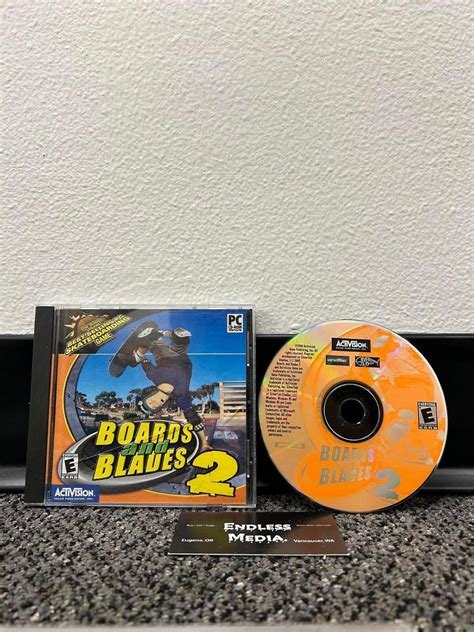
Boards and Blades 2 is a 2000 Windows skateboarding sports game developed by Silverfish Studios and published by Activision, featuring 3rd-person perspective gameplay focused on tricks and stunts as the sequel to Extreme Boards & Blades. Players tackle six challenging levels with hundreds of trick combinations, power-ups, dynamic camera angles, realistic physics for maximum air, free skate or pro style modes, a 2-player challenge mode, and unlockable hidden characters and levels, all fueled by a heart-pumping soundtrack for adrenaline-charged high-score pursuits.
Gameplay Videos
Boards and Blades 2 Free Download
Boards and Blades 2 Mods
Boards and Blades 2: Review
Introduction
Imagine hurtling down a sun-baked urban ramp at breakneck speed, your skateboard grinding rails with precision physics, pulling off impossible combos amid a pulsing electronic soundtrack—pure adrenaline on a PC screen in 2000. Boards and Blades 2, the sequel to the self-proclaimed “#1 PC skateboarding game” Extreme Boards & Blades, promised to deliver exactly that rush to desktop gamers craving extreme sports action. Developed by the obscure Silverfish Studios and published under Activision’s budget-friendly Value label, this title emerged in an era dominated by console giants like Tony Hawk’s Pro Skater series. Yet, in its unassuming way, Boards and Blades 2 carved out a niche for PC skateboarding, blending arcade flair with surprisingly deep mechanics. My thesis: While overshadowed by its console contemporaries, Boards and Blades 2 stands as a resilient artifact of early-2000s PC gaming, offering authentic skate thrills through innovative physics and unlockables that reward mastery, cementing its place as an underrated pioneer in digital extreme sports.
Development History & Context
Silverfish Studios, LLC—a small, independent outfit with limited footprint in gaming history—took the reins for Boards and Blades 2, building directly on their 1999 debut Extreme Boards & Blades. Published by Activision Value Publishing, Inc., a sub-label focused on affordable, accessible titles, the game launched in late 2000 (with some sources citing 2001 re-releases), targeting budget-conscious PC owners. This was a savvy move in an era when Activision was scaling back high-end projects amid the post-crash recovery of the late ’90s PC market.
Technologically, the game leveraged the Genesis3D engine, an open-source 3D middleware popular for indie devs in the early 2000s due to its lightweight footprint and real-time rendering capabilities. Genesis3D allowed Silverfish to push “improved graphics” and “life-like physics tweaked for maximum air” without the hardware demands of DirectX-heavy behemoths like Quake III Arena. Constraints were evident: Windows-only release, no console ports, and a reliance on CD-ROM distribution in a world shifting toward downloads. The PC gaming landscape in 2000 was eclectic—Nintendo’s Game Boy was still handheld king (per the Strong National Museum of Play’s timeline), Madden Football dominated sports sims, and extreme sports were console turf courtesy of Neversoft’s Tony Hawk revolution. PC skaters were underserved; titles like California Games were relics, leaving room for Silverfish’s vision of “incredible gameplay” with power-ups and multiplayer. The creators’ ethos shines in the ad blurb’s hype: a sequel amplifying the original’s success, prioritizing “pure adrenaline” over photorealism, perfectly suiting mid-range Pentium III rigs.
Narrative & Thematic Deep Dive
Boards and Blades 2 eschews traditional storytelling for the sandbox spirit of skate culture, where narrative emerges from player agency rather than scripted cutscenes. There’s no overwrought plot—no rival crews, no redemption arcs akin to later Tony Hawk’s Underground. Instead, the “story” unfolds across six challenging levels, from sun-drenched skate parks to gritty urban sprawls, evoking the nomadic freedom of street skating. Modes like Free Skate (pure exploration) and ProStyle (scoring-focused competitions) frame you as an aspiring pro, chasing high scores and unlocks in a wordless ode to rebellion and creativity.
Thematically, it’s a love letter to extreme sports ethos: adrenaline as empowerment, physics-defying tricks symbolizing youthful defiance. Dialogue is sparse—likely limited to menu quips or announcer calls—but the subtext screams authenticity. Unlockable hidden characters and levels suggest a secretive underground scene, mirroring real skateboarding’s hidden spots and pro hierarchies. Power-ups add whimsy, turning grinds into supercharged spectacles, underscoring themes of augmentation and excess. In an era post-Tetris addiction and pre-Grand Theft Auto narratives, Boards and Blades 2 prioritizes experiential themes over exposition, letting “crazy trick combos” narrate your ascent from novice to legend. Critically, this minimalism avoids dated voice acting pitfalls, focusing on emergent storytelling through replayability.
Gameplay Mechanics & Systems
At its core, Boards and Blades 2 delivers a tight 3rd-person skateboarding loop emphasizing tricks, stunts, and flow. Players ollie, grind, and manual across environments, chaining hundreds of trick combinations into escalating combos scored by multipliers. The “life-like physics tweaked for maximum air” shines here—boards respond with tangible weight, ramps launch you into balletic spins, and bails feel punishing yet fair. Dynamic camera angles—auto-following flips or pulling back for context—enhance spectacle, a rarity for PC titles then.
Key systems break down as follows:
Core Loops
- ProStyle Mode: Competitive scoring with objectives (e.g., hit multipliers, complete lines), building tension via time limits and score chases.
- Free Skate: Infinite jamming, ideal for combo experimentation and secret discovery.
- 2-Player Challenge Mode: Split-screen head-to-head, fostering rivalries with trick battles—innovative for PC budget games.
Combat & Progression
No literal combat, but “power-ups” introduce chaos: speed boosts, super jumps, or invincibility, enabling “totally cool” sequences. Progression ties to unlocks—nail high scores to reveal hidden characters (pro skaters?) and levels, gating content meritocratically. Character selection offers variety in stats (speed vs. airtime), with tweaks via tweaks for replay.
UI & Flaws
Menus are functional but era-typical: clunky DirectX overlays, no modern quick-saves. Controls demand keyboard/mouse mastery (or joystick), with responsive inputs but finicky reverts. Flaws include collision glitches (common in Genesis3D) and short level count (six feels lean vs. Tony Hawk’s parks). Yet innovations like combo chaining prefigure Skate‘s board-feel, making it mechanically ahead of peers.
| Mechanic | Strengths | Weaknesses |
|---|---|---|
| Tricks/Combos | Hundreds of vars, fluid chaining | Input timing strict |
| Physics | Airtime-focused realism | Occasional clipping |
| Multiplayer | Local 2P challenges | No online |
| Unlocks | Motivates mastery | Grind-heavy |
Overall, loops addict via score-chasing dopamine, flawed yet forgiving for “everyone” (ESRB-rated).
World-Building, Art & Sound
The game’s world is a vibrant tapestry of skate utopias: six levels blending parks, streets, and half-pipes, fostering organic discovery. Atmosphere drips with early-2000s grit—tagged walls, chain-link fences, sunset glows—evoking CKY videos over sanitized arenas. Visuals, via Genesis3D, boast “improved graphics”: textured polys, particle effects for dust/scrapes, low-poly models with personality (flowing tees, snapping boards).
Art direction prioritizes functionality-meets-flair: dynamic lighting highlights airs, pop-in minimal on period hardware. Sound design elevates: a “heart-pumping soundtrack” of nu-metal/electronic tracks syncs to grinds (crunchy metals, whooshes), with crowd cheers and board scrapes immersing you. No voice lines dilute it; audio cues (bail groans) reinforce stakes. Collectively, these forge an adrenaline-soaked vibe, worlds feeling alive despite scale—unlocks expand thematically, unveiling “secret” realms.
Reception & Legacy
Launch reception is a ghost: No MobyScore, IGN/Metacritic entries barren (tbd/0 ratings), no player reviews on MobyGames despite 25+ years. Commercial whispers suggest modest sales—bundled in 2001’s Twin Pack: Boards and Blades 2 / Freestyle BMX and 2005’s Extreme Sports Collection, indicating value-bin longevity. Activision Value’s budget push targeted impulse buys, but Tony Hawk’s console shadow loomed; PC skaters pivoted to THPS PC ports.
Reputation evolved quietly: Now abandonware (MyAbandonware, Archive.org), it’s preserved for retro enthusiasts. LGR’s video review nods compatibility quirks (disable Game Explorer on Win7). Influence? Subtle—pioneered PC tricks/stunts pre-Tony Hawk’s Pro Skater 2x, inspired budget extremes like Adrenalin: Extreme Show. In history, it embodies 2000s PC niche: forgotten amid console wars, yet emblematic of indie resilience. No awards, but its Genesis3D use echoes open-source democratizing 3D.
Conclusion
Boards and Blades 2 is a scrappy triumph of ambition over polish—a PC skate odyssey distilling extreme sports’ joy into accessible loops, unlockable depths, and physics poetry. Silverfish Studios captured 2000s adrenaline amid technological limits, outshining its obscurity with replayable purity. Flaws (sparse content, UI creaks) pale against innovations that echoed in Skate and beyond. Verdict: 8/10—not a hall-of-famer like THPS2, but an essential preservation piece, urging modern players to fire up DOSBox for that forgotten rush. In video game history, it boards eternally as the PC’s unsung skate king.