
- Release Year: 2012
- Platforms: iPad, Macintosh, Windows
- Publisher: Slitherine Ltd.
- Developer: Lordz Games Studio, The
- Genre: Strategy, Tactics
- Perspective: Top-down
- Game Mode: Hotseat, Online PVP, Single-player
- Gameplay: Fog of war, Naval warfare, Research, Turn-based combat
- Setting: World War I
- Average Score: 78/100
Description
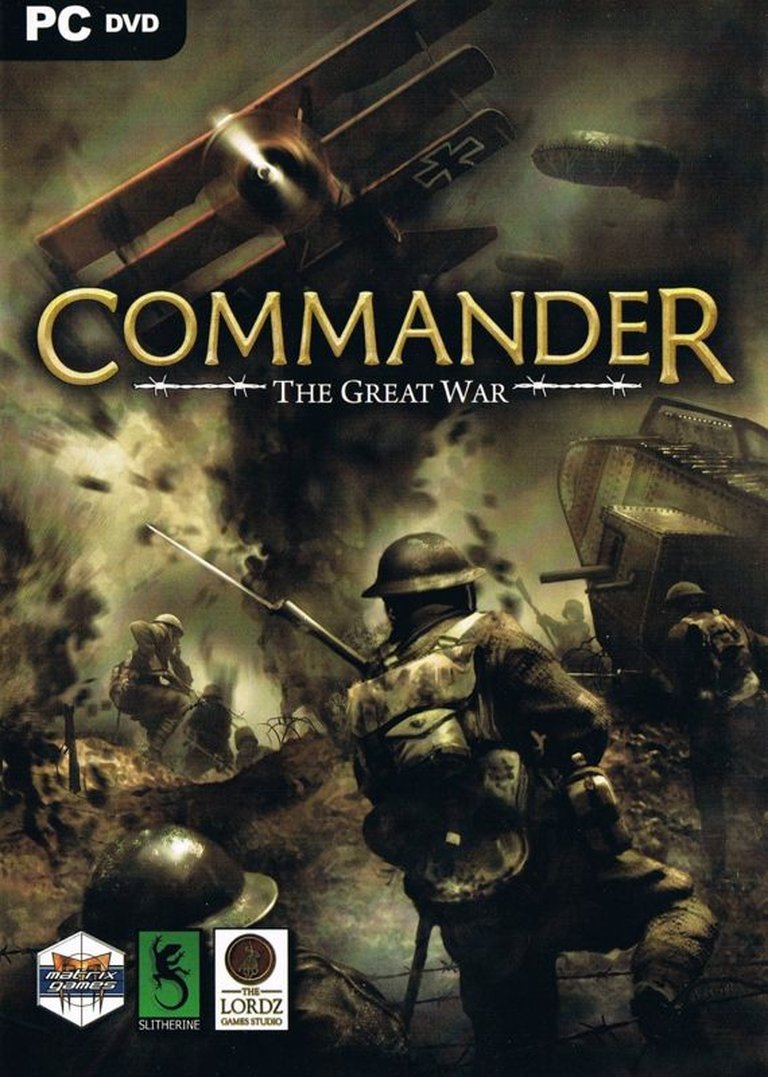
Commander: The Great War is a turn-based strategy game set in World War I, featuring five grand campaigns starting in pivotal historical years—1914: The Great War, 1915: Ypres-Artois, 1916: The Battle of Verdun, 1917: The Nivelle Offensive, and 1918: The Kaiserschlacht—where players command either the Central Powers or the Entente Allies. It offers eighteen unit types, historical commanders, research and technology upgrades, and realistic combat mechanics that account for supply, morale, terrain, leadership, equipment, training, and fog of war.
Gameplay Videos
Where to Buy Commander: The Great War
PC
Commander: The Great War Patches & Updates
Commander: The Great War Mods
Commander: The Great War Guides & Walkthroughs
Commander: The Great War Reviews & Reception
metacritic.com (68/100): Mixed or Average
gamepressure.com (81/100): Very Positive
forums.matrixgames.com (84/100): A clear candidate for the award ‘Best Wargame 2012.’
steambase.io (81/100): Very Positive
pocketgamer.com : Offers a unique challenge to the mobile gamer.
Commander: The Great War: Review
Introduction
In the shadowed trenches of gaming history, where World War I simulations have long languished amid stereotypes of futile mud and endless stalemates, Commander: The Great War emerges as a beacon of strategic brilliance. Released in 2012 by The Lordz Games Studio and published by Slitherine Ltd., this turn-based grand strategy title daringly reimagines the “war to end all wars” not as a quagmire of despair, but as a grand chessboard of industrial might, logistical mastery, and pivotal breakthroughs. Drawing from the thunderous legacy of prior Commander series entries like Commander: Europe at War, it spans the globe from the fog-shrouded fields of Ypres to the sun-baked sands of Arabia, challenging players to command either the Central Powers or Entente Allies across five meticulously crafted campaigns.
This is no glorified shoot-’em-up; it’s a historian’s dream and a strategist’s crucible, where every hex pulses with the weight of history. My thesis: Commander: The Great War stands as a landmark achievement in WWI gaming, blending unprecedented operational depth with accessible mechanics to deliver a profoundly replayable experience that educates as it exhilarates, cementing its place as the definitive digital chronicle of 1914-1918.
Development History & Context
The Lordz Games Studio, helmed by CEO and Executive Producer Tim van der Moer (aka Lord Zimoa), birthed Commander: The Great War amid a burgeoning renaissance in digital wargaming. Announced in 2010 via development diaries on forums like Total War Center, the project evolved from the studio’s acclaimed Commander: Napoleon at War and Commander: Europe at War, refining a formula rooted in hex-based, turn-based strategy. Key talents included Lead Programmer Szymon Gatner, Lead Designer Lukas Nijsten, AI specialist David Forster, and composers Damon Fries, Stefan Osadzinski, and Alessandro Ponti, with beta testing by wargame veterans like John Dahlen (Slick Wilhelm).
Slitherine Ltd. and Matrix Games provided publishing muscle, leveraging their PBEM++ (Play-by-E-Mail++) multiplayer infrastructure—a revolutionary async system that extended play sessions across continents. Technologically, the game harnessed a bespoke engine optimized for widescreen resolutions (1024×600+), a leap from era peers constrained by legacy code. Released November 12, 2012, for Windows (later Mac and iPad in 2014), it arrived in a landscape dominated by WWII titles like Panzer Corps (sharing 28 credited personnel) and Unity of Command. WWI games were scarce—titles like 1914: The Great War (2002) or WWI: The Great War (2003) felt dated—leaving room for innovation amid the 2014 centenary hype.
Development diaries previewed factions, units, and mechanics, emphasizing historical fidelity: from Serbia’s 1914 mobilization to the 1918 Kaiserschlacht. Patches up to v1.6.6 (2015) addressed AI quirks and bugs, though support ended thereafter. Priced at full retail (~$40-50 initially, now $29.99 on Steam), it targeted hardcore wargamers, not casuals, in an era when mobile ports like the iPad version expanded reach via touch controls (pinch-zoom substituting mouse).
Narrative & Thematic Deep Dive
Commander: The Great War eschews traditional plots, characters, or dialogue for a narrative woven from history’s unyielding thread. Players embody faceless high commands, scripting the war’s arc through five grand campaigns: 1914: The Great War (invasion of Belgium), 1915: Ypres-Artois, 1916: Verdun, 1917: Nivelle Offensive, and 1918: Kaiserschlacht. Each spans pivotal offensives, culminating in the full 1914-1918 Armistice saga—a 118-turn odyssey from fluid Schlieffen Plan maneuvers to tank-led breakthroughs.
Themes probe the industrialized apocalypse: logistical tyranny, where supply lines dictate victory amid U-boat wolfpacks and convoy vulnerabilities; attrition’s grim calculus, modeling morale collapse, national will erosion, and manpower shortages; and technological Darwinism, via research trees evolving reconnaissance balloons into strafing fighters, shrapnel barrages into creeping artillery, and cavalry charges into Mark I tanks. Over 40 historical/what-if events—Russian Revolution triggers, Ottoman collapse, U.S. entry—inject dynamism, pondering “what-ifs” like a successful Brusilov Offensive or unbroken Gallipoli.
No voiced protagonists or branching dialogues exist; “characters” are historical commanders (e.g., Falkenhayn for ground, Hindenburg for leadership bonuses; admirals like Jellicoe; aces like Richthofen). Attach them wisely—generals boost infantry tenacity, aces shred air efficiency—forcing thematic trade-offs: offensive zeal vs. defensive grit. Fog of war obscures enemy intents, mirroring command uncertainty, while morale national mechanics evoke homefront collapse (e.g., French mutinies post-Nivelle). It’s a somber meditation on hubris: early blitzkriegs falter into trenches, breakthroughs demand prescience, underscoring WWI’s thesis as modernity’s meat grinder.
Gameplay Mechanics & Systems
At its core, Commander thrives on a masterful loop: mobilize, research, produce, advance, consolidate. Turns (two weeks) unfold on a colossal hex map—from U.S. neutrality to Urals vastness—via top-down, turn-based IGOUGO pacing. Command Central Powers (Germany/Austria-Hungary/Ottomans/Bulgaria) or Entente (France/Britain/Russia/Serbia/Italy/U.S./Japan), scaling from 1-2 offline/online players.
Core Systems Deconstructed:
– Units (18 Types): Infantry/garrisons hold lines; cavalry/armored cars exploit; artillery/railroad guns soften; tanks (late-war) pierce; naval (cruisers/subs/battleships) contest seas; air (fighters/bombers/airships) recon/attack. Stats model supply, morale, terrain penalties, leadership, equipment/training/fog. Order: fighters (reduce efficiency), airships/artillery/bombers/infantry/garrisons maximizes damage.
– Combat Realism: Probabilistic, morale-driven clashes; bends expose flanks (AI exploits 3-4:1 odds). Reserves rotate damaged units; replacements heal (1-2 points/turn).
– Progression: Research (air/artillery/armor branches) unlocks upgrades; production queues garrison/infantry floods. Commanders attach for bonuses (e.g., +attack in terrain).
– UI/Controls: Intuitive—mouse/keyboard (PC), touch-tab (iPad). Tabs for fronts, production, diplomacy (limited: alliances, no deep intrigue). No undo, but saves mitigate errors. Steam guides (Dr. Duh’s) detail: plug lines early, fighter-prep assaults, emulate AI rotations.
– Multiplayer: PBEM++ shines—async, cross-platform (PC/iPad), limitless replay.
– Innovations/Flaws: Events trigger dynamically; Lua moddability tweaks combat/terrain. AI challenges (1914 fluid, later stalemates), but timid (e.g., British Mideast); bugs (Belgium glitch); micro-heavy (multi-nation management); no excessive diplomacy.
Loops: Scout/research/produce for offensives; defend/consolidate post-push. 1914: Serbia plugs gaps; 1918: tanks storm. Hard to master—early defeats teach AI emulation.
World-Building, Art & Sound
The game’s world is a faithful diorama: hexes evoke Western Front trenches, Eastern vastness, naval chokepoints (Channel/Dardanelles), colonial peripheries (Africa/Arabia). Atmosphere builds via fog-shrouded recon, morale icons signaling collapse, event popups narrating Brusilov or Zimmerman Telegram. Scale impresses—global theatre captures WWI’s totality, from U.S. factories to Russian steppes.
Visuals: Functional top-down hexes; unit icons crisp (infantry silhouettes evolve). Average graphics (5.5/10 per reviews)—no flashy effects, but widescreen optimization and concept art (Mariusz Kozik) suit 2012 tech. iPad scales seamlessly.
Sound Design: Sparse but evocative—marching infantry, rumbling artillery, Zeppelin hums. Music (Fries/Osadzinski/Ponti) swells with martial gravitas, evoking somber marches. Effects immerse without distraction, amplifying tension in knife-edge assaults.
Collectively, they forge immersion: not cinematic spectacle, but analytical tension, where a hex flip feels monumental.
Reception & Legacy
Launched to niche acclaim, Commander garnered 80% from IGN Italia (“pinnacle of mobile strategy,” praising naval/morale fluidity, critiquing diplomacy/price). Steam: Very Positive (81%, 286 reviews)—praise for accessibility (“most playable WWI wargame”), challenge (“AI kicks butt”); gripes: bugs, graphics, micro. Wargamer: “addictive, fun”; Tacticular Cancer: “arm-wrestling over sword duel”; Strategyprime: 4/5. Metacritic user 6.8/10; Pocket Gamer lauded depth, mobile fit caveats.
Commercially modest (niche appeal), ports boosted iPad sales (2017 iTunes discount). Legacy: Influenced WWI titles (Strategic Command: World War I); PBEM++ endures; mods extend life. In industry, it proved grand strategy viable mobile/PC cross-play, bridging Panzer General hex tactics with grand ops. No sequels (support ended 2015), but as “classic” (IGN), it endures for wargamers seeking stalemate mastery.
Conclusion
Commander: The Great War masterfully distills WWI’s essence—industrial grind yielding rare genius—into an exhaustive, replayable triumph. Exhaustive campaigns, realistic systems, and multiplayer cement its mechanics; thematic depth and historical fidelity elevate it beyond gameplay. Flaws (AI quirks, visuals, micro) pale against innovations, earning 9/10: essential for strategy historians. Its place? Pinnacle of operational WWI gaming—a timeless testament to The Lordz’s vision, urging players: command wisely, or consign empires to oblivion. Buy it; relive the Great War.