
- Release Year: 2008
- Platforms: Macintosh, Windows
- Publisher: astragon Software GmbH, Big Fish Games, Inc, Frogwares Game Development Studio, GSP Software
- Developer: Frogwares Game Development Studio
- Genre: Adventure
- Perspective: Third-person
- Game Mode: Single-player
- Gameplay: Hidden object, Puzzle elements
- Setting: Belle Époque, London
- Average Score: 43/100
Description
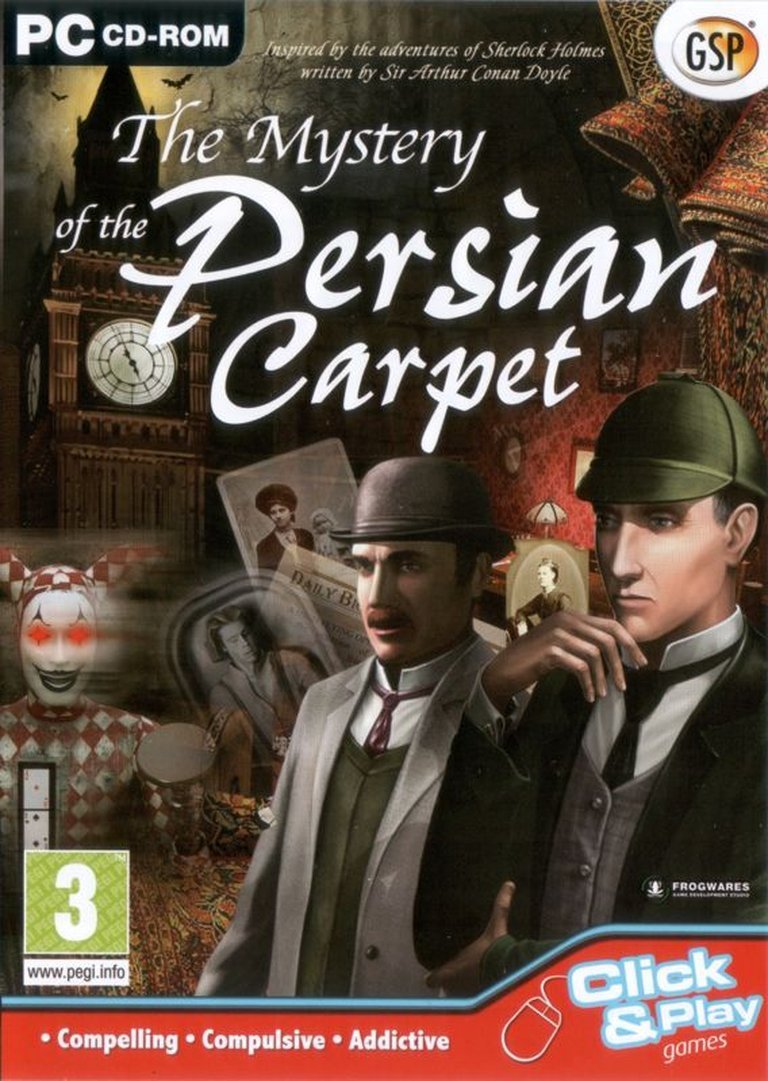
In Sherlock Holmes: The Mystery of the Persian Carpet, players step into the shoes of the iconic detective in Victorian London to investigate a bizarre murder: a young painter found dead and rolled up inside a Persian carpet. This adventure game blends point-and-click exploration with hidden object mechanics, utilizing Holmes’ apartment for deductions on a blackboard and chemical analysis, Scotland Yard for reports and profiles, and a map of London to uncover clues across various locations leading to the culprit.
Gameplay Videos
Where to Buy Sherlock Holmes: The Mystery of the Persian Carpet
PC
Sherlock Holmes: The Mystery of the Persian Carpet Free Download
Sherlock Holmes: The Mystery of the Persian Carpet Cracks & Fixes
Sherlock Holmes: The Mystery of the Persian Carpet Guides & Walkthroughs
Sherlock Holmes: The Mystery of the Persian Carpet Reviews & Reception
metacritic.com (52/100): a rather crude cash grab with very unpolished gameplay and a short, boring plot.
adventuregamers.com : it stripped out a lot of the fun in the process.
gamespot.com : Disappointment is likely to be the first reaction.
Sherlock Holmes: The Mystery of the Persian Carpet: Review
Introduction
Imagine the fog-shrouded streets of Victorian London, where the sharp mind of Sherlock Holmes dissects a macabre puzzle: a promising young painter, brutally murdered and unceremoniously rolled into an exquisite Persian carpet like discarded rubbish. This is the tantalizing hook of Sherlock Holmes: The Mystery of the Persian Carpet, Frogwares’ 2008 foray into casual gaming that transplants the iconic detective from his traditional adventure roots into a hybrid of hidden-object hunts and logic puzzles. As part of Frogwares’ sprawling Sherlock Holmes series—spanning over two decades and evolving from pixelated point-and-clicks to modern open-world investigations—this title stands as a curious outlier, a “lite” experiment aimed at broadening the franchise’s appeal amid the rising tide of casual games. Its legacy is one of ambition undercut by execution: a promising blend of detective deduction and accessible puzzling that ultimately falters under pixel-hunting frustration and narrative detachment, cementing it as a footnote rather than a cornerstone in Holmes’ digital canon. Yet, for historians of the genre, it reveals Frogwares’ early pivot toward diversified markets, foreshadowing the series’ endurance.
Development History & Context
Frogwares Game Development Studio, a Ukrainian team founded in the late 1990s and later restructured under Irish oversight, had already established itself as the preeminent steward of Sherlock Holmes in gaming by 2008. Best known for full-fledged adventures like Sherlock Holmes: Nemesis (2007, aka Versus Arsène Lupin) and the atmospheric Sherlock Holmes: The Awakened (2007), the studio drew inspiration from Arthur Conan Doyle’s canon and ITV’s The Adventures of Sherlock Holmes starring Jeremy Brett. The Mystery of the Persian Carpet emerged as a side project from Frogwares’ casual division (sometimes branded Waterlily), targeting the booming shareware and downloadable market dominated by Big Fish Games.
Led by president Waël Amr and producer Volodymyr Horodnychyi, the small team of 25 (18 developers, 7 thanks) included key talents like Aurélie Ludot on story and game design, a roster of 2D artists (Olesya Guk, Kateryna Kozemirova, Marina Orlova, et al.), programmers Maksym Komisarenko and Peter Tarassenko, and 3D artists Maxim Scherbakov and Sergiy Goshko. Notably, it recycled assets—scenes and music—from Sherlock Holmes: Secret of the Silver Earring (2004), reflecting resource constraints in an era of modest budgets for casual titles.
Released on May 9, 2008, for Windows (Mac in 2010), it navigated a gaming landscape shifting toward casual accessibility. The mid-2000s saw hidden-object games explode via portals like Big Fish, amid publishers like Focus Home Interactive (later involved in mainline Holmes titles) pushing Frogwares toward consoles. Technological limits were low: Pentium III 600 MHz, 256 MB RAM, DirectX 9 graphics—optimized for CD-ROM/shareware distribution. PEGI 3 rating emphasized family-friendly toning down of Frogwares’ usual gore. Publishers included Big Fish Games, astragon Software, GSP, and Frogwares itself, with Steam re-release in bundles like The Sherlock Holmes Collection. This context positions Persian Carpet as Frogwares’ test balloon for casuals, bridging literary adaptations and the hidden-object boom, but revealing tensions between adventure depth and bite-sized play.
Narrative & Thematic Deep Dive
Set in 1896 at 221B Baker Street, the plot unfolds as Scotland Yard summons Holmes and Watson to a grisly yet peculiar crime: a young painter discovered murdered, corpse stuffed into a stolen Persian carpet. What begins as a straightforward whodunit spirals into a tapestry of jealousy, blackmail, secret affairs, and hidden motives among six suspects—revealed via profiles, reports, and testimonies at Scotland Yard. Holmes crisscrosses Victorian London via an interactive map, from opulent parlors and theaters to dingy factories and gardens, piecing together clues like shredded letters, footprints, and chemical traces.
Thematically, it evokes Doyle’s Belle Époque London—smoggy, class-stratified, rife with intrigue—but dilutes it for casual play. Core motifs include abductive reasoning (Holmes’ hallmark), mirrored in the deduction board; evidence analysis at the chemistry table and microscope; and social undercurrents like artistic ambition clashing with scandal. Dialogue is sparse, limited to textual reports and Watson’s occasional interjections (“for my part, I am no further ahead”), fostering detachment. Suspects lack direct interaction, reducing them to dossiers, while the narrative rushes through seven chapters, culminating in a Holmesian reveal.
Strengths lie in thematic fidelity: the carpet symbolizes concealed truths, echoing Doyle’s themes of hidden vices (A Scandal in Bohemia). Yet flaws abound—plot feels disjointed, revelations arbitrary, and progression linear despite “freedom of investigation” promises. No voice acting (unlike mainline titles) starves character depth; Holmes and Watson are icons, not personalities. As a non-canon original, it prioritizes puzzle service over storytelling, a casual concession that undermines immersion. Still, it nods to series lore, positioning itself post-Nemesis, pre-Awakened Remastered.
Gameplay Mechanics & Systems
Persian Carpet fuses point-and-click adventure with hidden-object mechanics, eschewing mainline Frogwares’ 3D exploration for static screens. Core loop: access Holmes’ apartment (blackboard deduction grid, chemistry table), London map, or Scotland Yard (reports/profiles) via top-left icons. Each scene features a bottom inventory with silhouettes for 5-7 evidence items (e.g., keys, ash, hair)—click to collect, then drag to jigsaw icon (assembly puzzles) or gears icon (usage/interaction). Icons glow gold when exhausted.
Hidden Objects: Relevant to the case (no random rubber ducks), but pixel-hunting reigns—tiny clues blend into detailed backdrops, no hotspot cursors. Hints (3 per chapter/location) highlight areas or items, rechargeable slowly.
Puzzles: 20+ varieties per chapter: sliders, jigsaws, codes, scales, mazes, matchstick games, joker-card enigmas, 3D spatial rotators. Analyzed at 221B (microscope scalpel/tweezers, Bunsen tests). Deduction Board: Capstone grid linking suspects/objects (green=correct, red=retry), vague connections demand trial-and-error.
Progression/UI: Three difficulties (Casual/Detective/Adventure) vary hints/skips (3 puzzle-solves total). Linear but with minor backtracking; timer optional. Inventory auto-discards post-scene. Innovative yet flawed: assembly/use icons streamline adventures, but obtuse hints/instructions frustrate (e.g., unexplained matchsticks).
No combat/progression trees—pure logic. ~6 hours first play, replayable puzzles. Flaws: repetitive hunts, poor integration (puzzles as barriers), limited skips. Strengths: deduction evokes Holmes’ mind palace.
| Mechanic | Strengths | Weaknesses |
|---|---|---|
| Hidden Objects | Case-relevant; atmospheric scenes | Pixel-perfect; blends into backgrounds |
| Puzzles | Variety (logic/spatial); skippable | Unclear instructions; trial-and-error |
| Deduction | Thematic reasoning grid | Vague links; blind guessing |
| UI | Intuitive icons/map | No hotspots; hint limits |
World-Building, Art & Sound
London 1896 pulses with Belle Époque authenticity: cluttered parlors, shadowy alleys, ornate theaters—hand-drawn 2D/2.5D screens evoke Doyle’s fogbound city. Reused Silver Earring assets ensure cohesion, with hi-res detail (ornate rugs, gas lamps) building immersion. No dynamic 3D, but fixed perspectives heighten scrutiny, magnifying glasses on profiles adding intimacy.
Art direction shines: atmospheric Victorian clutter hides clues organically, fostering paranoia. 3D artists’ touches (subtle depth) blend seamlessly. Sound: orchestral period score (violins, piano) from prior games—haunting, evocative—sans voice acting, relying on ambient foghorns/footsteps. Music loops reinforce tension, but silence in dialogues underscores detachment.
Elements synergize for sleuthing coziness: visuals immerse, soundscapes unsettle, world-building via map/locations (gardens, factories) mirrors Doyle’s urban sprawl. Yet static nature limits scale versus mainline’s open worlds.
Reception & Legacy
Launch reception was tepid: MobyGames critics averaged 55% (GameZebo 70%: “atmospheric… many puzzle styles”; Adventure Gamers 40%: “flawed first step into casuals”). Players: 2.3/5 (6 ratings). Steam: Mostly Negative (39% positive from 485 reviews)—praised puzzle variety/nostalgia, lambasted pixel hunts, no voices/UI confusion. GameSpot (2010): 6/10, “challenging… good for kids,” but “grueling hunts.”
Commercially modest, bundled in Sherlock Holmes Collection, it sold via Big Fish/shareware. Reputation evolved negatively: Wikipedia deems it “poorly rated… not appropriate sequel”; Adventure Gamers “underwhelming.” No awards, unlike Awakened‘s accolades.
Influence: Casual spin-off in Frogwares’ 20+ Holmes titles (mainline sold 3-4M by 2012). Paved way for Osborne House (DS, 2010), Hound of the Baskervilles (2011), but highlighted pitfalls—hybrid mechanics inspired later blends (Lost Cases), yet series refocused on core adventures (Crimes & Punishments, 2014). Culturally, preserves Holmes for casuals, influencing hidden-object detectives, but legacy as “cash-grab experiment” using recycled assets.
Conclusion
Sherlock Holmes: The Mystery of the Persian Carpet embodies Frogwares’ bold 2008 gamble: distilling deductive genius into casual bites, yielding atmospheric visuals, varied puzzles, and thematic nods amid frustrating hunts and sparse narrative. Exhaustive in mechanics yet shallow in story, it earns a 5.5/10—serviceable for puzzle fans/kids, but a misstep for series purists craving Nemesis‘ depth. In video game history, it’s a transitional artifact: Frogwares’ casual detour amid rising accessibility, underscoring the Holmes franchise’s adaptability. Play for nostalgia or bundles, but seek mainline epics for true Baker Street brilliance. Elementary, yet flawed.