
- Release Year: 2011
- Platforms: Windows
- Publisher: Egmont Polska Sp. z o. o.
- Developer: honey flavour, Wydawnictwo Dagiel
- Genre: Adventure
- Perspective: Side view
- Game Mode: Single-player
- Gameplay: Mini-games, Point-and-click, Side-scrolling
- Setting: Fantasy
- Average Score: 68/100
Description
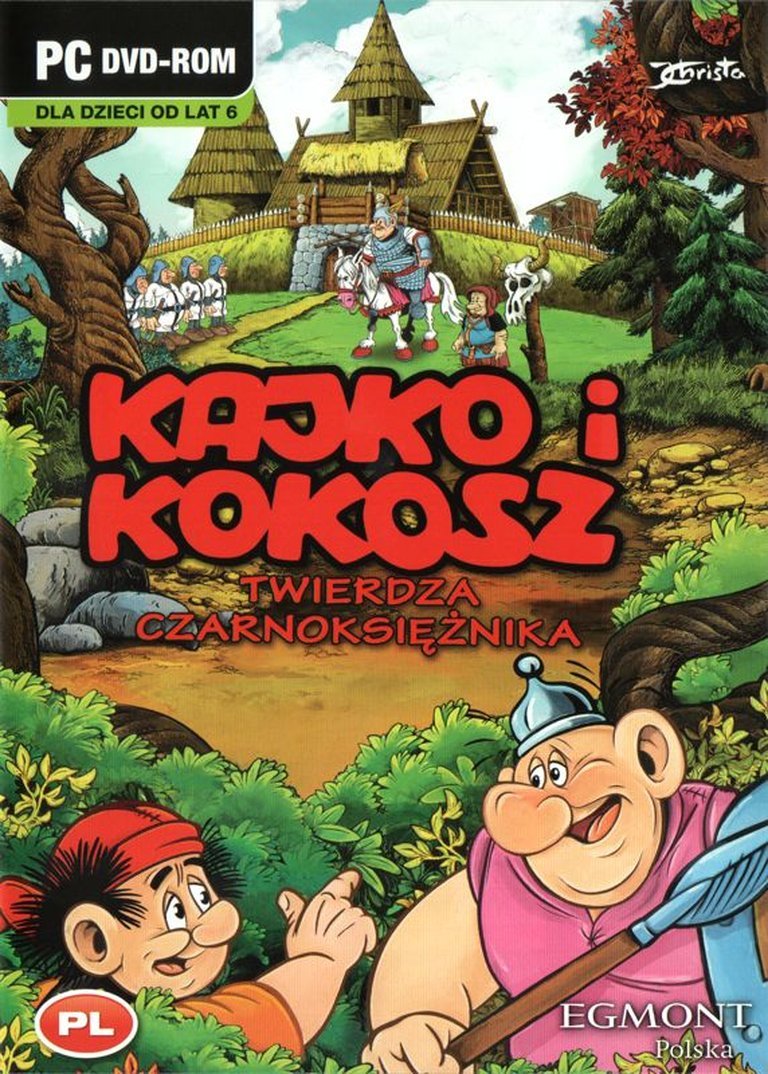
Kajko i Kokosz: Twierdza Czarnoksiężnika is a colorful side-scrolling point-and-click adventure game for kids, loosely based on the Polish comic book series Kajko i Kokosz. Divided into three chapters, it follows the brave knights Kajko and Kokosz as they confront the evil sorcerer Hodon, who disguises himself as a merchant to trick castellan Mirmił into building an expensive castle with heavy taxes on Mirmiłowo Wielkie residents, allies with the Bloody Hegemon for an invasion, and flees to his island fortress after defeat, stealing sorceress Jaga’s raven along the way; the game features mini-games testing dexterity, logic, and memory.
Kajko i Kokosz: Twierdza Czarnoksiężnika Reviews & Reception
filmweb.pl (65/100): Jest dobra i równo podzielona pół rozgrywki to są łamigłówki a pół to przygoda point and click
Kajko i Kokosz: Twierdza Czarnoksiężnika: Review
Introduction
Imagine a world where Slavic folklore meets slapstick comedy in vibrant, hand-painted panels straight out of a beloved comic book—welcome to Kajko i Kokosz: Twierdza Czarnoksiężnika, a 2011 point-and-click adventure that resurrects Poland’s iconic duo of bumbling yet brave warriors. Rooted in Janusz Christa’s timeless Kajko i Kokosz comic series, which has enchanted generations since the 1970s with its mix of medieval mischief, anti-hero bandits, and pint-sized knights, this game arrives as a loving digital tribute amid a landscape dominated by high-budget blockbusters. Released on December 2, 2011, for Windows by the modest Polish teams at Wydawnictwo Dagiel and honey flavour under Egmont Polska, it distills the comics’ whimsical essence into an accessible package for kids. My thesis: While not revolutionary, Twierdza Czarnoksiężnika excels as a nostalgic, family-friendly gem that faithfully honors its source material, blending simple puzzles, mini-games, and heartfelt humor to carve a niche in Polish gaming history as a bridge between analog comics and interactive storytelling.
Development History & Context
The game’s origins trace back to a rich lineage of Kajko i Kokosz adaptations, beginning with Seven Stars’ buggy 1994 Amiga/DOS title—plagued by financial woes, missing music, and a game-breaking glitch that required recalls—yet commercially successful with over 20,000 sales in Poland’s nascent PC market. By 2011, Poland’s gaming scene had evolved dramatically: post-2008 financial crisis, indie studios like those behind Twierdza leveraged affordable tools to revive cultural IPs amid a global point-and-click renaissance (think Machinarium or Botanicula).
Dominik Dagiel, wearing multiple hats as scenario writer, programmer, sound designer, and production manager for Wydawnictwo Dagiel, spearheaded development alongside honey flavour’s artists—Agnieszka Sakra, Andrzej Dąbrowski, and Maciej Sojka. This small-team ethos (just 12 credited individuals) mirrored early Polish dev constraints: no AAA budgets, relying on keyboard/mouse input, DVD-ROM distribution, and a focus on 2D art over flashy tech. Filip Seweryn composed the music, while voice talents like Grzegorz Wolf (Kajko), Rafał Kowal (Kokosz, Hegemon, Kapral), Piotr Michalski (Mirmił, Łamignat, Hodon, Narrator), and Olga Długońska-Kowal (Lubawa, Jaga) brought comic authenticity.
Technological limits—static screens with subtle animations—echoed the era’s Flash-influenced kids’ games, prioritizing fidelity to Christa’s dynamic linework over cutting-edge engines. The gaming landscape? Western adventures like Sam & Max sequels dominated, but Poland’s market craved local heroes; Egmont, holding Christa copyrights, positioned this as a “classic side-scrolling point-and-click for kids,” later splintering it into three 2012 episodes (Mirmiłowo Wielkie, Podstęp Kaprala, Rozprawa z Hodonem) for episodic appeal. Vision: Recapture the comics’ joy without the pitfalls of prior adaptations, targeting 6+ players in a singleplayer, commercial model.
Narrative & Thematic Deep Dive
Twierdza Czarnoksiężnika crafts an original tale loosely inspired by Christa’s universe, divided into three chapters that form a cohesive epic of deception and heroism. Chapter 1 opens in idyllic Mirmiłowo Wielkie, where a traders’ caravan from the west introduces the disguised sorcerer Hodon—a sly manipulator who preys on castellan Mirmił’s vanity, convincing him to erect a lavish stone fortress via crippling taxes on villagers. This sparks unrest, positioning Kajko (the clever, athletic knight) and Kokosz (his rotund, gluttonous sidekick) as reluctant sleuths exposing the plot.
Chapter 2 escalates with Hodon’s pact alongside the “Bloody Hegemon” (the brutish bandit chief) and his oafish Kapral, launching an invasion. Their failure forces Hodon to flee to his island fortress, absconding with sorceress Jaga’s raven—a mystical theft symbolizing disrupted balance. Chapters culminate in Kajko and Kokosz’s siege, blending infiltration, alliances, and showdowns.
Characters shine through Christa-esque archetypes: Kajko’s strategic wit contrasts Kokosz’s comic appetite (cue pie-devouring gags); Mirmił’s pompous hypochondria and wife Lubawa’s no-nonsense scolding ground the domestic humor; Jaga’s earthy magic adds whimsy; Hegemon’s bombast and Łamignat’s cowardice provide slapstick foes. Dialogue, laced with Polish idioms and puns, crackles—narrated by Piotr Michalski—evoking comic balloons’ rhythm.
Themes delve deeper than kids’ fare: Greed’s corrosion (taxes mirror feudal satire), deception’s peril (Hodon’s schemes echo comic villains), communal resilience (villagers unite), and heroism’s humility (duo triumphs via brains over brawn). Environmental nods (Jaga’s raven) and anti-authority jabs (Mirmił’s folly) reflect Christa’s folkloric roots, blending Slavic mythology with PRL-era satire. Pacing masterfully builds from intrigue to action, rewarding lore fans with Easter eggs like Zbójcerze callbacks.
Gameplay Mechanics & Systems
At its core, this is a side-view, 3rd-person point-and-click adventure: mouse over 40+ hand-painted screens to examine hotspots, collect inventory items, combine them logically, and trigger events. No complex progression—linear chapters guide young players—but freedom in exploration (side-scroll between locations) encourages curiosity. Puzzles emphasize logic: tax evasion via clever trades, raven rescue through memory mini-games, alliance-building dialogues.
Mini-games inject variety, demanding dexterity (e.g., quick-time sieges), thinking (object assembly), or memory (pattern recall)—balanced for kids, with intuitive hints. No combat system; “fights” resolve narratively or via puzzles. UI is minimalist: bottom inventory bar, right-click context menus, esc for saves—flawless for keyboard/mouse, singleplayer only. Flaws? Occasional pixel-hunting in cluttered art, opaque combos (e.g., scarf + felt for disguise), but rewind/replay mitigates frustration. Innovative: Dual-character control (switch Kajko/Kokosz for unique interactions), echoing comics’ buddy dynamic. Loops feel rewarding, clocking 4-6 hours, replayable for missed banter.
World-Building, Art & Sound
Mirmiłowo’s thatched huts to Hodon’s ominous isle forge a lived-in, comic-faithful realm—over 40 static-yet-animated backdrops (subtle parallax scrolling) burst with color, evoking Christa’s bold inks. Atmosphere thrives on detail: bustling markets, foggy swamps, raven-haunted towers; side-scrolling reveals hidden paths, amplifying discovery.
Visual direction prioritizes charm—cartoonish proportions, exaggerated expressions—closest to 1998’s W Krainie Borostworów. Sound design elevates: Filip Seweryn’s folk-infused score (lutes, flutes) underscores whimsy; Dagiel’s effects pop (slapstick boings). Full Polish voice acting steals the show—Wolf’s heroic timbre, Kowal’s gravelly Hegemon—immersive, humorous delivery syncing perfectly with lip-sync. Collectively, they immerse in a cozy, perilous fairy tale, heightening tension via Hodon’s lair contrasts.
Reception & Legacy
Launch reception was warmly niche: MobyGames’ lone 3/5 player score belies GRY-Online’s 7.7/10 (players), Gamepressure’s 7.9/10 users, and Filmweb’s 6.5/10—praised for visuals, humor, dubbing; critiqued as “kids’ game” or simplistic. No critic reviews on Moby, but forums hail it as “zwięzła, ciekawa” (concise, engaging), with fans noting balanced puzzles/adventure split. Commercially modest, it spawned 2012 trilogy, sustaining Egmont’s licensee group.
Legacy endures in Poland’s comic-to-game pipeline—influencing modern adaptations like 2022’s Kolorowanka, amid Wiedźmin‘s global rise. It democratized point-and-clicks for youth, preserving Christa’s IP (post-2006 Cudowny Lek), fostering nostalgia. Globally obscure, yet culturally pivotal: a testament to indie Polish devs elevating folklore against Western imports.
Conclusion
Kajko i Kokosz: Twierdza Czarnoksiężnika isn’t flawless—pacing dips in mini-games, puzzles occasionally trial-error—but its strengths overwhelm: comic-true narrative, delightful art/sound, accessible mechanics. A heartfelt revival distancing from 1990s predecessors’ bugs, it secures a definitive spot as essential Polish heritage gaming—8/10 for families, 9/10 for fans. In video game history, it exemplifies how modest visions can immortalize cultural icons, proving point-and-clicks’ timeless magic endures. Play it, laugh, and tip your mace to Christa’s legacy.