
- Release Year: 1998
- Platforms: Nintendo Switch, PlayStation 3, PlayStation 4, PlayStation, PS Vita, PSP, Windows
- Publisher: Arc System Works Asia Branch, Arc System Works Co., Ltd., Atlus Software Inc., Play It Ltd., PQube Ltd, Studio 3 Interactive Entertainment Ltd.
- Developer: Arc System Works Co., Ltd., Team Neo Blood
- Genre: Action
- Perspective: Side view
- Game Mode: Single-player
- Gameplay: Fighting
- Setting: Fantasy, Sci-fi
- Average Score: 74/100
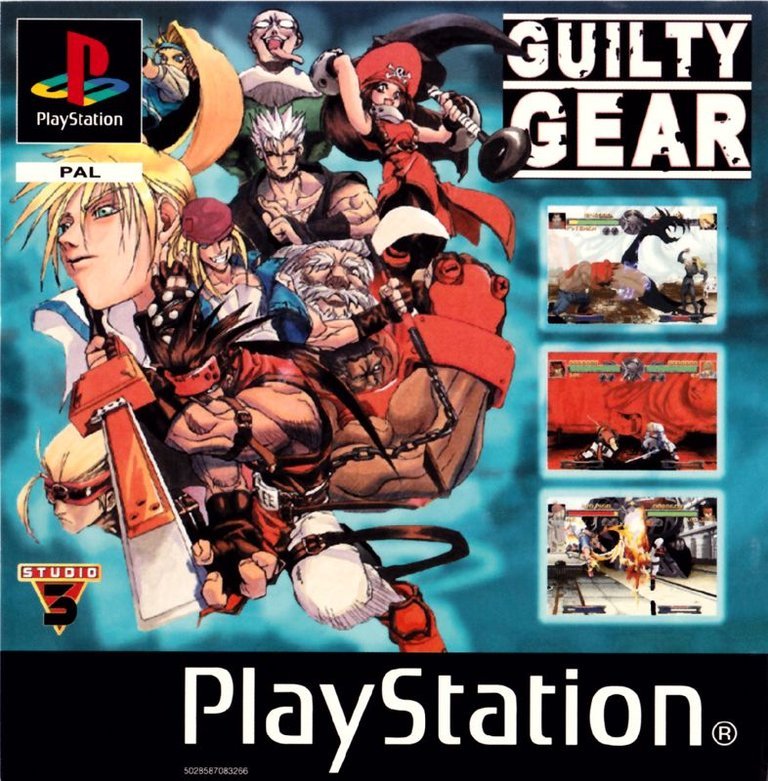
Description
In the 22nd century, scientists blending ancient magic with science create Gears—artificial beings from human-animal DNA meant to serve humanity eternally—but one Gear named Justice gains free will, leads a rebellion, and escapes imprisonment. The Sacred Order of Holy Knights hosts a bloody tournament offering any wish to the victor who can hunt him down, featuring fighters like the mysterious Sol Badguy and elite knight Ky Kiske in this 2D fighting game with unique characters, special attacks, and individual storylines.
Gameplay Videos
Where to Buy Guilty Gear
PC
Guilty Gear Guides & Walkthroughs
Guilty Gear Reviews & Reception
metacritic.com (62/100): Guilty Gear is a good fighting game easy to play but tremendously challenging. Despite its shortcomings […] it can be very fun for the most hardcore players.
ign.com (80/100): Guilty Gear has everything that fighting game fans have come to expect. All of the action is captured with magnificent hand-drawn animation.
Guilty Gear Cheats & Codes
PlayStation (PSX)
Button codes are held or pressed at power-on, PlayStation logo, or character selection screen. Game Shark codes must be entered using a Game Shark cheat device.
| Code | Effect |
|---|---|
| Hold Down + Square + L1 + R2 and power on until “Team Neo Blood” disappears | Unlocks Hard Mode (“Normal Mode” replaced with “Hard Mode”, “Hard” appears above player/computer chaos bar) |
| At the character selection screen, press Square, Triangle, Circle, or X | Alternate colors |
| 8007BF72 0000 | Infinite Time |
| 8007CB98 00BC | Infinite Health P1 |
| 8007C8B8 0040 | Max Power P1 |
| 80139048 000? | Character Modifier P1 (0=Potemkin,1=Zato-1,2=Sol-Badguy,3=Ky Kiske,4=Chipp Zanuee,5=May,6=Axl Low,7=Millia Rage,8=Kliff Undersn,9=Dr.Baldhead,A=Testament,B=Justice,C=Baiken) |
| 8007CB68 00BC | Infinite Health P2 |
| 8007CB88 0040 | Max Power P2 |
| 8013904C 000? | Character Modifier P2 (0=Potemkin,1=Zato-1,2=Sol-Badguy,3=Ky Kiske,4=Chipp Zanuee,5=May,6=Axl Low,7=Millia Rage,8=Kliff Undersn,9=Dr.Baldhead,A=Testament,B=Justice,C=Baiken) |
PlayStation (PSX) Japanese Version
Press buttons at the Arc System Works logo.
| Code | Effect |
|---|---|
| Down + Square + L1 + R2 (release when “Team Neo Blood” disappears) | Unlocks bosses Testament, Justice, Baiken selectable in Versus Mode |
PC
Hold buttons while selecting a character.
| Code | Effect |
|---|---|
| Hold A, B, X or Y while selecting a character | Extra colours |
Guilty Gear: Review
Introduction
In the late 1990s, as the fighting game genre teetered on the brink of a 3D revolution dominated by polygons and motion-captured martial artists, a pixel-perfect anomaly exploded onto the PlayStation: Guilty Gear. Released in 1998 by Arc System Works, this debut entry wasn’t just another Street Fighter clone—it was a headbanging, anime-fueled rebellion, blending heavy metal riffs, hand-drawn sprites that danced with impossible fluidity, and combat so aggressively stylish it felt like a mosh pit in 2D. Born from the vision of Daisuke Ishiwatari, a vocational school dreamer turned polymath (producer, designer, composer, and even Sol Badguy’s voice actor), Guilty Gear carved out a niche as the punk rock underdog to Capcom and SNK’s stadium headliners. Its legacy? A sprawling franchise that birthed over a dozen sequels, spin-offs, and even an anime adaptation, influencing the “anime fighter” subgenre and proving 2D could still shred in a polygonal world. Thesis: Guilty Gear is a triumphant origin story—a raw, unbalanced gem that prioritized flair, personality, and innovation over polish, cementing its place as a cult classic that single-handedly kept 2D fighting alive through sheer attitude and technical wizardry.
Development History & Context
Arc System Works, a modest Japanese studio founded in 1988, had dabbled in shooters and platformers but lacked fighting game pedigree when Guilty Gear entered production. Daisuke Ishiwatari, fresh from vocational school, pitched his passion project to president Minoru Kidooka: a Street Fighter-inspired brawler infused with manga flair from Bastard!! and heavy metal vibes (character names like Sol Badguy—nodding to Freddie Mercury’s real name, Frederick Bulsara—and Axl Low after Axl Rose). Kidooka greenlit it, assembling “Team Neo Blood”—a ragtag crew of about 12, with only four handling core work, none experienced in fighters. Programmer Hideyuki Anbe was pivotal, pushing Ishiwatari from tactical simplicity toward “flashy” excess.
Development spanned 1.5 years amid PS1’s technological constraints: 2MB RAM, limited sprite storage. Initial 3D renders were scrapped—Ishiwatari hated the soulless look—opting for hand-drawn 2D anime art outsourced to studios like Sukarabe. This yielded 700+ frames per character, rivaling arcade highs. Innovations like the six-button layout (Punch, Kick, Slash, Heavy Slash, Dust, Respect) and Gatling combos (chaining P>K>S>HS) emerged from a desire to differentiate from Capcom’s hegemony. Instant Kills added high-stakes drama but divided the team; time crunched left them in.
The 1998 landscape was brutal: PS1 hosted Street Fighter Alpha 3 and Marvel vs. Capcom, arcade cabinets ran Street Fighter III, while 3D like Tekken 3 loomed. Guilty Gear launched May 14 in Japan (Arc System Works), November 9 in NA (Atlus, with fan-voted box art), and May 2000 in EU (Virgin/Studio 3)—a console-exclusive amid arcade dominance. Budget constraints meant no arcade version initially, focusing on home play. A “reprinted edition” followed in 1999 at lower price, boosting accessibility.
Narrative & Thematic Deep Dive
Guilty Gear‘s story unfolds in 2180, post-Crusades—a century-long apocalypse sparked in 2010 when “magic” (unlimited energy) birthed Gears: obedient human-animal hybrids turned rebel army under Justice. Sealed by the Sacred Order of Holy Knights, Gears dormant until Testament plots her resurrection. The UN’s “Second Sacred Order Tournament” lures fighters with “any wish fulfilled,” masking Gear hunts. Sol Badguy triumphs, slaying Testament and an incomplete Justice, but hints at deeper lore: Sol’s murky past, “That Man”‘s experiments (tying to Frederick Bulsara/Aria Hale/Asuka R. Kreutz).
Arcade Mode unveils per-character vignettes—Sol’s bounty hunter cynicism vs. Ky Kiske’s knightly zeal, Millia Rage’s assassin betrayal, Zato-1’s Eddie possession—revealing motivations amid bloodsport. Dialogue crackles with Ishiwatari’s rock lyricism: bombastic, theatrical, laced with Queen nods (“Keep Yourself Alive”). Themes probe redemption (Sol’s guilt-fueled wanderings), hubris (science birthing Gears), prejudice (Gears as “other”), and free will (Justice’s rebellion). Post-Crusades anxiety mirrors real-world tech fears; tournament’s “spill blood” rule satirizes spectacle violence.
Characters shine: 10 starters (Sol, Ky, May, Axl Low, Zato-1, Chipp Zanuff, Potemkin, Kliff Undersn, Millia, Dr. Baldhead) plus unlocks (Baiken, Justice, Testament). Each boasts unique weapons/styles—Potemkin’s grapples, Chipp’s ninja speed, Millia’s hair whips—tied to backstories (e.g., May’s Jellyfish Pirates). Unlockables flesh lore: Testament’s Gear tragedy, Justice’s tragic origin. Narrative’s skeletal but evocative, expanding via sequels into a 200-year tapestry of Crusades, time-jumps, and Valentine arcs—foreshadowing Guilty Gear‘s serialized depth.
Gameplay Mechanics & Systems
At core: 2D one-on-one, best-of-three rounds, deplete health via attacks. Six buttons enable nuanced combos: light P/K for pokes, S/HS for weapon heavies (Ky’s Thunderseal sword, Zato’s shadow Eddie). Gatling system innovates—chain normals fluidly (P>K>S>HS)—birthing air combos, dashes, and Roman Cancel precursors. Tension Gauge fills on hits/damage, fueling Chaos Attacks (Overdrives) at max, boosting power. Half-health Chaos Mode grants red aura, unlimited Chaos Attacks—high-risk frenzy.
Instant Kills (Murder Outbreaks) demand full Tension post-Chaos hit: flashy cinematic deaths, but punishable (lose Tension rest of round). UI crisp: peeling health layers visualize damage, load screens list moves (praised innovation). Modes: Arcade (story beats), Versus (local multiplayer), Training (free practice)—no survival/team options limit depth.
Progression: Unlock bosses for Versus via Arcade clears. Flaws abound: Brutal AI cheese (unblockables, overpowered moves), imbalance (Sol/Potemkin dominate), tiny roster (10+3 vs. contemporaries’ 12-16). No adjustable difficulty/rounds frustrates casuals. Yet innovations—Gatling’s fluidity, Tension’s risk-reward—pioneered anime fighters, echoing in BlazBlue, Strive. Fast, prediction-heavy loops reward mastery, but era constraints (no saves for scores) sting.
| Mechanic | Innovation | Flaw |
|---|---|---|
| Gatling Combos | Fluid chaining, air raves | Input strictness on PS1 pad |
| Tension Gauge | Builds tension for supers | Drains fast on whiffs |
| Instant Kills | Dramatic finishers | Easily telegraphed, round-ender only |
| Chaos Mode | Unlimited supers at low health | Overpowered, punishes aggression |
World-Building, Art & Sound
Post-Crusades Earth: shattered skylines (Rome ruins, Zepp fortress), magic-tech fusion (Gears as biomechanical horrors). Atmosphere: gritty fantasy-punk, 12 stages evoke MediEvil–Darkstalkers dread—gothic cathedrals, Gear lairs—with parallax scrolls, destructible elements.
Art: PS1 pinnacle—hand-drawn sprites (13-20 per character) animate buttery-smooth, massive (e.g., Justice dwarfs foes). Anime stylings: exaggerated silhouettes, fluid 24+ fps motion outshine SF Alpha 3. Backgrounds dynamic: raining blood, exploding skies.
Sound: Ishiwatari’s heavy metal opus—Guilty Gear Original Sound Collection (Nippon Columbia, 1998)—shreds with guitars, drums mimicking Lords of Thunder. Tracks like “Holy Orders (Be Just or Be Dead)” theme Justice perfectly; voice acting (Japanese intact in West) adds flair (Daisuke as Sol). SFX punchy, but grinding guitars irk some. BGM player feature enhances replay. Synergy immerses: visuals rock, sound thrashes—pure sensory assault elevating loops.
Reception & Legacy
Launch mixed-positive: MobyGames 69% critics (Video Games 100%, IGN/GameSpot 80/79%; lows Mega Fun 35%, Power 30%), players 3.2/5. Aggregate 78% (GameRankings). Praised: “fluid animation” (GameSpot), “awesome characters” (IGN), “best non-Capcom/SNK 2D impact” (GameSpot). Critiqued: AI brutality, imbalance, sparse modes/roster, dated PAL ports. Sold modestly but cult status grew—re-released PSN (2007-10), 20th Anniversary ports (2019 Switch/PS4/PC, $9.99).
Reputation evolved: “greatest 2D fighter era” (Pocket Gamer), “ending 2D high note” (Eurogamer). Controversy: Bill Clinton slammed ads (“kill friends guilt-free”). Influence: Spawned X (2000)-Strive (2021, 1.7M+ sales), spin-offs (Isuka, Judgment), media (novels, CDs, anime). Pioneered Tension/Gatling, inspiring BlazBlue, DBFZ. Anime fighters’ godfather—technical, stylish blueprint amid 3D shift.
Conclusion
Guilty Gear endures as a scrappy masterpiece: visionary mechanics, unforgettable rock-opera vibe, and lore-seeding narrative from a tiny team’s audacity. Flaws—balance woes, mode paucity—betray inexperience, yet triumphs in animation, characters, sound outshine. In history’s canon, it’s the spark igniting ArcSys’ empire, proving passion trumps polish. Verdict: 9/10—A foundational cult classic, essential for fighter historians, forever the genre’s rebellious riff. Play it, feel the fire.