
- Release Year: 2002
- Platforms: Macintosh, Windows
- Publisher: Wycliffe Bible Translators
- Developer: Planet Digital
- Genre: Educational
- Perspective: 1st-person
- Game Mode: Single-player
- Gameplay: Puzzle elements
- Setting: Contemporary
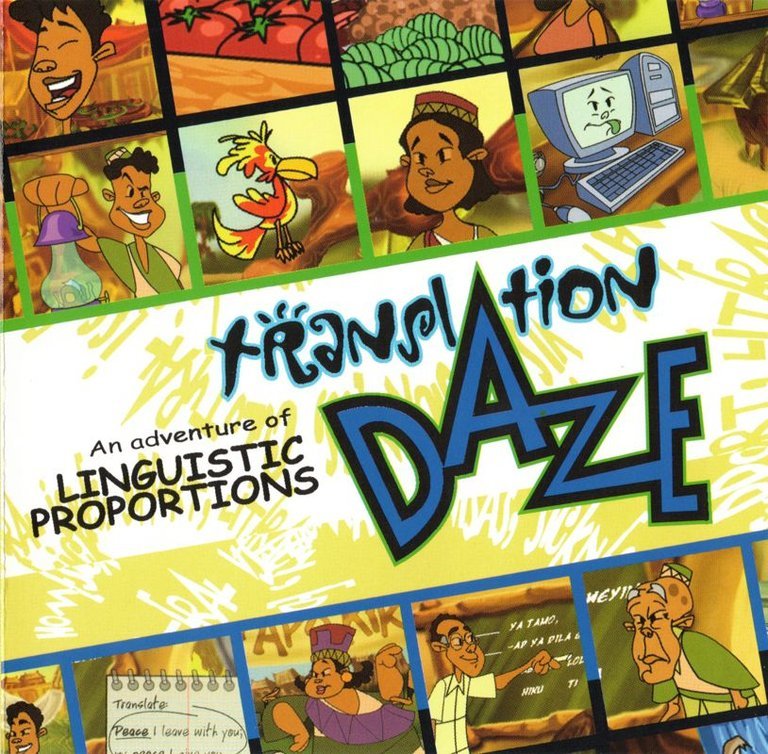
Description
Translation Daze is an educational first-person puzzle game set in a contemporary world, where players explore the challenges of translating the Bible into the fictional Diimdi language through seven interactive activities, including vocabulary learning, key term translation with Pastor Didu, market haggling, dinner etiquette, team management, computer troubleshooting, and a dedication celebration, each followed by real-life stories from the Wycliffe Bible Translators team.
Translation Daze: Review
Introduction
Imagine stepping into a vibrant, fictional African village where every word you learn could unlock the mysteries of an ancient text, and every cultural misstep teaches a profound lesson about bridging worlds. Translation Daze, released in 2002, isn’t your typical blockbuster—it’s a niche edutainment title that dares to make Bible translation feel like an adventurous puzzle quest. Developed amid the early 2000s wave of interactive learning software, this game from Planet Digital and Wycliffe Bible Translators simulates the real-world hurdles of linguistic fieldwork through seven immersive activities. Its legacy lies in its earnest fusion of education and empathy, turning abstract concepts like cultural nuance and teamwork into playable experiences. My thesis: Translation Daze is a forgotten gem of religious edutainment, masterfully using first-person point-and-click puzzles to humanize the often invisible labor of Bible translators, cementing its place as a pioneering tool for cultural awareness in gaming history.
Development History & Context
Translation Daze emerged from the mission-driven ethos of Wycliffe Bible Translators, a nonprofit dedicated to global Bible translation, in collaboration with Planet Digital, a developer specializing in educational content. Creative director Craig Duddles not only conceived the game’s core vision but also invented the fictional Diimdi language from scratch—a clever conlang blending phonetic realism with translation pitfalls to mirror real indigenous tongues. The writing team, including Jon Bilbro, Dawn Kruger, Madison Trammel, and Luci Tumas, crafted dialogues grounded in authentic fieldwork anecdotes, while voice acting by talents like David Chernault (narrator and multiple characters) and Kirsten Cruzen brought the Diimdi villagers to life.
Launched in 2002 for Windows and Macintosh, the game was born in an era when edutainment ruled the PC landscape. Think The Oregon Trail (1971 revival) or Reader Rabbit series—simple, accessible software for schools and kiosks amid rising home computing. Technological constraints were pronounced: fixed/flip-screen visuals and point-and-select interfaces harked back to 1990s adventures like Myst (1993), optimized for low-spec machines (no high-poly 3D here). It was initially designed as a kiosk exhibit for Wycliffe’s WordSpring Discovery Center in Orlando, Florida, reflecting the post-dot-com edutainment shift toward experiential learning centers. The gaming landscape? Dominated by console juggernauts like Grand Theft Auto III and Final Fantasy X, but PC edutainment thrived in religious and educational niches, filling a void for “serious games” before the term exploded in the 2010s. Wycliffe’s publishing arm ensured free distribution to churches and missionaries, prioritizing impact over profit in a pre-Steam indie era.
Narrative & Thematic Deep Dive
At its heart, Translation Daze weaves a meta-narrative around the translator’s odyssey: you embody a fieldwork novice immersing in Diimdi culture to render the Bible’s New Testament. The plot unfolds non-linearly across seven vignette-activities, each capped by real-life Wycliffe testimonials—raw, unpolished stories from actual translators, blending fiction with testimony for emotional heft.
Plot Breakdown: It opens with basic immersion (Language Learning), escalates to semantic debates (Key Terms With Pastor Didu, pondering “peace” in John 14:27 amid Diimdi warrior ethos), navigates social faux pas (At the Market, Dinner with Mama Botana), builds collaboration (Translation Teamwork), troubleshoots tech woes (A Computer “Bug”), and culminates in triumph (Dedication Day). Characters like Pastor Didu (wise mentor), Mama Botana (gracious host), and vendors embody cultural archetypes, voiced with nuance—Craig Duddles’ gravelly Didu contrasts Luci Tumas’ warm Botana.
Themes Explored: The game masterfully dissects translation’s “daze”—cognitive dissonance from literal vs. dynamic equivalence. Linguistic relativity shines: Diimdi lacks direct words for abstract biblical concepts, forcing cultural adaptation (e.g., “peace” as warrior truce?). Teamwork critiques siloed scholarship, while tech bugs symbolize modern fieldwork fragility. Religiously, it evangelizes subtly, portraying translation as divine partnership without preachiness. Dialogue sparkles with pidgin humor—”not make fool self”—highlighting empathy’s role. Underlying motifs of humility, perseverance, and celebration elevate it beyond rote learning, making players ponder: How do you convey “shalom” to nomads? This thematic density rivals literary VNs like Doki Doki Literature Club, but rooted in ethnography.
Gameplay Mechanics & Systems
Translation Daze thrives on bite-sized, first-person puzzle loops, eschewing grind for revelation. Core interface: point-and-select in fixed/flip-screen scenes, evoking Riven simplicity—intuitive for kids/missionaries, no complex controls.
Core Loops:
– Language Learning: Explore a hut, click objects (lanterns, stools) for Diimdi vocab; quiz matches English-Diimdi via drag-drop. Replayable for mastery.
– Key Terms: Branching dialogue trees with Pastor Didu; select synonyms (calm? truce?), unlocking Bible verses. Semantic puzzles test nuance.
– At the Market: Haggle mini-game—identify prices via clues, balancing cultural norms (overpay = insult?). Resource management lite.
– Dinner with Mama Botana: Etiquette sim—click correct utensils/foods amid kids/relatives; wrong choice triggers funny fails, teaching taboos.
– Translation Teamwork: Management sim—assign roles (linguist, checker) across related languages; choice-based to optimize “machine.”
– A Computer “Bug”: Diagnostic puzzle—click peripherals (dusty outlets, loose wires) in flip-screen tech lair.
– Dedication Day: Festive closer—sequence rituals (speeches, dances) for flawless ceremony.
Progression & UI: Linear but modular; no XP, just satisfaction gates. UI is clean—bold icons, phonetic hints—though era-typical clunkiness (no saves mid-activity). Innovations: Real-time feedback (e.g., villager reactions) and post-puzzle stories reinforce learning. Flaws: Repetition in quizzes, limited replayability sans scores. Combat? Absent—pure cerebral puzzles, innovative for edutainment.
| Activity | Core Mechanic | Challenge Type | Educational Tie-In |
|---|---|---|---|
| Language Learning | Object labeling + quiz | Memory/Matching | Vocab acquisition |
| Key Terms | Dialogue branching | Semantic choice | Word equivalence |
| Market | Price haggling | Logic/Negotiation | Cultural economics |
| Dinner | Etiquette selection | Observation/Timing | Social norms |
| Teamwork | Role assignment | Strategy/Optimization | Collaboration |
| Bug Hunt | Item diagnosis | Deduction/Process of elimination | Tech troubleshooting |
| Dedication | Ritual sequencing | Pattern recognition | Celebration rites |
World-Building, Art & Sound
Set in contemporary Diimdi village—mud huts, bustling markets, lantern-lit dinners—the world pulses with lived-in authenticity. Fictional yet evocative of sub-Saharan cultures, it fosters immersion via details: woven baskets, smoky fires, phonetic Diimdi chatter. Atmosphere builds tension/release—market chaos to dinner warmth—mirroring translation’s highs/lows.
Visuals: Fixed/flip-screen 2D art is charmingly hand-drawn, colorful palettes (ochres, greens) evoking Flash-era vibrancy. Simple animations (haggling gestures, bug sparks) punch above weight; no gore, just cultural flair. Scales well on kiosks/low-res screens.
Sound Design: Stellar voice work—21 credits, multi-role casting (Chernault’s versatile villagers)—infuses personality. Ambient loops (market bustle, dinner chatter) and subtle SFX (clicks, chimes) enhance mood. No OST, but narrated Bible snippets and real stories add gravitas, making failures poignant.
Elements synergize: Art/sound immerse in Diimdi “daze,” reinforcing themes—e.g., distorted audio in bug hunt evokes frustration.
Reception & Legacy
Launch reception? Muted obscurity—no MobyScore, zero critic/player reviews on MobyGames (as of 2025). Commercial? Non-monetized kiosk fare, collected by mere handfuls, bypassing retail. Evolved rep: Rediscovered via preservation sites, hailed in edutainment circles for Diimdi conlang ingenuity. Influenced? Prefigures “serious games” like Papers, Please (bureaucracy sims) or That Dragon, Cancer (empathy edutainment). Industry ripple: Boosted Wycliffe’s interactive outreach; echoes in modern Bible apps (YouVersion gamification). Niche cult status among conlang enthusiasts (cf. Dothraki tools), underscoring edutainment’s role in cultural preservation amid 2000s Flash death.
Conclusion
Translation Daze distills translation’s toil into joyful puzzles, blending education, narrative depth, and cultural reverence into a cohesive whole. Its kiosk roots belie timeless mechanics—empathetic, iterative learning loops—and thematic ambition, flaws notwithstanding (replay slimness, dated UI). In video game history, it claims a vital niche: pioneer of mission-driven edutainment, humanizing overlooked labor before Gone Home-era walksims or Hellblade‘s psychosis sims. Verdict: Essential for educators/historians (8.5/10); obscure treasure deserving emulation/ports. Play it to appreciate: Every word translated is a bridge built.