
- Release Year: 2016
- Platforms: Quest, Windows
- Publisher: Oculus VR, LLC
- Developer: Oculus Rex
- Genre: Simulation
- Perspective: 1st-person
- Game Mode: Single-player
- Gameplay: Motion control, Real-time
- Setting: Futuristic, Sci-fi
- Average Score: 92/100
- VR Support: Yes
Description
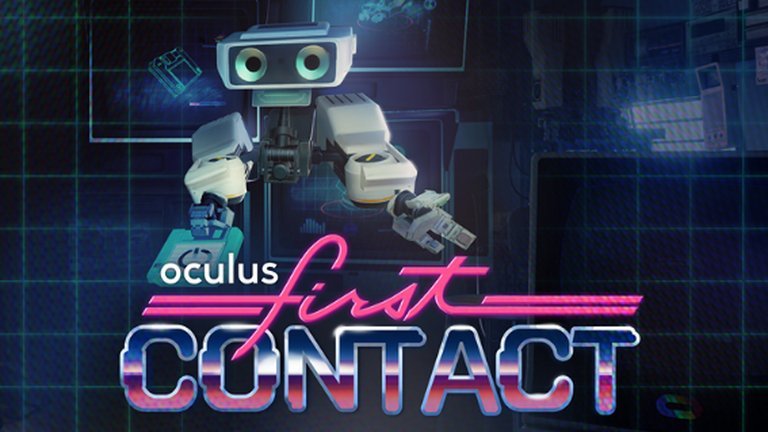
Oculus: First Contact is an official Oculus VR experience and simulation demo released in 2016 for Windows and later Quest, serving as an introductory showcase for Oculus Touch controllers in a sci-fi/futuristic setting. Players interact with a friendly robot guide and a magical box filled with 1980s-inspired toys, exploring the sensation of ‘presence’ through intuitive motion-controlled actions like touching, tapping, bouncing, holding, and throwing objects in a playful, immersive environment.
Gameplay Videos
Oculus: First Contact Reviews & Reception
queststoredb.com (92/100): Best Introductory Game
Oculus: First Contact: Review
Introduction
Imagine strapping on a VR headset for the very first time, your hands trembling slightly as you reach out into a digital void—and suddenly, a floppy disk materializes in your palm, its edges gritty and real under your fingertips. This is the electrifying “presence” that Oculus: First Contact delivers, a sensation that turned skeptics into believers back in 2016. As the official launch title for Oculus Touch controllers, this unassuming tech demo from Oculus Rex didn’t just introduce a new input method; it etched itself into VR history as the gold standard for onboarding new users to virtual reality’s magic. My thesis: Oculus: First Contact transcends its origins as a simple tutorial, emerging as a masterful exercise in interaction design, nostalgic wonder, and immersive pedagogy that continues to shape VR experiences nearly a decade later.
Development History & Context
Oculus: First Contact emerged from the crucible of VR’s explosive early days, developed by Oculus Rex—a talented internal Oculus team responsible for prior hits like Dreamdeck, Farlands, Prologue, and the original Toybox demo. Released on December 6, 2016, for Windows via the Oculus Rift, it coincided perfectly with the launch of Oculus Touch, the company’s motion-tracked controllers that promised hand presence without the clumsiness of traditional gamepads. Publisher Oculus VR, LLC positioned it as the “entryway to Oculus Touch,” a free experiential bundle designed to showcase 6DoF (six degrees of freedom) tracking in a consumer-friendly package.
The 2016 gaming landscape was VR’s Wild West: Oculus Rift had just shipped after years of Kickstarter-fueled hype, competing with PlayStation VR’s console debut and HTC Vive’s room-scale ambitions. Technological constraints abounded—early headsets suffered from screen door effect, limited battery life (though Rift was tethered), and motion sickness risks—making locomotion-free experiences like this one a smart choice. Oculus Rex drew explicit inspiration from the 1980s, that “magical decade when computers and game consoles moved from science fiction to household items,” infusing the project with retro artifacts like floppy disks to demystify VR tech. A 2019 port to Oculus Quest by Fun Bits Interactive extended its life to standalone headsets, proving its timeless appeal amid VR’s shift toward wireless freedom. This wasn’t a full game but a deliberate proof-of-concept, honed to perfection under the pressure of launching a revolutionary input paradigm.
Narrative & Thematic Deep Dive
Oculus: First Contact eschews traditional plotting for a vignette-driven structure, unfolding as a wordless, intuitive “first date” with VR itself. You awaken at a cluttered 1980s desk in a cozy, wood-paneled room, face-to-face with a diminutive, pixelated robot guide—your adorable companion for the 10-15 minute journey. No dialogue or voiceover disrupts the immersion; instead, the robot’s expressive animations (waving hello, clapping in delight, mimicking your gestures) convey warmth and curiosity, forging an instant emotional bond.
The “narrative” progresses via floppy disk “cartridges” inserted into a glowing “magic box,” each unlocking playful vignettes that escalate in complexity: a bouncing ball to teach grasping, a rocket launcher demanding bimanual coordination, gravity-defying toys that warp reality. Characters are sparse—the robot is the star, its cute, blocky design evoking E.T. or WALL-E, symbolizing innocent technological companionship. Underlying themes pulse with profound resonance: nostalgia for analog-digital transition, nodding to 80s icons (VHS tapes, the floppy-derived “save” icon), positioning VR as the next evolutionary leap; the wonder of presence, blurring real and impossible through tactile interactions; and democratized discovery, gamifying learning to make VR accessible sans language barriers. Easter eggs abound—shove VHS tapes into a TV for hidden animations or experiment with desk objects for surprises—rewarding curiosity and replayability. Far from shallow, this thematic tapestry critiques modern tech overload by celebrating tactile simplicity, making “first contact” a metaphor for humanity’s enduring awe at innovation.
Gameplay Mechanics & Systems
At its core, Oculus: First Contact is a simulation of pure interaction, a real-time, 1st-person motion-control playground devoid of locomotion to prioritize comfort and focus. The primary loop is discovery-through-play: scan your playspace (stationary room-scale), spot a floppy disk, grab it with intuitive Touch haptics, slot it into the magic box, and unleash a toy or effect. Early mechanics teach basics—pinch-to-grab a ball, fling it with physics-based momentum—building to advanced synergies like dual-wielding a blaster or stacking objects precariously.
No combat or progression trees exist; instead, “character growth” mirrors your controller mastery, from clumsy pokes to fluid manipulations. UI is elegantly invisible: holographic prompts fade as mastery grows, with the robot’s reactions providing feedback (thumbs-up for success, puzzled tilts for errors). Innovative systems shine in bimanual physics, where toys demand both hands (e.g., aiming a launcher), and environmental persistence—objects bounce off your real desk, blending passthrough elements for grounding presence. Flaws are minimal: its brevity (one room, no failure states) limits depth, potentially frustrating veterans, and auto-reinstall complaints on Quest hint at platform quirks. Yet, this streamlined design—progressive skill-gating via toy complexity, zero time limits—gamifies tutorials masterfully, turning “press A to jump” drudgery into joyful experimentation.
World-Building, Art & Sound
The game’s singular setting—a meticulously detailed 1980s study atop your real-world desk—masterfully fuses virtual world-building with physical space, creating an intimate, stationary bubble of sci-fi whimsy. Low-poly models evoke CRT-era charm: CRT monitors flicker, floppy disks clack authentically, and the magic box pulses with otherworldly neon. Visual direction prioritizes retro-futurism, with saturated colors (oranges, blues) and subtle scanlines amplifying 80s nostalgia, while high-fidelity hand models and shadows sell uncanny realism. Atmosphere is playful yet intimate—no vast sci-fi expanses, just a cozy diorama that encourages leaning in, heightening presence.
Sound design complements seamlessly: crisp tactile audio (disk clicks, ball thuds, rocket whooshes) feeds back every gesture, layered with ambient synth hums and the robot’s chirpy beeps (delightful gasps, giggles). No score overwhelms; instead, reactive SFX build immersion, like echoing bounces off virtual/real walls. These elements synergize to evoke childlike wonder, transforming a demo into an atmospheric jewel—polished, as one critic noted, “with an eye for detail like in other ‘real’ VR games.”
Reception & Legacy
Launch reception was quietly enthusiastic: MobyGames lists an unscored review from Gameplay (Benelux) praising its polish despite being “not much more than a demonstration,” while user ratings soared—4.6/5 from 1.5K on Quest Store, with comments lauding its introductory charm (“Best Introductory Game,” “Nostalgia from Rift CV1”). No aggregated Metacritic or MobyScore emerged, befitting its free demo status, but blogs like Virtual Umbrella hailed it as VR’s blueprint for newbies, citing gamified learning, cuteness, simplicity, and easter eggs.
Commercially, as a free Oculus Store staple (0.6GB on Quest), it drove Touch adoption amid 2016’s VR hype. Legacy endures: ported to Quest in 2019, it remains pre-installed (sometimes stubbornly), influencing successors like Job Simulator or I Expect You To Die in tutorial design. Its no-movement, interaction-first ethos prefigured standalone VR’s comfort focus, while 80s motifs inspired retro wave in titles like Synth Riders. In industry terms, it normalized “presence demos,” proving VR’s viability for casual audiences and cementing Oculus Rex’s pedigree before VR’s mainstream pivot.
Conclusion
Oculus: First Contact distills VR’s essence into 15 minutes of unadulterated joy: a robot friend, retro toys, and the thrill of digital hands that feel real. From Oculus Rex’s visionary crafting amid 2016’s tech dawn, through its thematic celebration of nostalgic innovation, masterful mechanics, evocative art, and enduring acclaim, it exemplifies interactive perfection. Flaws like brevity pale against its innovations. Verdict: An absolute cornerstone of video game history—essential for every VR library, a 9.5/10 timeless tutorial that launched an era. If you’ve never waved at that little robot, boot it up today; your first contact awaits.