
- Release Year: 1998
- Platforms: Windows
- Publisher: Head Games Publishing, Inc.
- Genre: Compilation
- Game Mode: Single-player
- Average Score: 85/100
- Adult Content: Yes
Description
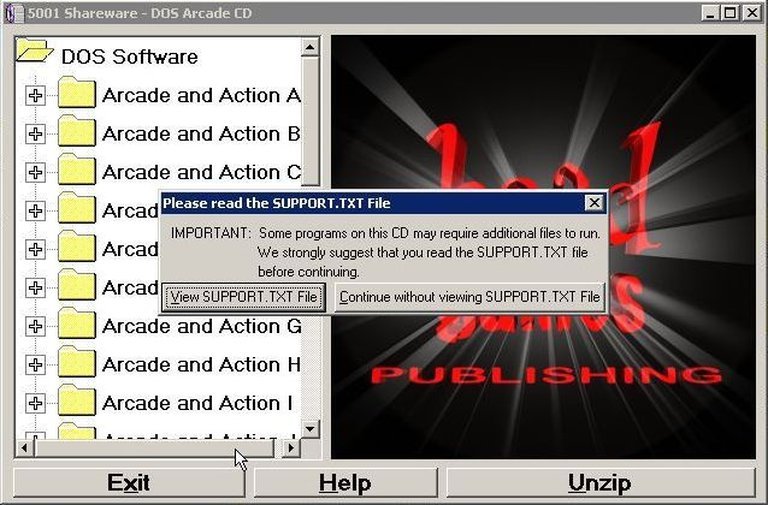
5001 Games, released in 1998 for Windows on four CD-ROMs by Head Games Publishing, is a vast compilation of over 5,000 shareware games, demos, additional levels, map packs, editors, and utilities for titles like Doom, Quake, Command & Conquer, and Descent, alongside puzzles, board games, card games, chess libraries, sports simulations, and non-gaming tools such as lottery pickers and office managers. Discs are thematically organized—Disk 1 for DOS software alphabetized by name, Disk 2 for DOS programs grouped by genre like Tetris clones and trivia, Disk 3 for Windows 3.1 arcade, puzzles, casino games, and educational titles—with many duplicates and extras across platforms.
5001 Games Free Download
5001 Games: Review
Introduction
Imagine popping four gleaming CD-ROMs into your beige Windows 95 tower, only to unleash a digital Pandora’s box containing not one epic quest, but thousands of bite-sized diversions—shareware shooters, puzzle marathons, chess variants, Doom wads, lotto pickers, and even a “dumb little Ouija game.” Released in 1998 by Head Games Publishing, Inc., 5001 Games: The Ultimate Games Pack promised the moon: “The GREATEST Compilation Of Games Ever Assembled,” spanning arcade classics to nascent 3D adventures, enough to “keep the whole family entertained for hours and hours.” In an era when dial-up internet made downloading a single demo an exercise in patience, this shovelware behemoth was a godsend for budget gamers, a chaotic archive of the PC gaming underground. Its legacy? A dusty time capsule of late-’90s shareware culture, bloated with duplicates and oddities, yet invaluable for historians. My thesis: 5001 Games isn’t a game—it’s a monument to excess, democratizing gaming’s fringes while exposing the Wild West of pre-Steam digital distribution.
Development History & Context
Head Games Publishing, Inc., a short-lived American outfit known for budget CD compilations (headgames.net, now a relic), curated 5001 Games amid the shareware boom of the mid-to-late 1990s. Shareware thrived on physical media: floppy disks evolved into massive CD-ROMs sold at Walmart for $20, bundling demos, freeware, and trials from indie devs. The creators’ vision was audacious—compile “5001” titles (a hyperbolic marketing ploy; the true count blends games, levels, tools, and utilities across four discs) into an “advanced interface” for easy access, complete with previews, cheats, and hints. Each disc autoloads a custom menu program, tailoring content to era-specific tech: Disc 1 for DOS, Disc 2 for DOS miscellany, Disc 3 for Windows 3.1, and Disc 4 for Windows 95.
Technological constraints shaped its form. CD-ROMs held ~650MB each, perfect for hoarding gigabytes of low-res DOS executables and early Windows apps, but navigation relied on clunky autorun shells—no unified launcher, just per-disc menus grouping by alphabet, genre, or type. The 1998 gaming landscape was explosive: Quake II and StarCraft dominated, but PCs ran Windows 95/98 with DirectX emerging, joystick/mouse support standard. Shareware CDs like this countered high retail prices (Doom expansions cost $30+), mirroring contemporaries like 555 Games XP Championship (2005) or Smart Games Puzzle Challenge series. Amid Y2K fears and the dot-com bubble, Head Games tapped shareware portals (e.g., CNET’s Download.com) for content, including Moraff’s endless puzzle variants and Tommy’s Toys card packs. No named leads or studios beyond the publisher; it was assembly-line curation, prioritizing volume over polish—a product of an industry transitioning from BBS uploads to broadband dreams.
Narrative & Thematic Deep Dive
Lacking a singular plot, 5001 Games defies traditional narrative analysis—it’s a post-modern anthology, its “story” the meta-tale of gaming’s democratization. Themes emerge organically: abundance vs. curation, with duplicates like National Lampoon’s Chess Maniac 5 Billion and 1 scattered across discs, symbolizing shareware’s copy-paste ethos; utility as play, blending “proper” games with lotto generators, sports trackers, and RPG tools (e.g., dungeon master planners); and nostalgia for the fringe, evoking a pre-app-store world where Zong (Disc 1’s Z-group) sat beside Exile: Escape from the Pit (Disc 4).
“Characters” are absent, replaced by archetypes: the pixelated hero of DOS shooters (Abuse, Alien Carnage), the stoic chess AI (Alybadix problem-solver), the gambler’s vice (Jennifer’s Sexy Video Poker). Dialogue? Sparse, limited to trivia prompts (Hawaii State Trivia, OJ Simpson Trial Trivia) or interactive fiction like Zork variants on Disc 3’s Z-code group (C.I.A. Adventure, Softporn Adventure). Underlying motifs probe addiction and escapism—Tetris clones (1993tris, Floatris) induce flow states, casino packs (Dr. Blackjack, Slots of Trivia 95) mimic vice, educational oddities (Build That Nuclide, Dental Office) gamify learning. Disc 2’s miscellany (blonde jokes, astrology) adds absurd humor, critiquing (unintentionally) consumerist bloat. In extreme detail, Disc 3’s IF sections—TADS (Babel, Uncle Zebulon’s Will), Z-code (Curses, Phred Phontious And The Quest For Pizza)—offer parser-driven tales of cosmic horror and whimsy, a microcosm of text adventures’ decline amid graphical dominance. Thematically, it’s shareware’s manifesto: play is everywhere, from Apollo moon sim (masquerading as “sports”) to ProjectBrazil city-builder, democratizing joy amid tech inequality.
Gameplay Mechanics & Systems
At its core, 5001 Games loops through discovery-install-play: autorun menus categorize content (alphabetical on Disc 1, genre-typed elsewhere), preview descriptions, and launch EXEs. No progression or metagame—pure à la carte chaos. Core “mechanics” vary wildly:
- Arcade/Action: Disc 1’s alphabetical groups yield shooters (Zone 66, Terminal Velocity), platformers (Zool). Disc 3/4 add Windows flair (Bad Toys, NanoCore).
- Puzzles/Board: Hundreds—Moraff’s Mahjongg variants (8 games + 100 tile sets on Disc 2), Yahtzee multiples, jigsaws (Jigsaws Galore).
- Card/Casino: Bloated (300+ on Disc 3), with Pretty Good Solitaire v2.0a (30 variants), Tommy’s Toys (19 titles), slots (Double Dynamite), and lotto tools.
- Addons/Tools: Revolutionary for modders—300+ Doom WADs, 200+ Red Alert maps, Duke Nukem 3D gore patches/cheats, Quake editors. Disc 2’s “Game Cheats & Hints” spans SNES too.
- Demos/Strategy/RPG: Disc 4 gems (Close Combat, Earthworm Jim level), RPGs (Aethra Chronicles, Stars!), Tetris (70+ clones).
Flaws abound: duplicates waste space (Bad Toys repeats), finicky installs (VB Runtime, WinG required), no search/UI cohesion. Innovation shines in menus’ indexing and “try before buy” ethos. Combat? Pixelated run-‘n’-guns. Progression? Leaderboards absent; it’s endless replay. Joystick/mouse support fits era, but modern emulation (DOSBox) needed. Exhaustive loops: grind Doom WADs, chain Tetris variants, or mod Warcraft— a sandbox of obsolescence.
| Disc | Key Categories | Standout Titles/Tools | Count Estimate |
|---|---|---|---|
| 1 (DOS) | Alphabetical | Abuse, Apocalypse Cow | Hundreds |
| 2 (DOS) | Genre (Chess, WADs, Demos) | 300+ Doom, 70+ Tetris | 1000+ |
| 3 (Win3.1) | Arcade, Cards (300+), IF (50+ TADS) | Zork series, Pretty Good Solitaire | 1000+ |
| 4 (Win95) | Demos (40+), Strategy | Fury³, Indiana Jones Desktop Adventures | 500+ |
World-Building, Art & Sound
No unified world—it’s a multiverse of 90s PC aesthetics. Settings span DOS grit (Alien Carnage‘s alien hellscapes) to Windows cartoons (Dave Dude‘s arcade romps). Atmosphere? Eclectic nostalgia: Disc 1’s EGA/VGA pixels evoke CRT glow; Disc 4’s DirectX demos tease 3D (Fury³). Visuals range from minimalist (Tetris blocks) to quirky (Fuzzy’s World of Miniature Space Golf). Menus provide “world-building”—clean autoruns with categories, previews fostering explorer vibes.
Art direction: Shareware patchwork—blocky sprites, dithered gradients, MIDI chiptunes. Sound? Beepy DOS SFX, WAV casino jingles (Noisy Video Poker), IF text parsers silent save beeps. Contributions? Imbuing authenticity—feels like raiding a 1998 hard drive, from Muppets Inside demo’s whimsy to War Cry Magazine issue’s kitsch. Era tech (CD audio absent) limits immersion, but variety crafts a museum atmosphere, preserving pre-Polygonal innocence.
Reception & Legacy
Launch reception? Nonexistent—MobyScore n/a, zero critic/player reviews on MobyGames (added 2023 by piltdown_man). Commercial? Obscure budget title, collected by 3 Moby users; abandonware sites (MyAbandonware 4.25/5 from 8 votes) host ISOs. No charts amid 1998 giants (Half-Life, Baldur’s Gate), but thrived in retail bins.
Legacy evolves: Not influential like Doom (whose WADs it amplifies), but a preservation ark. Mirrors shovelware like 505 Game Collection, prefiguring Steam bundles. Influences? Modding culture (Quake/Doom tools); family packs. In history, it’s a lens on shareware’s peak—post-BBS, pre-piracy crackdowns—capturing indies (Moraff), demos (Lemmings Paintball), oddities (Purity Test). Archival value immense (Internet Archive ISOs); evokes 90s PC excess, influencing retro curations.
Conclusion
5001 Games is a glorious mess: hyperbolic count, rampant duplicates, genre sprawl from chess PGNs to Ouija boards, yet a peerless snapshot of 1998’s digital detritus. Head Games delivered abundance over elegance, thriving in shareware’s golden age before platforms homogenized discovery. Flawed UI and tech relics aside, its exhaustive variety—shooters, puzzles, mods, utilities—cements it as essential artifact, not masterpiece. Verdict: 8/10 for historians, 5/10 for players. In video game history, it claims a niche as the ultimate “everything disc,” a testament to gaming’s scrappy roots. Seek ISOs, fire up DOSBox, and bask in the bloat.