
- Release Year: 2005
- Platforms: Windows
- Publisher: eGames, Inc.
- Genre: Compilation
- Perspective: Unknown
- Game Mode: Single-player
- Gameplay: Pinball
- Average Score: 95/100
Description
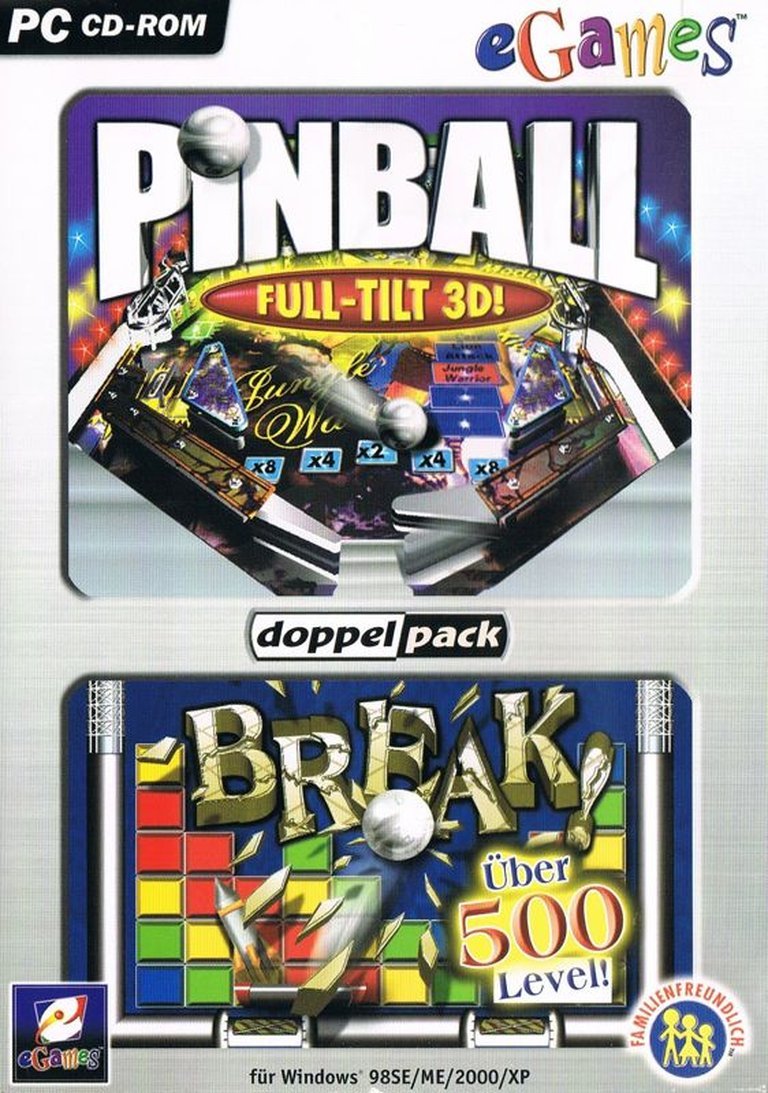
eGames Doppelpack: Pinball: Full-Tilt Fun! – Break! is a 2005 Windows compilation released by eGames, Inc., bundling two classic arcade-style games: Pinball: Full-Tilt Fun! (1999), a pinball simulation with dynamic tables and realistic physics, and Break!, a fast-paced brick-breaking puzzle game reminiscent of Breakout, offering hours of nostalgic flipper and paddle action.
eGames Doppelpack: Pinball: Full-Tilt Fun! – Break! Reviews & Reception
myabandonware.com (95/100): an above-average pinball title in its time.
eGames Doppelpack: Pinball: Full-Tilt Fun! – Break!: Review
Introduction
Imagine plunging a silver ball into a vibrant, glowing playfield where every bumper thwack and ramp launch echoes the golden age of arcade pinball, all repackaged for the budget-conscious PC gamer of the mid-2000s. eGames Doppelpack: Pinball: Full-Tilt Fun! – Break! (2005) is a humble CD-ROM compilation that bundles two casual arcade titles: the 1999 pinball simulator Pinball: Full-Tilt Fun! and the lesser-documented Break!. Released amid a sea of shareware and low-cost re-releases, this Doppelpack (German for “double pack”) exemplifies eGames, Inc.’s mission to deliver accessible, no-frills entertainment. Its legacy lies in preserving the tactile joy of mechanical arcade games in software form, bridging 1990s 3D experimentation with early 2000s nostalgia. Thesis: While sparse on innovation and critical acclaim, this compilation earns its place in gaming history as a faithful, playable artifact of budget PC gaming, offering enduring replayability for pinball purists despite the obscurity of its paired title.
Development History & Context
eGames, Inc., a prolific American publisher specializing in affordable CD-ROM titles, spearheaded this Doppelpack as part of their “Doppelpack” series targeting European and North American markets. The 2005 Windows release—distributed commercially on CD-ROM with a USK rating of 0 (no age restriction)—compiles Pinball: Full-Tilt Fun! (originally 1999) and Break!, reflecting eGames’ strategy of bundling older shareware-style games into value packs alongside titles like Flipster – Crystal Wizard and Drop! 2 – Bees & Bears. This era saw budget compilations thrive as PC gaming democratized, with consumers seeking quick thrills amid rising AAA costs.
Pinball: Full-Tilt Fun! was developed by Hungarian studio A.S.K. Homework, a small team credited with 20 contributors on MobyGames, including key figures like Antal Pálóczi (Coder/3D Engine), Tibor Mezei (Graphics/3D Objects), Kornél Garamvölgyi (Animations), and Roland Máltai (Musics). Producer Dana Dominick oversaw the project, with testers like Zsolt Bályi ensuring polish. Released initially in the US (1999), Germany (2000, 2002), and as variants like Pinball: Le Plein de Fun! or Pinball 2, it leveraged emerging Windows 3D acceleration—think Direct3D precursors—for realistic effects on mid-90s hardware.
Technological constraints defined the era: CD-ROMs capped at ~650MB (this ISO clocks in at 569-774MB per abandonware archives), mouse-only input, and no online features. The late-90s gaming landscape was dominated by arcade revivals (Full Tilt! Pinball, 1996) and simulations amid 3D hype post-Quake, but budget titles like this filled casual gaps for non-gamers. Break! remains enigmatic—no credits or specs detailed—but its pairing suggests a complementary breakout-style game, aligning with eGames’ arcade focus. Added to MobyGames in 2017 by contributor Rainer S., the Doppelpack embodies preservation efforts for overlooked software.
Narrative & Thematic Deep Dive
As pure arcade compilations, neither title prioritizes narrative, embracing the “plotless perfection” of their mechanical inspirations. Pinball: Full-Tilt Fun! forgoes characters, dialogue, or progression for three thematically distinct tables that evoke micro-stories through environmental storytelling. One table channels retro space exploration—rocket bumpers, alien targets, and cosmic backdrops symbolizing humanity’s tilt toward the stars. Another pulses with carnival energy, neon rails, and calliope motifs capturing fleeting joy and chaos. A third adopts metallic sci-fi flair, with dynamic signage hinting at interstellar battles or futuristic fairs.
These themes emerge via artwork and reactive elements: flashing LEDs signal “hot streaks,” while multiball frenzy mirrors narrative climaxes like escalating alien invasions. Sound design amplifies this—clanks for triumphs, urgent buzzes for near-misses—building tension sans words. Break! (inferred from title and eGames’ portfolio) likely follows Arkanoid conventions: a paddle shattering bricks in abstract, level-based “journeys” of destruction, perhaps themed around puzzles or chaos, but sources provide no plot details, underscoring its arcade minimalism.
Underlying themes celebrate addictive repetition and mastery over chaos, critiquing modern life’s complexity through simple, physics-driven catharsis. No dialogue or characters exist, but the tables’ personalities—playful yet punishing—personify pinball’s siren call, making narrative a emergent property of player-table interaction.
Gameplay Mechanics & Systems
Core loops revolve around arcade fidelity, with Pinball: Full-Tilt Fun! as the star. Standard pinball applies: Plunge the ball, manipulate flippers (mouse or keyboard) to hit targets, light bonuses, and chain multipliers. Three tables vary layouts—ramps, bumpers, drop targets—demanding precision: time shots for combos, trap balls for jackpots, avoid drains via nudges (tilt mechanics included). Physics shine: Silky-smooth 3D simulation yields lifelike rebounds, momentum, and table vibrations, rewarding angle mastery.
Innovative systems include 20 camera angles (five bases × four variations), from flipper close-ups to overhead panoramas, enabling strategic views mid-game. No character progression—scores reset per ball (typically 3-5)—but high-score leaderboards (local) encourage grinding. UI is intuitive: Clean menus for table select, settings (3D acceleration toggle), and play options; mouse-driven, pick-up-and-play.
Break! details are absent, but as a Doppelpack counterpart, it likely features breakout mechanics: paddle-ball control breaking bricks, power-ups (multi-ball, speed-ups), and escalating levels—flawed by potential repetition but innovative in eGames’ casual pairing. Flaws: No multiplayer, dated controls (mouse finicky on modern OS, though user comments confirm Win11 compatibility via direct EXE run), and simplicity alienates depth-seekers. Yet, the loop’s addictiveness—quick sessions to marathons—defines its strength.
| Mechanic | Pinball: Full-Tilt Fun! | Break! (Inferred) |
|---|---|---|
| Core Loop | Target hits → Bonuses → Multipliers | Paddle control → Brick breaks → Power-ups |
| Progression | High scores, table mastery | Level clears |
| Controls | Mouse/Keyboard flippers, nudge | Mouse paddle |
| Innovation | 20 cameras, 3D physics | N/A (paired value) |
| Flaws | No online, ball drains | Repetition risk |
World-Building, Art & Sound
Worlds are self-contained tables, immersive via 3D: gleaming glass with scratches, haloed lights, dynamic shadows, ball reflections. Tables’ atmospheres—space’s glow, carnival’s neon—craft tangible arcades. Break! presumably builds block mazes, but visuals align with eGames’ crisp 2D/3D hybrids.
Art direction excels: Crisp textures, no aliasing, reactive elements (animated signs, color-shifting LEDs). 3D acceleration on 1999 hardware yields smooth 30+ FPS, vibrant palettes (metallic silvers, cosmic blues). Sound design immerses: Satisfying clanks/ricochets, multiball frenzy tracks, thematic loops (calliope for carnival). József Ilyés’ effects and Roland Máltai’s music dynamically shift—urgent during bonuses—enhancing feedback without overwhelming.
These elements forge nostalgic authenticity, mimicking real machines: visuals for spectacle, audio for tactility, culminating in hypnotic flow states.
Reception & Legacy
Launch reception was muted: MobyGames lists no critic/player reviews for the Doppelpack (collected by 1 player), while Pinball: Full-Tilt Fun! scores 57% critics (4 ratings), 3.7/5 players (6 ratings, 0 reviews). No MobyScore; abandonware sites praise it as “above-average” (MyAbandonware 4.75/5 from 4 votes), with users noting Win11 playability (mount ISO, run pinball.exe).
Commercially, eGames’ budget model succeeded modestly—part of “Pepper Pack 3” (1999), later Zen Pinball echoes—but no blockbuster sales. Reputation evolved positively in retro circles: Archive.org hosts ISOs (4.7k+ views), MyAbandonware comments highlight virus-free EXEs, Retro Replay hails its physics/graphics. Influence: Minor, but credits overlap with Pure Pinball devs, inspiring 3D sims like Dream Pinball 3D. In industry context, it preserved pinball amid digital shifts, influencing casual bundles and abandonware preservation (e.g., MobyGames 2017 entry).
Conclusion
eGames Doppelpack: Pinball: Full-Tilt Fun! – Break! distills arcade essence into a budget gem: Pinball‘s masterful physics, visuals, and cameras deliver timeless fun, while Break! adds value through obscurity. Exhaustive yet simple, it triumphs in replayability despite narrative voids and review scarcity. Final Verdict: 7.5/10—a commendable historical footnote for retro enthusiasts, cementing eGames’ role in democratizing pinball and underscoring preservation’s vital place in video game history. Fire up that ISO; the tilt awaits.