
- Release Year: 1997
- Platforms: Windows 16-bit, Windows
- Publisher: Palladium Interactive, Inc.
- Developer: The Digital Ranch, Inc.
- Genre: Educational
- Perspective: Point and select
- Game Mode: Single-player
- Gameplay: Game show, quiz, trivia
- Setting: Astronomy, Science
Description
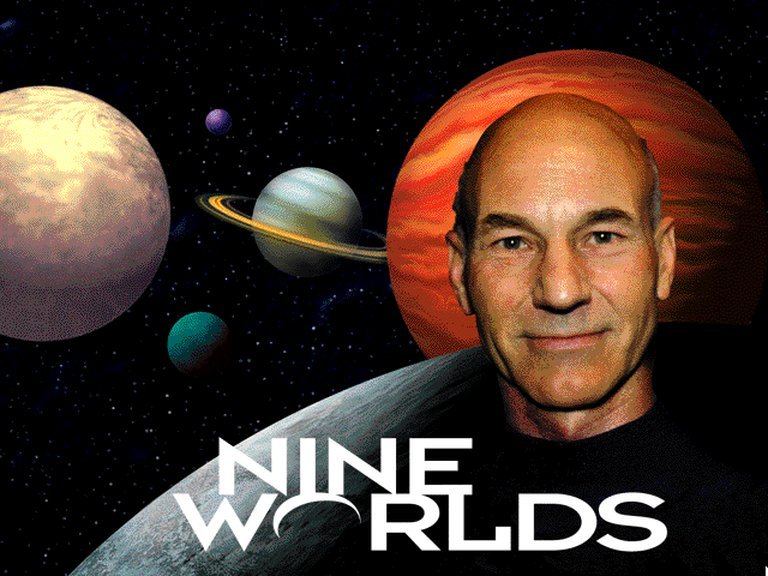
Nine Worlds hosted by Patrick Stewart is a 1997 educational CD-ROM for Windows, based on the 1993 documentary Patrick Stewart Narrates… The Planets, offering narrated facts about the solar system’s nine planets, a text-based history of astronomy, a bibliography, shareware programs, and a simple trivia quiz where players select from four answers to advance on correct choices without scoring or penalties for wrongs.
Gameplay Videos
Nine Worlds hosted by Patrick Stewart: Review
Introduction
Imagine Sir Patrick Stewart, the commanding voice of Captain Jean-Luc Picard, boldly going where few educators had gone before: transforming a dry astronomy lesson into an interactive CD-ROM adventure through our Solar System. Released in 1996 (with 1997 Windows ports), Nine Worlds hosted by Patrick Stewart is a quintessential artifact of the mid-90s edutainment boom, adapting the 1993 documentary Patrick Stewart Narrates… The Planets into a multimedia exploration of the then-nine planets. This isn’t a traditional game but an encyclopedic documentary masquerading as one, complete with quizzes and whimsical features that make learning feel like a cosmic joyride. My thesis: While its “gameplay” is rudimentary by modern standards, Nine Worlds excels as a time capsule of ambitious multimedia design, leveraging Stewart’s gravitas, NASA visuals, and Holst’s orchestral majesty to deliver an enduringly charming educational experience that punches above its weight in accessibility and engagement.
Development History & Context
Developed by The Digital Ranch, Inc. under the creative direction of Steven Horowitz (Video President, R&D, and Creative Director) and directed by Sue Zemel, Nine Worlds emerged from Palladium Interactive’s stable of CD-ROM titles, with additional publishing from Future Publishing Limited and others across regions like the US, France, Germany, and the UK. A modest team of 33 credits—including producers like Bruce Kent, Florian Erl, Rob Lihani, Peter Kenney, Keith Ulrich, and Rob Kirk; programmers David Benson, Todd Herman, Charly Prevost, and Keith Ulrich; graphic designers from studios like aplusa design (Audra and Andreas Kronenberg), Brad Beesley Design, and BugHouse Design (Rebecca and Jeff Klarin); story writers Catherine Valerioti, Victoria Tilney, and Bill Arnett; and researchers Rod Pyle and Dan Gambito—crafted this hybrid PC/Mac CD-ROM.
The project’s roots trace to the 1993 documentary, which Stewart narrated with his Shakespearean timbre, setting the stage for digitization amid the explosive growth of CD-ROM technology. The mid-90s were the golden age of multimedia edutainment: PCs shipped with CD drives standard, QuickTime enabled video playback, and 16-bit Windows 3.x/95 offered point-and-click interfaces ideal for non-gamers. Constraints like 640×480 resolution, 256-color mode, and grainy QuickTime movies defined the era—far from the 3D revolutions of Quake or Tomb Raider in 1996-97. Instead, Nine Worlds fit into a niche alongside titles like Microsoft Dinosaurs or Nile: Passage to Egypt, prioritizing education over action. Palladium’s vision was clear: repurpose public-domain NASA assets (Mariner/Voyager simulations) with Stewart’s star power to appeal to families, schools, and Star Trek fans, bundling extras like a bibliography, astronomy history texts, and shareware for value. Released amid Y2K-era optimism about space (pre-2006 Pluto demotion), it even linked to a website for updates, prescient for the dial-up age.
Narrative & Thematic Deep Dive
At its core, Nine Worlds eschews a linear plot for a documentary-style narrative structured around the nine planets (Mercury through Pluto), framed by Stewart’s narration as a guided tour of “the nine worlds” of our Solar System. Themes revolve around exploration, wonder, and human ingenuity, echoing the Space Age ethos: Stewart’s authoritative voice (joined by Mary Kay Bergman and Dee Bradley Baker for additional narration) recounts planetary facts, missions, and mysteries, blending awe (“the fiery depths of Venus”) with humor.
Each planet unfolds in layered segments:
– Overview Movies: QuickTime videos—NASA simulations of Voyager flybys or satellite approaches—narrated by Stewart, skipping Earth (assumed familiar) and Pluto (probe-less, image-only).
– Physical Characteristics & Moons: Interactive diagrams reveal interiors, attributes, and telescope/satellite imagery, with text on geology, atmospheres, and satellites (e.g., Jupiter’s Galilean moons).
– Exploration Sections: Text, pictures, and Stewart’s insights on missions, discoveries, and trivia.
– Vacation Planner: A standout thematic gem—50s comic-style postcards poke fun at inhospitable worlds. Click cracks on Mercury for a curmudgeonly voice quip: “Yeah, I’ve got cracks too, but I try not to show ’em to everybody!” Imaginary surface views calculate jet-travel time, local age/weight, temperature, weather, and quirky facts, humanizing the cosmos.
– Extras: Stewart’s face icon triggers bonus movies/text; satellite icons link to the Nine Worlds site. Overarching threads include a text history of astronomy and bibliography.
Dialogue shines through Stewart’s delivery—low, resonant, occasionally requiring volume tweaks—infusing facts with gravitas: planetary evolution as epic saga. Writers Arnett et al. weave subtle humor and speculation (e.g., Pluto’s isolation), thematizing humanity’s quest to understand our “nine worlds.” No characters per se, but Stewart embodies the wise guide, making abstract science intimate.
Gameplay Mechanics & Systems
“Nine Worlds” qualifies as a game via its quiz mode—a game show/trivia loop with multiple-choice questions on planetary facts. Select from four answers: wrongs do nothing (no penalty, forgiving for kids), corrects advance seamlessly. No scoring, timers, or evaluation; it’s pure reinforcement, aligning with educational goals over competition.
Core loops are point-and-click exploration:
– Navigation: Intuitive UI selects planets/sections via icons (e.g., Stewart’s portrait, satellite).
– Progression: Non-linear; revisit anytime. No levels/XP, but “unlocks” via clicks (e.g., postcard voices, surface sims).
– Innovations: Vacation planner’s interactivity stands out—clickable comics trigger audio Easter eggs. Website integration was forward-thinking.
– Flaws: Passivity dominates; no branching narratives, saves, or depth. UI is era-typical (clunky on modern hardware without VM/QuickTime), with slow loads and no feedback on wrongs.
| Mechanic | Strengths | Weaknesses |
|---|---|---|
| Quiz | Forgiving, fact-reinforcing | No score/leaderboards; simplistic |
| Exploration | Modular, replayable sections | Linear per planet; no agency |
| Interactivity | Humorous audio, sims | Grainy media, no customization |
| UI | Point-select simplicity | Resolution-locked (640×480, 256 colors) |
Overall, mechanics prioritize discovery over challenge, suiting families but alienating gamers.
World-Building, Art & Sound
The “worlds” are our Solar System, vividly reimagined through NASA’s lens: grainy-but-authentic QuickTime flybys simulate approaches, complemented by telescope photos, interior cutaways, and simulated surfaces. Art direction—superb static illustrations (postcards by Visual Vacations)—infuses whimsy: vibrant, personality-packed comics contrast stark planetary realities, fostering atmosphere from fiery Venus calderas to icy Pluto voids.
Visuals contribute immersion by balancing realism (NASA assets) and playfulness (comics), encouraging armchair tourism. Sound design elevates: Gustav Holst’s The Planets (Epoch 2000 by Spitz-Tari) provides ethereal, eerie backdrops—Mars’ warlike march for red deserts, Neptune’s mysticism for blue giants. Stewart’s narration anchors it, with Bergman’s/Baker’s voices adding levity. Effects (postcard quips) are charmingly lo-fi. Together, they craft a cosmic symphony, heightening wonder despite technical limits (grainy video, low volume).
Reception & Legacy
Launch reception is ghostly: No MobyGames/Metacritic scores, zero critic/player reviews. Obscure commercially (used eBay copies ~$6.84), collected by few (2 on MobyGames). Old-games.com user notes praise info depth/enjoyment (despite boredom risks) and replay via web, rating graphics/sound high. No major awards, but Stewart’s 29-game resume (e.g., voice work elsewhere) lent cachet.
Legacy endures as edutainment pioneer: Prefigured interactive docs like Cosmos apps, influenced NASA edutainment (e.g., modern planetariums). In 2024 (post-Pluto dwarf status), it’s prescient nostalgia. Credits overlap quirky titles (Microshaft Winblows 98, The X-Fools), highlighting indie multimedia hustle. Abandonware sites preserve it (needs VM for 64-bit), cementing archival value. Influences? Subtle in trivia modes (Kerbal Space Program‘s education) and celeb-narrated edutainment (Destiny 2‘s lore). A cult curiosity for retro historians.
Conclusion
Nine Worlds hosted by Patrick Stewart distills 90s CD-ROM ambition into a 440MB gem: Stewart’s narration, Holst’s score, NASA visuals, and clever quizzes create accessible Solar System awe, flaws (simplistic mechanics, dated tech) notwithstanding. Not a “great game,” but an exemplary historical artifact—innovative for education, influential in multimedia preservation. Verdict: Essential for retro enthusiasts and Picard fans; a 8/10 relic securing its place as a starry footnote in video game history. Fire up a VM, crank the volume, and engage warp drive.