
- Release Year: 2012
- Platforms: Windows Apps, Windows
- Publisher: Cenega Poland Sp. z o.o., Microsoft Corporation, Nordic Games GmbH, Remedy Entertainment Oy
- Developer: Remedy Entertainment Oy
- Genre: Action
- Perspective: Behind view
- Game Mode: Single-player
- Gameplay: Quick Time Events (QTEs), Survival horror
- Setting: Contemporary, Fantasy, North America
- Average Score: 83/100
Description
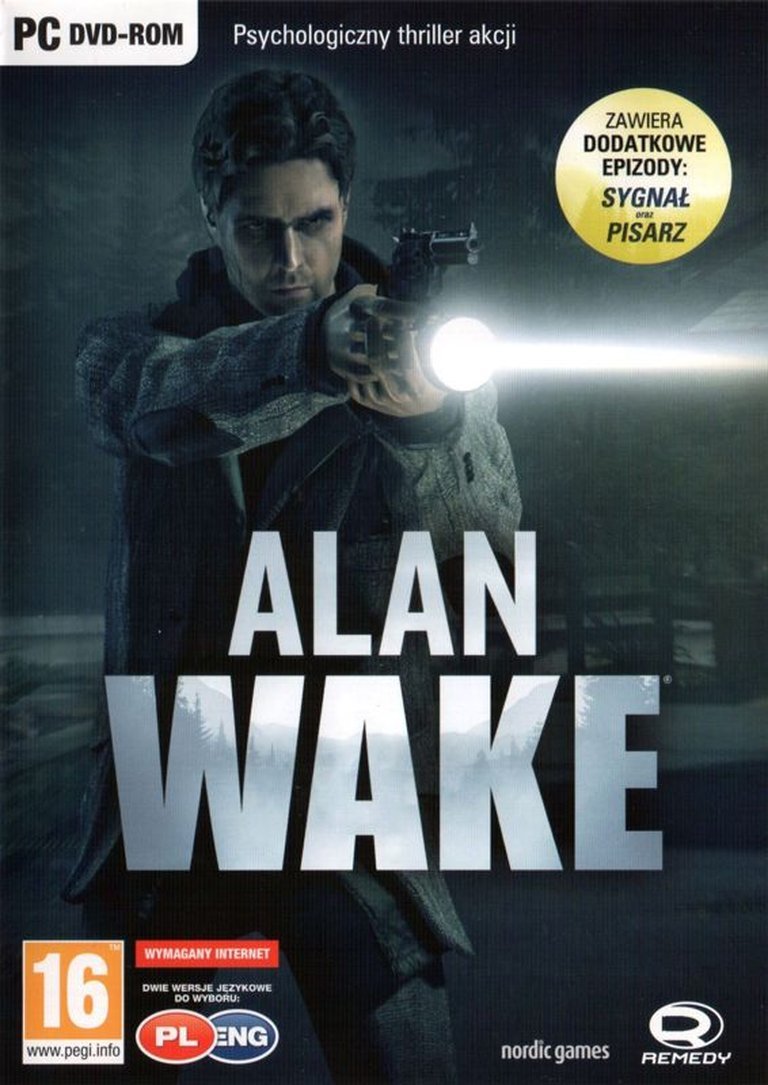
Alan Wake is a survival horror action game where bestselling thriller author Alan Wake vacations in the isolated Pacific Northwest town of Bright Falls with his wife Alice to overcome his writer’s block, only for her to be kidnapped and pages from a mysterious manuscript he doesn’t remember writing to come to life, forcing him to battle shadowy enemies called the Taken—possessed humans, birds, and poltergeists—using the power of light as his primary weapon in an episodic narrative blending detective mystery, fantasy, and horror.
Gameplay Videos
Where to Buy Alan Wake
PC
Alan Wake Free Download
Alan Wake Cracks & Fixes
Alan Wake Guides & Walkthroughs
Alan Wake Reviews & Reception
metacritic.com (83/100): Generally Favorable Based on 100 Critic Reviews.
ign.com : offers enough scares, laughs, and thrills to keep you hooked.
pcgamer.com : It took its sweet time, but its still a genuinely skin-twitching survival game.
xenodude.com : it remains a memorable adventure that’s worth checking out.
Alan Wake Cheats & Codes
PC
Console commands are only available on PC. Add these as command line parameters to the end of the ‘Target’ field in the game’s shortcut properties or Steam launch options.
| Code | Effect |
|---|---|
| -developermenu | Enables developer menu at the main menu for infinite ammo, guns, flashlights, and unlocks all level episodes |
| -w1280 | Sets screen width (example) |
| -h720 | Sets screen height (example) |
| -window | Forces windowed mode |
| -novsync | Disables V-sync |
| -showfps | Shows frame rate counter on screen |
| -forcesurround | Forces 5.1 speaker mode |
| -forcestereo | Forces stereo (2 channel) speaker mode |
| -nosound | Disables sound |
| -cleancloud | Deletes save games and settings from Steam Cloud |
| -noblur | Disables in-game vector blur |
| -rigidcamera | Enables more stiff mouse control/camera mode with camera centered behind Wake |
| -directaiming | Enables 1:1 mouse control mode (obsolete) |
| -sensscale=0.2 | Changes mouse sensitivity scale (example for high DPI mice) |
| -freecamera | Toggles free camera with right thumb stick |
| -locale=xx | Forces selected locale |
Alan Wake: Review
Introduction
In the dim glow of a flashlight beam cutting through encroaching shadows, Alan Wake emerges as a beacon of narrative ambition in gaming—a psychological thriller that transforms the player’s torch into both weapon and lifeline. Released in 2010 exclusively for Xbox 360 by Remedy Entertainment and Microsoft Game Studios, with a belated but enhanced PC port in 2012, the game follows bestselling novelist Alan Wake as he unravels the mystery of his wife Alice’s disappearance in the fog-shrouded town of Bright Falls, Washington. What begins as a vacation spirals into a nightmarish confrontation with the “Dark Presence,” a malevolent force that animates his forgotten manuscript Departure, turning words into deadly reality. Structured like a six-episode TV series complete with recaps and cliffhangers, Alan Wake draws from the eerie vibes of Twin Peaks and Stephen King’s metafictional horrors, delivering a cult classic that prioritizes suspenseful storytelling over rote action. My thesis: Alan Wake stands as a pivotal evolution in action-adventure games, pioneering “fight with light” mechanics and episodic pacing that influenced narrative-heavy titles like The Last of Us and Remedy’s own Control, cementing its legacy despite combat repetition and technical hurdles of its era.
Development History & Context
Remedy Entertainment, fresh off the bullet-time triumphs of Max Payne (2001) and its 2003 sequel, sought to pivot from linear shooters to something bolder: a psychological thriller antithetical to their past work. Conceptualized around 2003-2005, Alan Wake was initially envisioned as an open-world survival horror in the vein of Grand Theft Auto, set in a meticulously researched Pacific Northwest sandbox. Remedy’s team drove 2,000 miles across Oregon, Washington, and British Columbia, capturing over 6,000 photos and videos of misty forests, diners, and Americana to craft Bright Falls’ authenticity. Tools like semi-automatic biome generation helped populate roadsides with ditches and grass, while a dynamic day-night cycle tied into resource-gathering (e.g., gasoline for generators) and light-based defense against nocturnal threats.
Announced at E3 2005 as a next-gen/PC title, Remedy partnered with Microsoft in 2006 for Xbox 360 exclusivity (with Vista PC planned), but development hit snags. Over three years, merging sandbox freedom with a tight thriller narrative proved torturous—Sam Lake, Remedy’s creative director and writer, likened it to a “too many cooks” scenario amid missed milestones. In a pivotal two-month “sauna session,” department leads locked in a linear, episodic structure, repurposing open-world assets into chaptered levels: daytime for story/exploration, night for combat. This salvaged progress, adding landmarks for cohesion and foreshadowing.
The game went gold in April 2010 after five years, releasing May 14-18 amid competition from Red Dead Redemption. Xbox exclusivity stemmed from Microsoft’s caution on episodic digital releases, fearing declining sales per episode. Remedy begged for a PC port post-launch (initially canceled), partnering with Nitro Games in 2011 for a five-month overhaul: mouse/keyboard controls, higher-res textures, quad-core optimization, 3D support, HUD toggle, and slipstreamed DLCs (The Signal, The Writer). Self-published digitally, it recouped costs in 48 hours. Technological constraints like Xbox 360’s limits showed in animations and cutscenes (30 FPS in remaster), but innovations like MaxFX engine, Havok physics, FMOD sound, and Umbra occlusion shone. In a 2010s landscape dominated by open-world epics (GTA IV, Assassin’s Creed), Alan Wake‘s TV-like format was a risky, visionary counterpoint.
Narrative & Thematic Deep Dive
Plot Synopsis and Structure
Alan Wake unfolds across six episodes plus two DLC “special features,” mimicking a thriller series with “Previously on Alan Wake…” recaps, cliffhangers, and end-credits songs (e.g., Poets of the Fall’s “War,” Poe’s “Haunted”). Alan (voiced/modeled by Matthew Porretta/Ilkka Villi), plagued by two years’ writer’s block after the Alex Casey series (The Sudden Stop, 2008), vacations in Bright Falls with Alice. A shadowy force drags her into Cauldron Lake; Alan blacks out, awakening a week later with amnesia. Possessed “Taken” (humans, birds, objects) assail him nightly, echoing his unremembered manuscript Departure. Guided by manuscript pages (scattered collectibles foretelling events), Alan pieces together the Dark Presence—a lake-trapped entity that manifests writing as reality—previously foiled by poet Thomas Zane (diving-suited ally).
Flashbacks reveal Alan’s coerced week-long writing binge, holding Alice hostage. Key arcs: evading FBI Agent Robert Nightingale (haunted by partner Finn’s death), clashing with psychologist Emil Hartman (luring Alan for “therapy”), allying with agent Barry Wheeler, Sheriff Sarah Breaker, and hermit Cynthia Weaver (Zane’s guardian). Climax: Alan enters the Dark Place (surreal subconscious ocean), destroys Barbara Jagger (Dark Presence avatar), frees Alice via balanced narrative (“light and darkness… scales need balance”), but strands himself. DLCs trap him in looping insanity: The Signal battles his maniacal TV-self; The Writer confronts his irrational doppelganger, hinting sequels.
Prequel web series Bright Falls (2010) shows reporter Jake Fischer’s Dark Presence takeover. Expansions like novels (Alan Wake by Rick Burroughs), The Alan Wake Files, comics, and Night Springs episodes deepen lore.
Characters and Dialogue
Alan evolves from reluctant everyman (anti-Max Payne: writer, not cop) to metafictional hero, his voiceover quoting King: “Nightmares exist outside of logic.” Supporting cast shines: Barry’s comic relief (“It’s not safe to go out at night, Alan!”), Breakers’ grounded heroism, Andersons’ (Old Gods of Asgard) mythic moonshine wisdom. Antagonists like Mott (Hartman’s thug) and Nightingale add moral ambiguity. Sam Lake’s script—lauded for suspenseful narration, pop references (Shining maze, Birds flocks)—weaves guilt, creativity, and reality’s fragility. Themes probe art’s power (writing as weapon/curse), dualities (light/dark, rational/irrational), echoing King (The Shining, Secret Window) and Lynch (Twin Peaks: diner quirks, absurd humor).
Themes: Metafiction, Horror, and Psychology
Central: creation’s peril. Alan’s block mirrors Remedy’s struggles; Dark Place as writer’s hell. Horror blends psychological (blackouts, hallucinations) with supernatural (Taken’s whispers: “Follow me!”). Balance motif critiques imbalance—Zane’s failed resurrection, Alan’s sacrificial end. Influences abound: Twilight Zone (Night Springs), Hitchcock, Ellis/Gaiman. Uneven pacing (slow builds, info dumps) builds dread, leaving questions (Dark Presence’s origins) for cult appeal.
Gameplay Mechanics & Systems
Core Loops: Light and Shadow Combat
Third-person action emphasizes “fight with light”: flashlight strips Taken’s darkness shield (visualized as shrinking corona), then shoot (revolver/shotgun). Boost beam drains battery (rechargeable via batteries/stands); flares/flashbangs/searchlights nuke groups. Enemies vary: agile/teleporting humans, raven swarms, poltergeists, heavies (chainsaws). Dodge QTEs trigger Matrix-style slow-mo. Health auto-regens near lights; safe havens (lampposts) repel Taken. Day segments mix exploration, puzzles (find flashlight fuel), driving (ram Taken, boost headlights).
Episodic progression: tutorial Episode 1 (logging camp), escalating nights (mine, farm pyrotechnics), boss-like tornadoes/Jagger. Nightmare mode unlocks extra pages. UI: ammo top-right, battery top-left; minimalistic, toggleable on PC.
Progression, Collectibles, and Flaws
No traditional leveling—upgrades via weapon swaps, flares. Collect 100 thermoses (cheevos/secrets), 30 TVs/radios (lore: Night Springs, KBF-FM chatter), manuscript pages (narrative hints). DLC adds clocks. Innovative: light as reticle, environmental synergy. Flaws: repetitive “light-burn-shoot” loops fatigue late-game; clunky camera/auto-aim; QTE reliance; linear paths limit sandbox roots. PC fixes controller bias with mouse sensitivity, FOV tweaks. Driving brief but tense.
World-Building, Art & Sound
Bright Falls lives: researched Pacific Northwest (Astoria, North Bend) yields foggy woods, diners (Oh Deer), motels (Majestic), mines (abandoned post-1970 quake). Day vistas stun—lookouts, golden-hour forests; night warps to menace (red attack flashes, disintegrating Taken). PC enhancements: higher fidelity, Eyefinity 3D. Art direction (Saku Lehtinen) evokes Twin Peaks authenticity; animations/mocap dated but atmospheric.
Sound design excels: Petri Alanko’s score swells from relaxing wanders to dramatic combats; licensed tracks (Poets of the Fall’s “Children of the Elder God,” Bowie’s “Space Oddity”) punctuate credits. FMOD-engine whispers (“Alan!”), bird screeches, Taken taunts build paranoia. Voice acting (native US/JP) immersive; radio chatter, police pursuits (Episode 3 highlight) enhance immersion. Collectively, they forge “choking menace,” per critics.
Reception & Legacy
Launched to 83% Metacritic (Xbox/PC), Alan Wake polarized: Time’s #1 of 2010, IGN 9/10 (“redefines storytelling”), GameSpot 8.5/10 (“killer storytelling”); critiques hit repetition (GameSpy 60%), animations (Wired 6/10). PC port (83%) praised completeness (DLCs, commentary), visuals (IGN: “outstanding”). Players averaged 3.9/5 (MobyGames), loving suspense/graphics, few cons.
Sales: 145K first weeks (vs. RDR‘s 1.5M), but 4.5M+ franchise by 2015 via bundles/word-of-mouth. Cult status grew: remastered 2021 (PS4/5, Xbox, PC, Switch 2022; Epic-published, D3T-aided; 4K visuals, no product placement). Spin-off American Nightmare (2012), Control ties (AWE DLC), Alan Wake 2 (2023 survival horror). Influenced episodic narratives (Quantum Break, Telltale), light mechanics (Control). TV adaptations scrapped (AMC 2022, now Annapurna). Anti-piracy eyepatch Easter egg iconic.
Conclusion
Alan Wake masterfully fuses thriller TV structure, King/Lynch homage, and innovative light combat into a haunting whole, flaws like repetition paling against its atmospheric mastery and narrative depth. Remedy’s pivot from sandbox to linear brilliance birthed a Remedy Connected Universe cornerstone, evolving from slow-seller to enduring influence. Definitive verdict: An essential masterpiece in game history’s horror-thriller pantheon—grab the remaster, dim the lights, and let Alan’s words illuminate (or ensnare) your nights. Score: 9/10—a timeless beam piercing gaming’s darkest corners.