
- Release Year: 2001
- Platforms: Windows
- Developer: Hannes Aasamets, Tarmo Annus
- Genre: Strategy, Tactics
- Game Mode: Single-player
- Gameplay: Trading, Turn-based
- Average Score: 78/100
Description
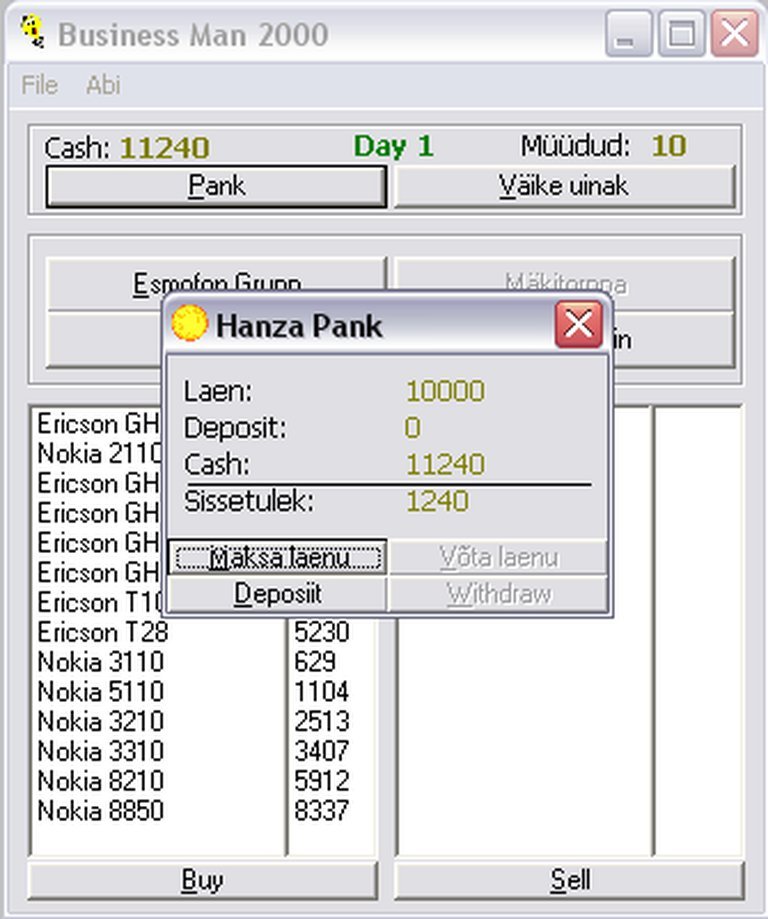
Business Man 2000 is a freeware strategy trading game reminiscent of Dope Wars, where players start with a bank loan and nights spent in public restrooms, aiming to maximize profits by buying and selling mobile phones across four shops within a limited number of days. With five moves per day, players must time purchases during sales and discounts while avoiding mishaps like muggings by the cleaning lady.
Business Man 2000: Review
Introduction
In the shadowy underbelly of early 2000s PC freeware, where ambition clashes with abject poverty, Business Man 2000 emerges as a gritty, unpolished gem—a trading simulator that swaps the illicit thrills of Dope Wars for the mundane hustle of flipping mobile phones. Released in January 2001 as a free download for Windows, this obscure Estonian creation captures the era’s DIY indie spirit, thrusting players into the boots of a desperate entrepreneur starting with nothing but a bank loan and a restroom for a bedroom. Its legacy endures not as a blockbuster, but as a testament to minimalist design’s power to evoke the raw economics of survival. This review argues that Business Man 2000, despite its simplicity, masterfully distills the tension of risk-reward trading into a addictive loop, cementing its place as an overlooked precursor to modern merchant simulations amid the post-Y2K indie explosion.
Development History & Context
Business Man 2000 (also known as Businessman 2000 or bm2k) was crafted by a tiny team led by Hannes Aasamets, who handled programming and documentation, with additional programming from Tarmo Annus. Both credited on scant other titles, they represent the archetype of early 2000s bedroom developers—passionate hobbyists leveraging accessible Windows tools to bypass traditional publishing gatekeepers. Released as freeware/public domain, it bypassed retail shelves entirely, distributed via downloads in an era when broadband was nascent and file-sharing forums like those on MobyGames’ eventual archive were lifelines for niche titles.
The game’s context aligns with the early 2000s PC gaming landscape: post-Dope Wars (a 1980s text-based drug-trading staple ported and cloned endlessly), freeware boomed amid economic uncertainty following the dot-com bust. Strategy/tactics genres flourished on PCs, with titles like Civilization III (2001) and Europa Universalis dominating, but Business Man 2000 carved a micro-niche in “merchant/trade-oriented games.” Technological constraints—Windows 9x/Me era, keyboard/mouse input, single-player offline—forced spartan design: no 3D engines like Unreal Tournament’s, just efficient code for endless simulations. The 2001 release coincided with mobile phone hype (Nokia’s dominance, pre-iPhone), mirroring real-world Y2K-era tech booms. Vision-wise, Aasamets and Annus envisioned a “clean” Dope Wars variant, replacing narcotics with Nokias to satirize entrepreneurial grind, amid a gaming scene shifting toward MMOs (EverQuest‘s shadow) and open-world epics, yet craving quick, replayable sims.
Narrative & Thematic Deep Dive
At its core, Business Man 2000 weaves a stark rags-to-riches tale of urban desperation. You embody an unnamed protagonist—a down-and-out hustler accustomed to “spending their nights in public restrooms”—kickstarted by a precarious bank loan. The plot unfolds over a fixed number of days, your goal: amass maximum wealth by trading mobile phones across four shops. No epic quests or branching dialogues; instead, a relentless daily cycle of buy-low-sell-high, punctuated by sales events and hazards like restroom muggings by the archetypal “cleaning lady.”
Thematically, it skewers the capitalist dream: starting broke in squalor, you’re forced into predatory timing—scout discounts, evade risks—to climb from debtor to magnate. Homelessness as a mechanic (restroom sleeping risks assault) humanizes the grind, evoking early-2000s economic precarity (post-dot-com layoffs). Characters are abstracted: shopkeeps with fluctuating prices, the cleaning lady as capricious fate. Dialogue? Minimal, likely terse text prompts (“Mugged! Lose cash?”). Underlying motifs—addiction to profit, randomness as RNG “fate”—mirror Dope Wars‘ peril but ground it in banal tech resale, critiquing mobile mania. No moralizing, just emergent stories: one run’s lucky sales streak versus another’s mugging spiral. In a decade of lore-heavy RPGs (Baldur’s Gate II), its procedural “narrative” via economics feels revolutionary, prefiguring roguelike sims.
Gameplay Mechanics & Systems
Business Man 2000‘s core loop is elegantly austere: 5 moves per day to traverse shops, buy/sell phones, balancing inventory, cash, and debt. Deconstruct it:
Core Trading Loop
- Scouting & Timing: Four phone shops offer variable prices; sales provide “attractive discounts.” Optimal play demands pattern recognition—buy low midday, sell high evenings?
- Risk Management: Restroom lodging invites cleaning lady muggings (cash loss), forcing location choices. Bank loan accrues interest, pressuring quick flips.
- Progression: No levels, just compounding wealth. Goal: maximize score in allotted days, replayable for high scores.
Combat? None—Pure Economics
Unlike tactics peers (Commandos 2), “combat” is economic warfare: overbuy and bankrupt; ignore sales and stagnate. Innovative: dynamic pricing simulates markets; flaws: potential repetition without saves?
UI & Controls
Keyboard/mouse simplicity suits freeware—text menus, likely ASCII maps. No bloat: specs confirm 1-player offline focus. Flaws: opaque RNG? Tedious travel? Yet addictive, like Dope Wars clones, rewarding memory over micromanagement.
Systems shine in replayability: infinite runs, procedural events foster mastery. In 2001’s sim-heavy scene (Tropico), it innovates via hyper-focus, flaws notwithstanding (no multiplayer, sparse feedback).
World-Building, Art & Sound
The “world” is a minimalist urban sprawl: four shops, public restrooms—no sprawling maps like Operation Flashpoint. Atmosphere evokes gritty 2000s Estonia (developers’ likely homeland)—cold streets, flickering neon phone ads. Visuals: probable retro text/graphics (MobyGames screenshots absent, implying ASCII/low-res sprites), evoking Dope Wars‘ charm. Mobile phones as MacGuffins ground it in era-specific tech (pre-smartphone bulkies).
Art direction: functionalist, no frills—bold colors for prices, icons for risks. Sound: silent freeware staple? Beeps for buys/sells, ambient restroom drips? Scarce details suggest chiptune-minimalism, amplifying tension. Collectively, they forge immersion via suggestion: restroom vulnerability heightens paranoia, shop bustle implies teeming markets. In an era of Max Payne‘s noir visuals, its spareness enhances replay focus, world-building emergent from mechanics.
Reception & Legacy
Launch reception: ghostly. No critic reviews (MobyGames: “Be the first!”); one player rates 4/5 (vgtimes: 7.7/10 from two). Commercial: freeware success unquantifiable—collected by three MobyGames users, forum whispers. Evolved rep: niche cult via 2006 MobyGames entry (by tarmo888, possibly Annus-linked), grouped with trade sims.
Influence: subtle. Prefigures Recettear (2010 merchant RPG), mobile Dope Wars ports. In freeware lineage (Serious Sam‘s budget ethos), it embodies 2000s indie grit amid GTA III‘s dominance. No direct clones, but echoes in economy sims (Offworld Trading Company). Obscurity stems from no marketing, yet preservation (developer site linked) ensures archival value. Post-9/11 delays bypassed it; survives as time capsule of pre-broadband sharing.
Conclusion
Business Man 2000 is no Civilization III titan—it’s a freeware footnote, yet profoundly effective. Hannes Aasamets and Tarmo Annus distilled trading peril into pure, replayable form, blending Dope Wars grit with 2001 mobile zeitgeist. Exhaustive in loops, evocative in themes, minimalist in execution, it falters only in polish but triumphs in essence. Verdict: Essential for historians—8/10 for sim purists; a definitive artifact of early indie commerce, whispering “hustle or perish” across two decades. Seek it on archives; your inner entrepreneur awaits.