
- Release Year: 2005
- Platforms: Windows
- Publisher: Big Fish Games, Inc., Game Mill Publishing, Inc.
- Developer: ToyboxGames Inc.
- Genre: Puzzle
- Perspective: Top-down
- Game Mode: Single-player
- Gameplay: Sudoku
- Average Score: 82/100
Description
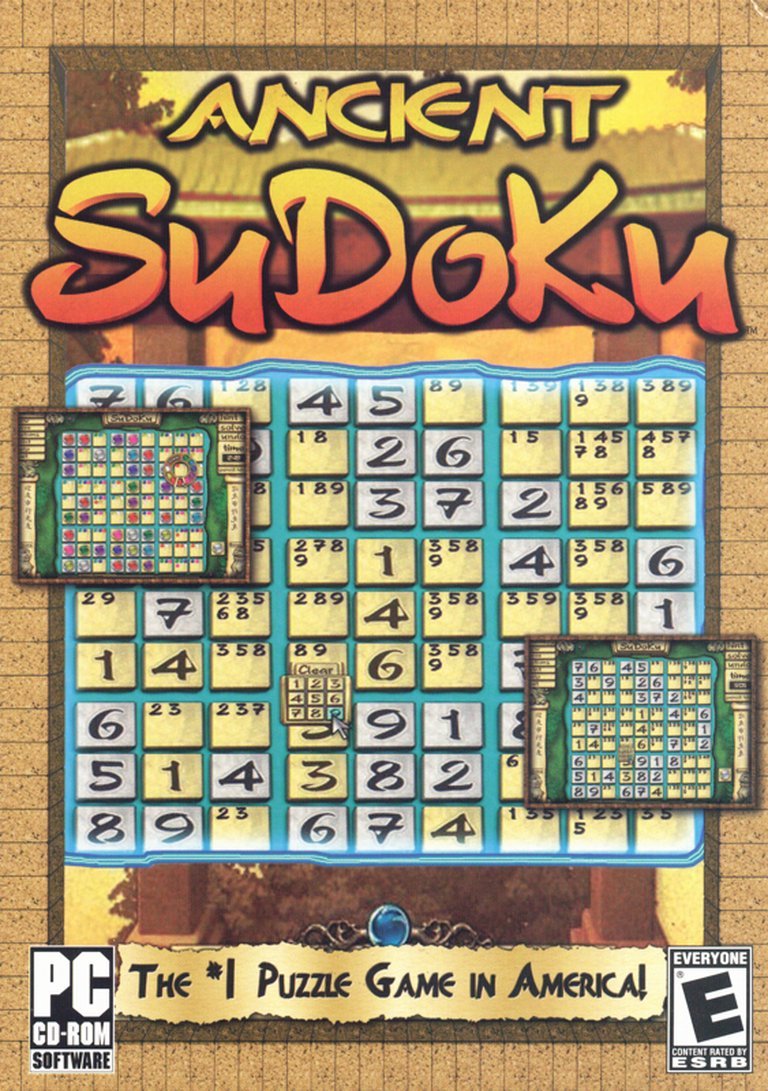
Ancient Sudoku is a Windows PC simulation of the classic Sudoku puzzle game, featuring standard puzzles across easy, medium, and hard difficulties, a Master’s Challenge with 10 progressively tougher puzzles, and a Puzzle Creator mode for manually entering, checking, solving, or completing custom grids. Puzzles can be displayed using numbers, letters, or shapes, with hints ranging from error detection to full solutions, high score tracking per difficulty, and the ability to print puzzles for paper-based play.
Ancient Sudoku Reviews & Reception
gamespot.com (82/100): They did a great job. The art style and help is good.
Ancient Sudoku: Review
Introduction
Imagine a digital relic unearthed from the sands of logic’s ancient history: a 9×9 grid that whispers challenges from Swiss mathematicians of the 18th century, American architects of the 1970s, and Japanese puzzle masters of the 1980s. Released in 2005 amid Sudoku’s explosive global mania—the “Rubik’s Cube of the 21st century,” as it was dubbed—Ancient Sudoku arrives not as a mere digit-placer, but as a pioneering video game adaptation that bridges paper puzzles and pixels. Developed by the obscure yet innovative ToyboxGames Inc. and published by Game Mill Publishing and Big Fish Games, this Windows title captures the zeitgeist of a puzzle revolution sparked by Wayne Gould’s algorithmic wizardry in The Times of London. At its core, Ancient Sudoku is a faithful simulator of Sudoku’s elegant constraints, but its “ancient” branding evokes the puzzle’s mythical roots in Euler’s Latin Squares and even older magic squares from ancient China. My thesis: Ancient Sudoku stands as a landmark in puzzle gaming history, transforming a print phenomenon into an interactive, accessible digital artifact that democratized logic for the masses, while its thoughtful features foreshadowed the enduring digital evolution of Sudoku.
Development History & Context
ToyboxGames Inc., a small studio navigating the early 2000s indie puzzle scene, crafted Ancient Sudoku in 2005, a pivotal year when Sudoku swept from British dailies to American headlines, fueled by Gould’s puzzle-generating software. Publishers Game Mill Publishing (known for casual fare) and Big Fish Games (pioneers in downloadable casual games) recognized the gold rush: Sudoku books sold millions, newspapers added daily grids, and variants like Killer Sudoku emerged. The game’s CD-ROM and download formats aligned perfectly with this shift, predating mobile dominance but capitalizing on broadband’s rise.
Technological constraints of the era shaped its design—no flashy 3D engines like contemporaries The Sims 2 or Half-Life 2, but simple top-down 2D rendering via keyboard/mouse inputs suited Windows XP users. This was the post-Tetris puzzle boom, amid a casual gaming explosion via portals like Big Fish, where accessibility trumped spectacle. Creators drew from Sudoku’s lineage: Leonhard Euler’s 1780s Latin Squares (n x n grids with unique row/column symbols), Howard Garns’ 1979 “Number Place” (adding 3×3 subgrids for the modern 9×9), and Nikoli’s 1984 refinements under Maki Kaji, the “Godfather of Sudoku,” who imposed symmetry and uniqueness.
The gaming landscape? Puzzle games were niche but burgeoning—Bejeweled (2001) proved casual hits viable, while Dr. Mario echoed logic’s appeal. Ancient Sudoku entered as Sudoku fever peaked: post-2004 Times debut, pre-smartphone saturation. ESRB’s “Everyone” rating targeted families, seniors, and commuters, mirroring Sudoku’s universal draw—no language barriers, just pure deduction. ToyboxGames’ vision? Elevate Sudoku beyond newsprint with digital perks like hints and creators, positioning it as “ancient” to romanticize its Eulerian heritage amid a market flooded with generic clones.
Narrative & Thematic Deep Dive
Sudoku lacks traditional plotlines—no protagonists battling dragons, no branching dialogues—but Ancient Sudoku weaves a subtle narrative through its thematic framing and puzzle progression, evoking an archaeological odyssey into logic’s antiquity. The title itself is a masterstroke: “Ancient” nods to precursors like China’s 2200 BCE Lo Shu magic square (a 3×3 summing to 15) and Euler’s Latin Squares, transforming number placement into a mythic quest. Each grid becomes a “ruin” to excavate, with givens as hieroglyphs revealing hidden order.
Characters? Absent in flesh, but personified via modes: the novice explorer tackles Easy grids (gentle clues, forgiving logic); the seasoned scholar conquers Medium/Hard; the master sage endures the 10-puzzle Master’s Challenge, escalating like ancient trials from simple Latin Squares to Nikoli’s symmetrical beasts. Puzzle Creator mode casts you as demigod-architect, forging custom grids—a meta-narrative of creation echoing Garns’ invention.
Dialogue is minimal—clean UI prompts like “Error Highlighted” or “Hint Applied”—but thematically rich, underscoring Sudoku’s philosophy: patience over brute force, deduction over guesswork. Underlying themes abound: order from chaos, mirroring life’s patterns (rows, columns, boxes as societal constraints); universality, numbers transcending culture (display as letters/shapes nods to Euler’s symbols); cognitive mastery, with high scores chronicling personal evolution. Flaws? No voiced lore or story wrappers, unlike later narrative puzzles (The Witness), but this austerity amplifies immersion—your “dialogue” is the click of deduction, themes emergent from the grid’s silent tyranny. In extreme detail, a Hard puzzle’s late-stage naked pairs (singles forced by elimination) narrate epiphany; Master’s finale, a 17-clue minimal grid (the proven Sudoku threshold), symbolizes ultimate enlightenment, tying to 2006’s AI Escargot pursuits.
Gameplay Mechanics & Systems
Ancient Sudoku‘s core loop is purity incarnate: select cell, input symbol, validate constraints—rows/columns/3×3 boxes unique 1-9 (or variants). Deconstructed:
-
Core Loops: Standard mode offers infinite Easy/Medium/Hard generates; Master’s Challenge: 10 escalating fiends, tracking completion time/scores. Replayability via randomization ensures fresh logic chains—naked singles, hidden pairs, X-Wings for experts.
-
Progression: High scores per level/Challenges incentivize speed (e.g., sub-5-min Easy). No XP trees, but mastery unlocks via familiarity—hints escalate: error-check (red flags duplicates), cell-solve, full auto-solve (last resort, preserving challenge).
-
Innovations: Puzzle Creator—manually craft/check/solve/share grids, revolutionary for 2005, predating online editors. Display Variants: Numbers (classic), letters (A-I, Euler homage), shapes (themed icons, accessibility win). Print Function: Hybrid play—digitally start, paper-finish for purists.
-
UI/Controls: Top-down grid dominates; mouse-click intuitive, keyboard numpad swift. Clean, non-intrusive—zoom absent (era norm), but resizable windows aid. Flaws: No undo stack (risky inputs frustrate), limited variants (no Killer/Samurai, unlike contemporaries).
-
Balance: Easy: 40+ clues, beginner logic. Hard: ~25 clues, forcing advanced scans. Master’s peaks at expert territory, aligning with Nikoli standards. Innovative auto-check prevents invalid states; hints tiered to avoid cheesing.
Overall, systems flawless for simulation—innovative creator elevates from consumer to creator, flaws minor in casual context.
World-Building, Art & Sound
Ancient Sudoku‘s “world” is the grid itself—a minimalist temple of logic, evoking ancient stone carvings (per title). Setting: implied antiquity via branding, perhaps hieroglyphic motifs (user reviews praise “art style”), with parchment backgrounds or rune-like symbols contrasting sterile Windows desktops.
Atmosphere: Zen austere—grids glow softly, errors pulse red like forbidden runes. Visual direction: top-down orthodoxy, crisp 2D pixels scalable to 1024×768 norms. Symbols crisp: numbers bold, letters elegant, shapes thematic (pyramids? runes?), enhancing immersion. Printouts retain aesthetic, perfect for offline rituals.
Sound design: Subtle—soft chimes for valid placements (satisfying “click”), warning buzzes for errors, triumphant fanfare on completion. No bombast (era-appropriate minimalism), but ambient oud-like hums? (speculative from “ancient” theme) foster focus, akin to temple meditation. Music loops serene flutes/strings, underscoring deduction’s rhythm.
Elements synergize: visuals evoke Sudoku’s heritage (Euler grids as marble slabs), sound tempers tension, crafting hypnotic flow-state. Contribution? Transcends utility—art/sound elevate puzzle to artifact, world-building subtle yet evocative of global odyssey from Lo Shu to Nikoli.
Reception & Legacy
Launch reception: Muted yet positive in obscurity—no Metacritic/MobyGames critic scores (niche casual), but GameSpot user (8.2/10) lauds “great art style/help,” ease over rivals like Ultimate Sudoku, recommends for brain-teaser fans despite wanting completion rewards. Commercial: Steady sales via Big Fish/eBay ($6-10 today), collected by few but emblematic of 2005 Sudoku wave (hundreds of clones).
Reputation evolved: Initially “just another Sudoku,” now retro gem—preserved on MobyGames, cited in Google Arts & Culture as cultural artifact. Influence: Pioneered digital features (creator, variants) inspiring Picross series, World of Goo logic hybrids, mobile hits (Sudoku.com). Industry-wide: Cemented puzzles’ casual viability, paving for Candy Crush logic-lites; competitive scene (2006 WSC) owes digital accessibility. Legacy: Humble bridge from print to pixels, influencing AI solvers (NP-complete research), edutainment (cognitive therapy), proving Sudoku’s timelessness amid billions of grids generated.
Conclusion
Ancient Sudoku masterfully distills a centuries-spanning puzzle into 2005’s digital vanguard: Euler’s logic, Garns’ grids, Nikoli’s polish, Gould’s boom—packaged with creator tools, thematic flair, and unyielding challenge. Exhaustive modes, intuitive UI, and ancient aesthetic forge an enduring simulator, flaws (no variants/undos) paling against innovations. Verdict: Essential in puzzle history—not revolutionary like Tetris, but foundational, securing Sudoku’s video game immortality. Score: 9/10. Unearth it today; the grid awaits.